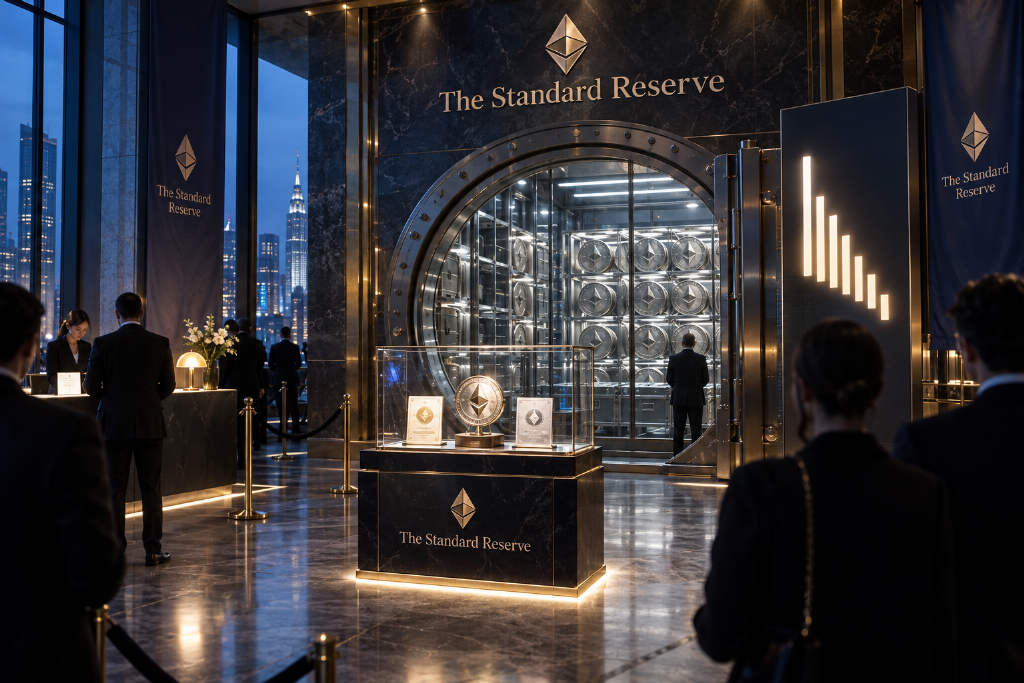
Odaily2026-09-15 03:03:17Address nets about $201,000 trading STANDARD in one hourAn address tracked by Lookonchain made a rapid profit from trading STANDARD within one hour, according to Odaily. The wallet bought 1.14 million STANDARD with 80 ETH and later sold the position for 160 ETH. That left a profit of 80 ETH, worth about $201,000 based on the figures cited in the report. Separately, GMGN data showed that STANDARD, described as a Robinhood chain ecosystem token, briefly pushed its market capitalization above $44.2 million before falling back to around $33 million. The move highlighted sharp short-term swings in the token during the same trading window.670
STANDARD2026-09-15 03:30:04STANDARD token economics draw focus after launch trading tops $40 millionSTANDARD, a Robinhood chain ecosystem token tied to The Standard Reserve, briefly reached a $40 million valuation within two hours of launch before pulling back to $28.91 million, while trading volume moved past $40 million, according to BlockBeats. On-chain circulation currently stands at 98,323,639.9815 tokens. The project says it is designed as an "on-chain sovereign central bank," using roughly 4,000 lines of immutable smart-contract code instead of a traditional central bank or DAO-based governance process to run monetary policy automatically. Its issuance model reacts to net ETH flows in the official Uniswap v4 pool: issuance expands when funds flow in and slows when funds flow out, with protocol revenue used for reserve accumulation, protocol-owned liquidity, or buybacks and burns depending on conditions. The white paper sets a hard cap of 1 billion STANDARD tokens. Of that amount, 100 million were pre-minted at genesis and locked as protocol-owned liquidity in the ETH-STANDARD pool on Uniswap v4. The remaining 900 million form the issuance budget. The protocol’s base issuance starts at 700,000 tokens per day, adjusted by a policy multiplier ranging from 0.2x to 1.25x, with 1x at launch.870
The Standard 2026-09-15 01:22:49The Standard Reserve closes Genesis Charters mint, raising 583.6 ETHThe Standard Reserve, which describes itself as a "sovereign on-chain central bank," has completed the mint for its Genesis Charters. According to ChainCatcher, the sale raised a total of 583.6 ETH, or about $1.47 million. The whitelist mint price was set at 0.15 ETH, while most public auction fills landed between 1.23 ETH and 1.25 ETH. The team said all proceeds from the mint will go to initial liquidity and the protocol treasury, with no team revenue share. Market data from GMGN showed STANDARD briefly reaching a market capitalization of $18.38 million before moving to $17.06 million. The token also launched with a temporary anti-sniping tax during its first hour of trading, starting at 90% and decaying exponentially, with most of that drop occurring in the first five minutes. The collected fees are directed to the protocol, and regular trading fees are set to resume after the first hour.670
Robinhood Cha2026-09-15 02:05:29STANDARD, a Robinhood chain ecosystem token, briefly hits a $45 million market cap two hours after launchAccording to GMGN market data cited by BlockBeats on Sept. 15, STANDARD, a Robinhood chain ecosystem token tied to The Standard Reserve, briefly pushed its market capitalization above $45 million within two hours of going live. It was later quoted at $44.2 million, with trading volume reaching $29.8 million. The project describes itself as an “on-chain sovereign central bank” and says it is attempting to replace a traditional central bank or DAO-based governance model with immutable smart contract code of roughly 4,000 lines to run an automated monetary policy system. Under the mechanism described in the release, the protocol adjusts issuance based on ETH net flows in the official Uniswap v4 trading pool. When funds show net inflows, it gradually expands STANDARD issuance and uses revenue to accumulate reserve assets and protocol-owned liquidity. When funds show net outflows, it reduces issuance and uses revenue to buy back and burn tokens. BlockBeats said users should remain cautious because of sharp price swings in related tokens.780
The Standard 2026-09-14 01:58:22The Standard Reserve sets Genesis mint terms, with unsold allocation moving to a Dutch auctionThe Standard Reserve, which describes itself as an "on-chain central bank," said it will go live on Sept. 14 and outlined the launch mechanics for its Genesis Charters mint. A whitelist mint window is scheduled for 5:30 p.m. to 8:30 p.m. ET, which translates to 5:30 a.m. to 10:30 a.m. Beijing time on Sept. 15, with a liquidity fee of 0.15 ETH. Any Genesis Charters left after the whitelist phase will move into a 30-minute descending Dutch auction. The auction will open at 1.25 ETH and fall to a floor of 0.15 ETH. The project said 100% of mint proceeds will be directed to initial liquidity and the protocol treasury, and that the team will not take a share. After the mint ends, the team said it will add liquidity and open trading for the STANDARD token. The first hour of trading will include a temporary anti-sniping tax that starts at 90% and decays exponentially, with most of that decay happening in the first five minutes. The tax revenue will go to the protocol. Regular trading fees are set to return after one hour. At the same time, Charter emissions will begin, and 100 branch licenses will be auctioned in Dutch-auction format, payable in STANDARD.900
The Standard 2026-08-24 08:05:59The Standard Reserve tests an on-chain monetary model tied to ETH flowsThe Standard Reserve is proposing an experimental on-chain monetary system that adjusts token issuance based on net ETH flows in a planned ETH-STANDARD pool built on Uniswap v4. Under the design described in its white paper, positive net ETH flow would push the system into expansion mode, increasing issuance and directing 70% of epoch revenue toward reserves, while flat or negative flow would trigger contraction, slower issuance, and buybacks of STANDARD for burning. The protocol also assigns a central role to Charter NFTs, which function as internal licenses for participants called Bankers. Each Charter starts with one Branch and can scale to as many as 10, with Branch count determining a holder’s share of newly issued STANDARD. Expansion requires purchasing Expansion Licenses in daily Dutch auctions using STANDARD, and those tokens are burned. Exits work differently: Bankers must close Branches to withdraw accrued balances, pay a Resolution Fee tied to seven-day exit pressure, and give up future issuance rights linked to the closed Branches. As of Aug. 24, The Standard Reserve had published its website, app page, and white paper v0.1, but STANDARD and Charter NFTs had not gone live. The project has not yet disclosed a production contract address, a full audit report, or all key operating parameters.5271
Standard2026-07-08 09:11:57Standard (STND) Shows 85.57 Million Tokens in Circulation as All-Time High Stands at $3.06Standard (STND) data shows an all-time high of $3.06 and a circulating supply of 85,574,950 tokens as of May 25, 2026. Investors are likely to focus on supply transparency, price drawdown, and custody options.330
Standard2026-07-08 09:09:13Standard (STND) Price Update: All-Time High at $3.06, Circulating Supply Reaches ~85.6 MillionStandard (STND) hit an all-time high of $3.06 but has since declined significantly. As of May 25, 2026, the circulating supply is 85,574,950 STND, with no disclosed maximum supply. This article explores its market performance and storage options.470