
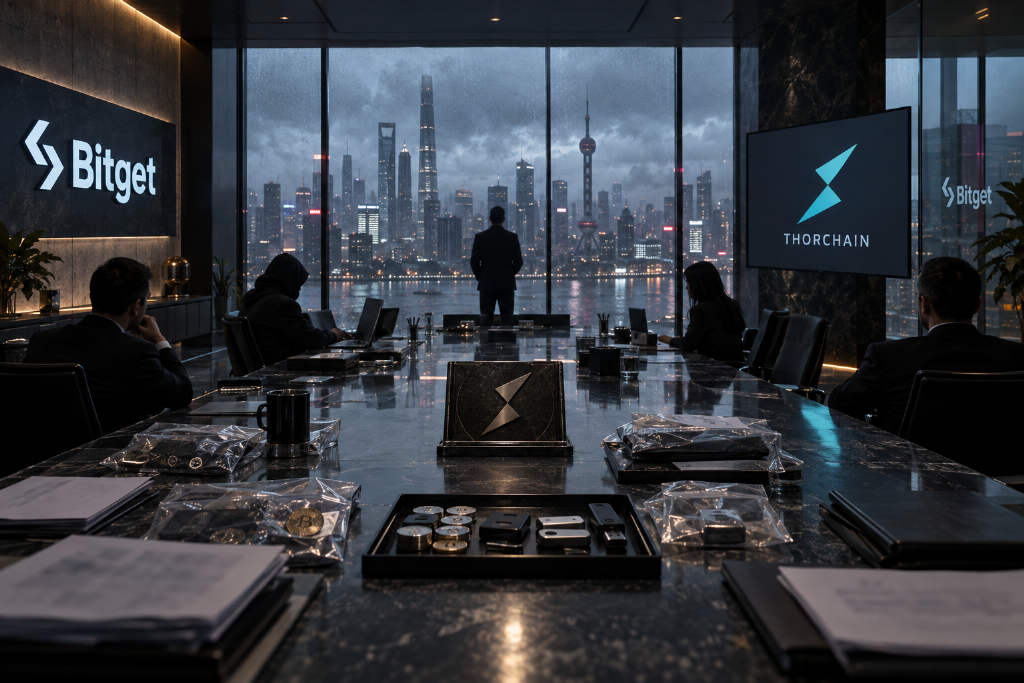
THORChain co-founder Chad Barraford said he will ask the protocol’s Treasury about the idea of sending Bitget part of the income earned by the developer fund from swaps tied to the exchange’s stolen crypto.
“I’ll take that up with the Treasury and have a conversation about that idea,” Barraford said Monday on Unchained during a debate with security expert Taylor Monahan, who also co-hosts Unchained’s Uneasy Money podcast.
He said the Treasury could take some percentage of the income that the developer fund actually controls and send it to Bitget. Barraford added that he had not checked in a while how much the fund currently receives.
Stolen Bitget funds were routed through THORChain into bitcoin
Attackers stole $387.5 million from Bitget on Sept. 24 and routed the funds through THORChain into bitcoin. THORChain rejected Bitget’s request to block the attacker’s wallets, saying it does not censor by design.
Bitget has said it is using its Protection Fund to cover the losses.
Research tracked $573,226 in liquidity fees from laundering-related swaps
According to an analysis by researcher Andrey Sergeenkov, the swaps used to launder the funds paid $573,226 in THORChain liquidity fees through Oct. 2.
That figure represented 75.3% of the $761,725 in protocol and service fees he tracked. The total did not include affiliate fees.
Monahan said on the show that the accusation against THORChain is that it profits directly, and heavily, from stolen funds, making people there less likely to act.
Barraford said the developer fund’s share is about 5%. “It’s a very small sliver,” he said. Across the protocol’s full history, he added, illicit income is barely a blip.
Monahan pushed back, saying that over a short enough period, those flows are literally the majority of the fees and the majority of the volume. She argued that even a six-figure repayment would matter because it would show the protocol does not want to profit from theft.
“To be fair, I don’t profit at all from this activity,” Barraford said on the podcast, later narrowing that to “directly, or maybe not even indirectly.”
Node operators could decide individually whether to return rewards
Barraford also said node operators who object to the activity can send their own rewards back to Bitget.
Asked whether he would recommend that course, he replied, “I think it’s up to the individual to make their own choices. It’s not up to me.”
He maintained that THORChain cannot block individual swaps quickly enough because validators take days to reach the two-thirds majority needed to act.
Monahan said THORChain has moved quickly before when it wanted to, pointing to decisions involving its ThorFi lending feature and its own hack.
Barraford answered: “With consensus, you could change anything you want,” adding that this is true for any protocol and that Bitcoin and Ethereum also choose not to act.
Barraford said U.S. agencies contacted him in 2022 or 2023
Asked about THORChain’s legal exposure, Barraford said U.S. government agencies contacted him in 2022 or 2023 to understand how THORChain works, though he declined to name the agencies.
“They weren’t really interested back then either,” he said on the podcast, adding that the conversations were not adversarial.