
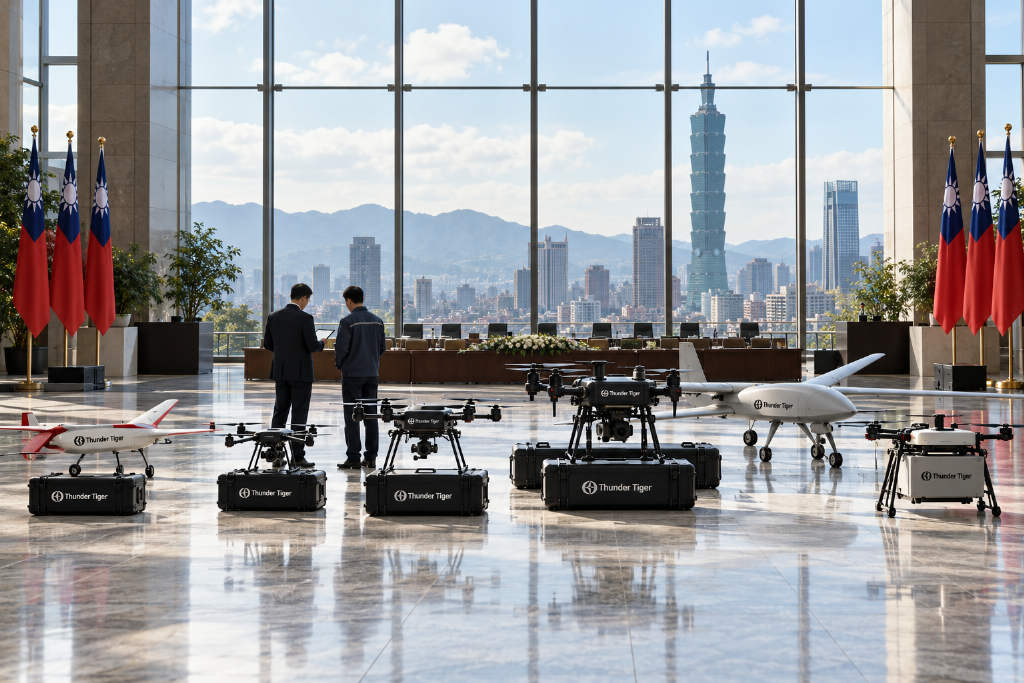
Thunder Tiger Technology (8033) said on Oct. 28 that it had obtained winning-supplier qualification under a joint government supply contract for drone systems handled by Bank of Taiwan on behalf of the Ministry of the Interior and eight other ministries. The procurement program has an estimated volume of 5,920 units and a total announced budget of NT$1.048 billion.
Qualified across six drone categories
According to the announcement, Thunder Tiger’s awarded categories cover training drones, aerial imaging drones, entry-level inspection drones, advanced inspection drones, long-range surveillance drones, and transport drones. The report said clearing all six categories in a cross-ministry tender with varied specifications and strict review standards points to the company’s system integration capability, from light aircraft platforms to higher-end communications, long-endurance models, and heavy-payload transport aircraft.
The contract also imposes strict requirements on domestic manufacturing, origin restrictions, supply-chain controls, and cybersecurity compliance. As governments and industry participants push to reduce reliance on Chinese drone supply chains, the report said Thunder Tiger’s long-running use of non-China-made components worked in its favor in this tender.
Budget ceiling is not a guaranteed order book
Thunder Tiger said in its filing that the NT$1.048 billion figure represents the maximum budget for the entire procurement program, not a guaranteed order amount for the company alone. Under this framework, Bank of Taiwan serves as the government’s centralized procurement and tendering platform, taking charge of specification review and price negotiation at the front end.
After securing qualification, Thunder Tiger can receive orders directly from the Ministry of the Interior and the other eligible agencies under the agreed pricing terms of the joint supply contract, without requiring a separate tender for each purchase. The report said that structure should lower the company’s B2G, or business-to-government, customer acquisition costs. Actual financial contribution, however, will still depend on the pace of agency orders, as well as delivery and acceptance schedules.
The article added that once qualification is in place, the company’s operational focus will shift toward production scheduling, training, and after-sales warranty support.
Capacity expansion and overseas certification
In recent years, Thunder Tiger has shifted from being a traditional model aircraft manufacturer to a domestic drone system integrator. In addition to this public-sector joint supply contract qualification, the company had previously won a related drone procurement project from the Ministry of National Defense’s Army, showing that its products are moving into the defense supply chain.
To prepare for expected growth in demand from military and government users, Thunder Tiger has been expanding production capacity and manufacturing sites. It also plans to raise funds through a cash capital increase to support operations and expansion.
On overseas business, the report said the company has obtained Blue UAS-related certification in the United States, which could help it pursue procurement opportunities with the U.S. government and defense system and raise its visibility in international markets.
Next phase depends on orders and build-out
With the government promoting drone localization and defense self-reliance demand continuing to rise, Thunder Tiger’s prospects in public-sector procurement, defense applications, and overseas markets will depend on actual order wins, the pace of capacity build-out, and market expansion results.



