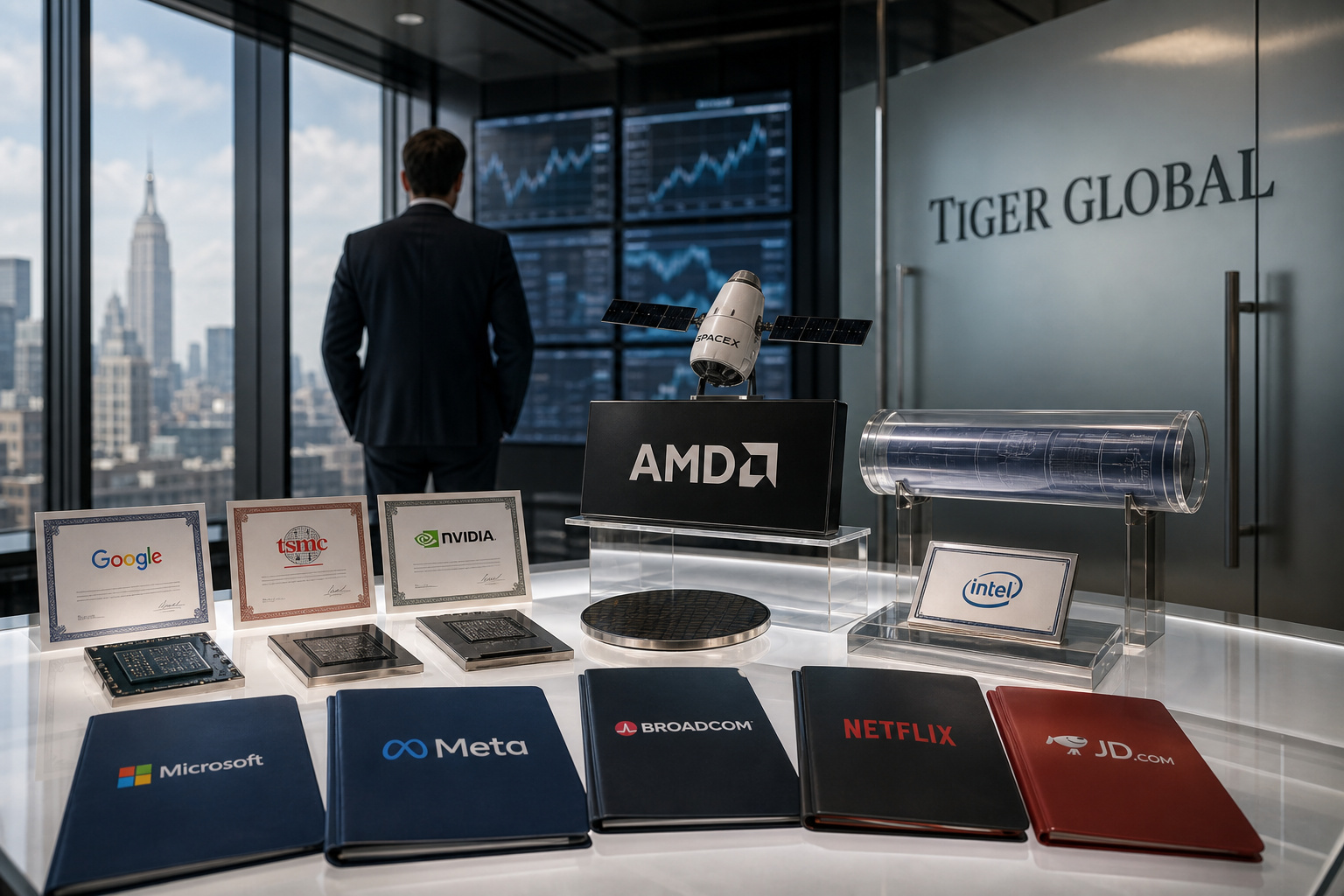
Tiger Global Management made broad portfolio changes in the second quarter, according to a BlockBeats brief published on Aug. 15. On the selling side, the fund cut its holdings in Broadcom by 51.1% to 1.8 million shares, Alphabet Class A by 45.4% to 5.8 million shares, and Taiwan Semiconductor Manufacturing by 12.3% to 4.9 million ADS. It also reduced Microsoft to 2.3 million shares, Meta Platforms Class A to 2.8 million shares, Nvidia to 11.2 million shares, and JD.com to 201,500 ADS. On the buy side, Tiger Global raised its Intel position to 4.3 million shares and opened new stakes in AMD and SpaceX. The new positions were 674,000 shares of AMD and 375,000 shares of SpaceX. The fund also fully exited Netflix during the quarter.
Tiger Global Management made large portfolio adjustments in the second quarter, according to BlockBeats on Aug. 15.
Among the reductions, the fund cut Broadcom (AVGO.O) by 51.1% to 1.8 million shares. It reduced Alphabet Class A (GOOGL.O) by 45.4% to 5.8 million Class A shares, Taiwan Semiconductor Manufacturing (TSM.N) by 12.3% to 4.9 million ADS, Microsoft (MSFT.O) by 9.3% to 2.3 million shares, Meta Platforms (META.O) by 8.5% to 2.8 million Class A shares, Nvidia (NVDA.O) by 6.8% to 11.2 million shares, and JD.com (JD.O) by 41.5% to 201,500 ADS.
On the buying side, Tiger Global increased its Intel (INTC.O) holding to 4.3 million shares. It also opened new positions in AMD (AMD.O), totaling 674,000 shares, and SpaceX (SPCX.O), totaling 375,000 shares.
The fund fully exited Netflix (NFLX.O) in the second quarter.
This article was originally published by Bit.Fan. For more cryptocurrency news and market insights, visit www.bit.fan. Disclaimer:
The market information, project data, and third-party content displayed on this platform are for industry information sharing only and do not constitute any form of investment advice or return commitment.
Cryptocurrency trading carries high risks. Users should fully assess their risk tolerance and make independent decisions. All profits, losses, and legal responsibilities are borne by the users themselves.