

Tiger Research asks what the crypto world might look like in 2036, then answers with four ordinary lives instead of a top-down forecast. Its picture centers on four shifts: stablecoins replacing local fiat in weak-currency economies, tokenized assets trading nonstop across borders, public blockchain infrastructure consolidating after an era of fragmentation, and online content moving from ad-funded distribution to direct payment from AI agents.

Stablecoins move from trading rails to everyday money
The first story is set in 2036 at a currency exchange booth in the fictional country of Zutopia. Judy, who has worked there for 34 years, pulls out a bill counter and starts sorting Bucks, the local currency. “People still use Bucks?” she says. In Tiger Research’s scenario, the currency still exists legally, but most day-to-day life has already shifted to dollar stablecoins because inflation keeps eroding the value of Bucks.
Judy looks back to 2002, when she was 22 and lived through a sovereign default. Banks shut their doors. Depositors could not access their savings. Her father used to say their wages had to be converted into dollars the moment they were paid because Bucks would visibly lose value if they waited even one day. People checked black-market dollar rates more often than newspaper headlines. Official exchange rates did not help, monthly foreign-currency quotas were capped by the government, and nobody knew when dollar deposits might be frozen.
By the mid-2020s, younger customers were asking Judy a new question: could they buy USDT? At first, stablecoins were mostly used by freelancers and exporters receiving payments from overseas. The appeal was simple. No bank. No line. Just a phone to swap Bucks into stablecoins and back again when needed.
Judy did not think that change would eventually displace her own work. Older customers still wanted cash, and many companies still used the local currency. But the lines kept shrinking. Young customers disappeared first, then middle-aged ones. By 2030, even payday lines were gone. Once companies no longer had a reason to hold Bucks, they started paying wages directly in stablecoins. Bucks remained useful mostly for taxes and utility bills.
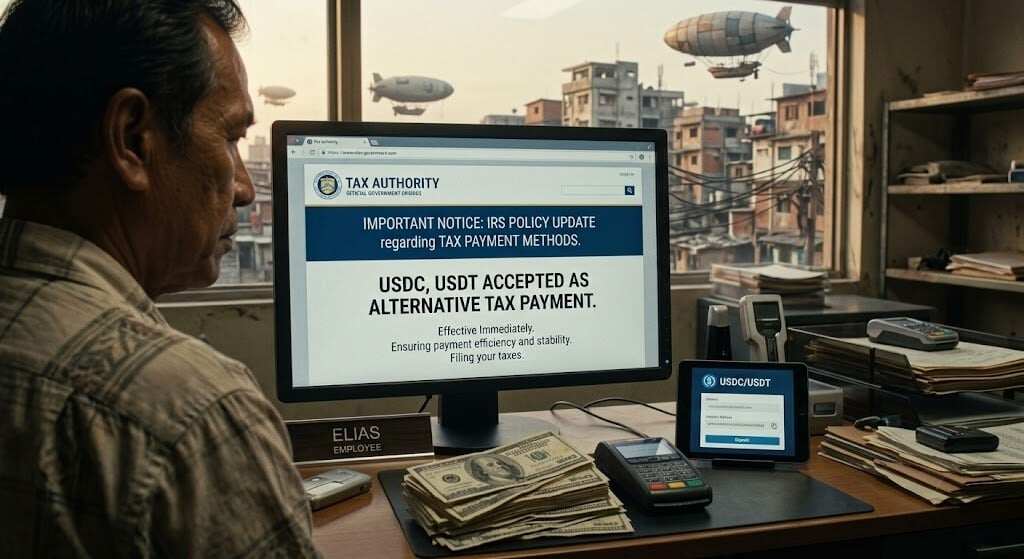
Tiger Research marks 2033 as a turning point. The tax authority changed course and posted a short notice saying it would accept USDC and USDT as alternative means of paying taxes. Bucks still existed, but the state itself had declared that it preferred receiving someone else’s money.

The shift deepened in 2034, when the finance ministry followed. Bonds issued in Bucks kept failing to attract buyers, so the ministry eventually sold new debt denominated in dollar stablecoins. Public-sector wages followed. In 2035, some local governments started paying half of civil servants’ salaries in stablecoins because employees paid only in Bucks were getting hit first and hardest by inflation.
In that telling, the powers once tied tightly to the state — issuing money, collecting taxes, paying salaries — are slowly transferred to stablecoins.
Tiger Research grounds that scenario in present-day figures. As of May 2026, total stablecoin market capitalization stood at about $320 billion, with annual transaction volume at $2.8 trillion. For comparison, the U.S. wholesale payments network handles more than $2 trillion a day, so annual stablecoin volume is only about three weeks of that system’s throughput. After excluding wash volume and fake activity, less than 6% is used for actual payments, according to the report, while 88% circulates inside exchanges for trading and collateral before flowing back.
Its point is not only how small the payment share is today, but where that 6% happens. Stablecoin attention may start in New York and Silicon Valley, yet the places that need it most are not the United States. Americans already have credit cards and bank accounts. The sharper demand comes from countries where local money loses value every day.
Markets that never close
The second story moves to Singapore in 2036. At 2 p.m., Lia, sitting in a small rental room, gets a limit-order alert for Nvidia. New York equities are not open at that hour, but on her screen the Nvidia chart is already moving. She buys without hesitation. On the same interface, alongside Nvidia, are U.S. Treasuries, real estate investment trusts, and data-center infrastructure funds.
By that point, the report argues, people are no longer just trading stocks. They are trading everything. Lia sums it up in one line: investing never stops, no matter where you are. For her generation, that is normal.
Tiger Research traces part of that mindset back to 2021, when 9-year-old Lia watched U.S. retail traders push GameStop shares skyward. In that episode, participation itself became as important as the underlying asset, and online communities, not brokerages, organized the crowd.
The report cites a 2025 World Economic Forum survey across 13 countries, which found that 30% of Gen Z started investing as soon as they reached adulthood, well above 9% for Gen X and 6% for baby boomers. It also says 86% of Gen Z had learned how to invest before entering the workforce, compared with 47% of boomers.
It adds another data point from Coinbase’s fourth-quarter 2025 survey: 73% of younger respondents said it was difficult to build wealth through traditional means, versus 57% for older generations. In Tiger Research’s framing, investing has become a default behavior for younger users, and they want access to a much broader set of assets.
The report points to June 2025, when tokens backed 1:1 by major U.S. stocks such as Apple, Tesla, and Nvidia flowed into decentralized exchanges. They came without nationality restrictions and without strict KYC. If a user had a wallet address, U.S. equities were within reach, and leverage was effectively unlimited in practice.

In that world, Lia logs on to a borderless trading platform called Lemming Brothers and buys a tokenized product linked to a Korean real estate index. Ten minutes later, her phone vibrates with a liquidation alert. She swipes it away as if it were routine background noise.
That contrast matters. Lia’s parents still buy so-called safe assets through regulated exchanges and regular recurring purchases. Lia lives in a market where every form of value is turned into an asset and priced continuously. It runs 24 hours a day and keeps asking for the next trade.
From hundreds of chains to fewer than ten
The third story turns to infrastructure. In 2036, Do-hyun, a blockchain infrastructure engineer with 12 years in the field, scrolls through a network dashboard at a startup office in Pangyo Tech Valley. Then he stops. “Ten years ago you had to keep scrolling. Now there aren’t even ten chains left on one screen,” he says.
He remembers 2024, the year he started his career, as the peak era of Layer 2 rollups. Anyone could copy a framework and a stack, put a new name on it, and launch a chain. His company joined that buildout by setting up validator nodes.
One of those networks was called Allchain. In June 2024, helped by airdrop expectations, its total value locked reached $2.2 billion. Do-hyun still remembers the team celebrating in a meeting room and talking as if they might become the next Ethereum.
The euphoria did not last. Once the token was listed and airdrop rewards ran out, both price and usage fell off a cliff. Projects and users who had come for incentives left as soon as Allchain stopped paying them. Within a year, 97% of deposits were gone.

Tiger Research says Allchain was not an exception. Many independent networks that emerged in that period followed the same pattern. Incentives pulled in developers and liquidity. When the money dried up, ecosystems hollowed out almost instantly, leaving behind silent infrastructure shells.
The economics of running a standalone chain only made the problem worse. Fixed costs were too high for individual projects to carry for long. As maintenance bills climbed, one Allchain after another announced shutdowns and faded away. Only a very small number survived the scrutiny of capital. The report describes hundreds of chains that once claimed they would change the world, only to split a little more than 10% of the market and then disappear.
Do-hyun’s hindsight is blunt. In 2026, many people mistook the number of chains for blockchain scalability itself. What users actually got was a fractured experience and higher security costs. What they wanted was not hundreds of complicated networks, but a few very large pieces of infrastructure with deep liquidity and better speed.
By 2036, in Tiger Research’s scenario, the chain wars end not in endless multiplication but in consolidation.
When AI agents pay for content directly
The fourth story is set in 2036 at a media startup office in Sangam-dong. Jae-hoon is browsing another platform when he notices a banner ad in the lower-right corner and laughs. “There are still companies sticking banner ads on screens and waiting for readers,” he says.

In this version of the web, banner advertising belongs to the past. Some platforms still post record monthly traffic, yet the old ad revenue never comes back. When Jae-hoon entered media in the early 2020s, the formula was straightforward: write strong articles, attract readers, sell banner inventory. “How many page views do we have today?” was the question that decided survival every morning.
That formula started breaking down in the late 2020s. By 2029, according to the report, more than half of global web traffic no longer came from humans, but from AI agents and bots. AI could scrape an article and summarize it in a second. Machines, however, did not have eyes for banner ads.
At first, like many media companies, they blocked bots because server costs were exploding. But the price of blocking them was severe. A publisher buried outside AI search and recommendation systems could be forgotten altogether. Media companies were forced into a painful choice: block bots and lose traffic, or let them in and earn nothing under the old ad model.
The question inside the office became simple and desperate: who are we selling our content to now? Tiger Research’s answer is to price the content itself, not the ad slot around it.
The report points to Coinbase’s launch of the x402 standard in May 2025 as the opening move. In its account, x402 revived the HTTP 402 response code — “payment required” — after roughly 30 years in the corner of internet standards.

By 2029, the focus had shifted to building the supporting rails, including Know Your Agent, or KYA, verification and settlement infrastructure. The real breakout started in 2030, when one media company began selling data directly to AI through the x402 system. Once that model was validated, other media and data companies moved in quickly.
At first the income looked trivial. Each machine call brought in only a few dozen won. It seemed too small to matter. But when daily requests climbed into the hundreds of thousands and then the millions, the money overtook banner advertising. Jae-hoon says the company no longer worries about what advertisers think because machines pay full price for the content and the business runs on that revenue.
In Tiger Research’s framing, the old web economy built on human attention fades out while a machine economy built on API transactions takes over. Jae-hoon shuts his dashboard, picks up his coffee, and watches a visitor curve that still looks almost vertical by old standards. He no longer checks how many people came. He checks how many AI agents paid today. Tomorrow, hundreds of thousands of them will knock on his servers again, and the payment log will still be there.
Four stories, one direction
Tiger Research uses Judy, Lia, Do-hyun, and Jae-hoon to map four separate lines of change in a 2036 crypto economy. Stablecoins become everyday money in weak-currency markets. Tokenization pulls more assets into always-open trading. Blockchain infrastructure shifts from proliferation to concentration. Online publishing moves from advertising to direct machine payment.
The report does not present those outcomes as guaranteed. It does something narrower and more concrete. It links future scenes to signals already visible in 2025 and 2026: current stablecoin scale, younger investors’ behavior, the rise and fall of incentive-led chains, and web traffic increasingly driven by AI. The argument is not that 2036 must look this way. It is that the outlines of that world are already visible now.