

Tiger Research says AI agent wallets are emerging as a new battleground in crypto payments, driven by the idea that future online transactions may be initiated by software rather than people. If that shift takes hold, the report argues, payment infrastructure will need to handle huge volumes of automated, low-value transfers that traditional card rails were never built to support.
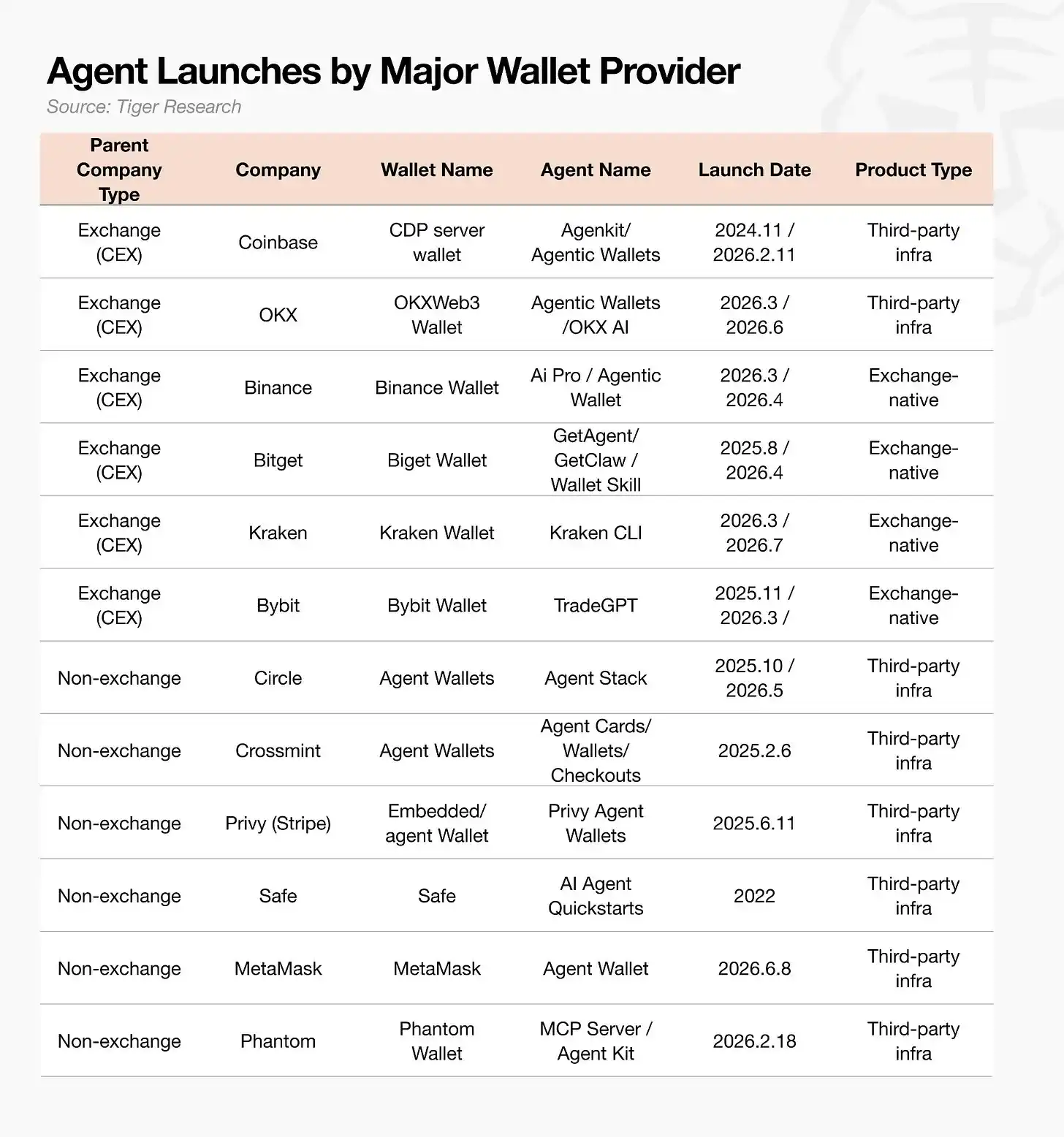
More than 10 companies are already building wallets specifically for AI agents, according to the report. Coinbase, Binance and other firms are still investing even though near-term revenue is limited. Tiger Research says the reason is straightforward: these companies are trying to secure future users and transaction flow before agent-driven commerce reaches scale.
AI agents are beginning to trade in live environments
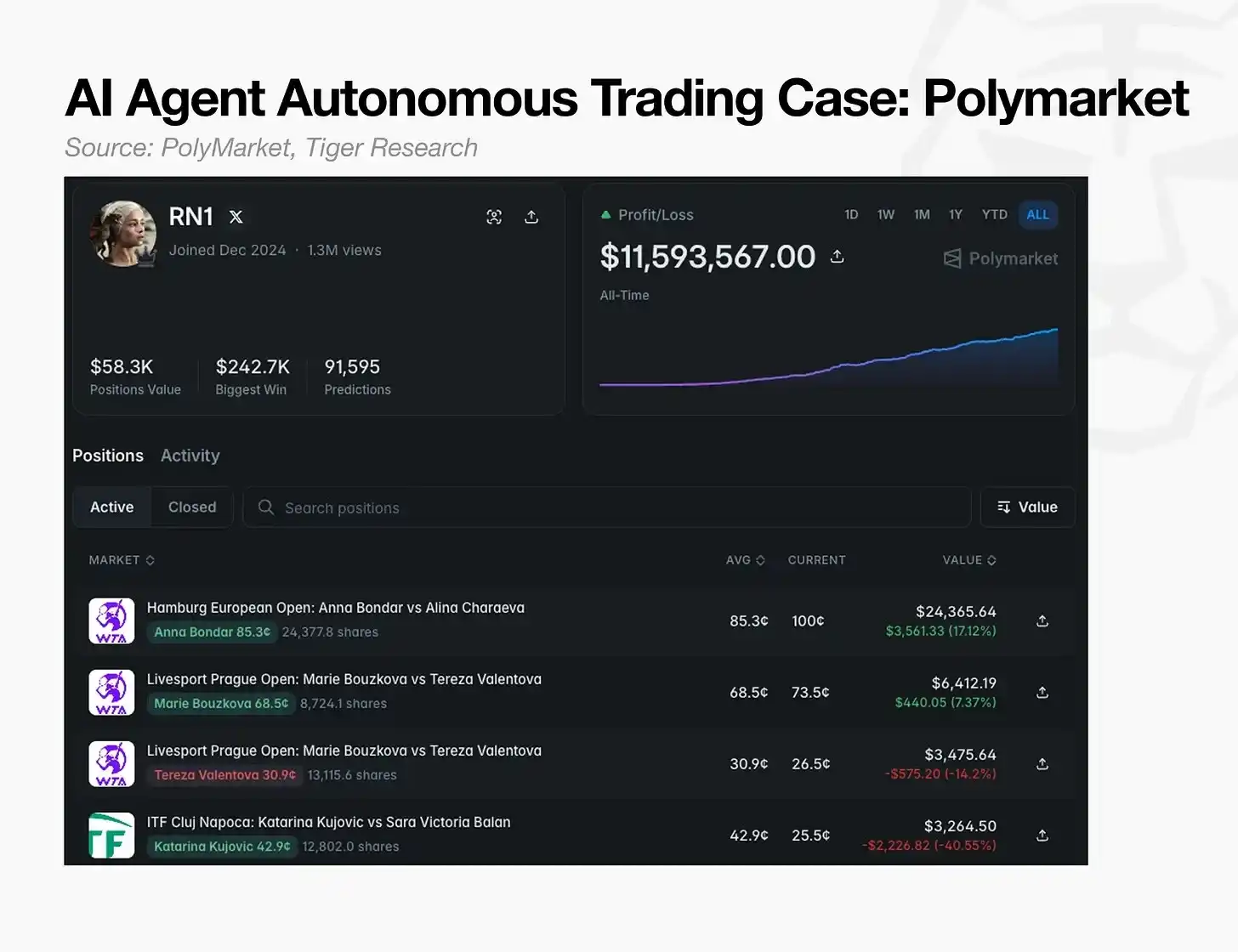
The report points to an experiment on prediction market Polymarket earlier this year. An AI agent was given $50 in starting capital and allowed to trade on its own, with one condition: if it failed to earn enough to cover API and server costs, it would “disappear.” Tiger Research says the agent traded successfully, and similar agents later entered the market using the same model.
AI agents are not yet part of daily life, the report notes, but broad adoption in the future already looks increasingly plausible. For now, their most active use case remains inside crypto, especially in trading bots that operate outside traditional payment networks and focus on cryptocurrency markets.
Every agent transaction starts with a wallet
Tiger Research argues that AI changes the structure of payments themselves. Once agents rather than humans act directly on the internet, transaction values can fall sharply. A single API call may cost just $0.001, while a data query in an extreme case may be priced at $0.00001.
Handling payments at that level requires more than storing payment credentials. The report says the system must support conditional transfers, automatic splitting of funds and settlement without human intervention. That, in its view, is the context in which x402 payment rails have emerged, with wallets serving as the foundation.
Existing payment systems were designed around people as the transacting party. Cards are issued to named holders, use chargebacks to resolve disputes and typically carry fixed fees of several dozen cents per payment. That structure works when a person occasionally spends $20. It breaks down economically if an AI agent sends thousands of payments per second, each worth $0.001 for an API call or $0.00001 for a data record.
At the center of the issue is whether money itself can be programmed. Tiger Research says cards can automate the entry of payment details, but they cannot natively split funds based on conditions, stream payments or settle fund flows in real time. Wallet-based rails, by contrast, are built with those capabilities in mind. If commerce shifts toward direct machine-to-machine transactions, the report says, wallets become the only realistic starting point.
Why exchanges and stablecoin players are investing early
Tiger Research says the field of wallet providers already spans exchanges and stablecoin issuers. The common thread is not present-day profitability. These companies are preparing for future business rather than chasing immediate returns.
The report describes a scenario in which AI agents run continuously in browserless environments with little or no human involvement. A user may ask an agent to produce a research report. As it gathers information, the agent could make small payments across multiple platforms each time it accesses paid data or services. A single request from the user could trigger 20 to 30 payments, or more, almost instantly.
What looks like one simple action from a human perspective can turn into a dense payment tree once an AI agent executes it. Tiger Research says this shift in payment intensity could materially change how wallet providers and platforms generate revenue.
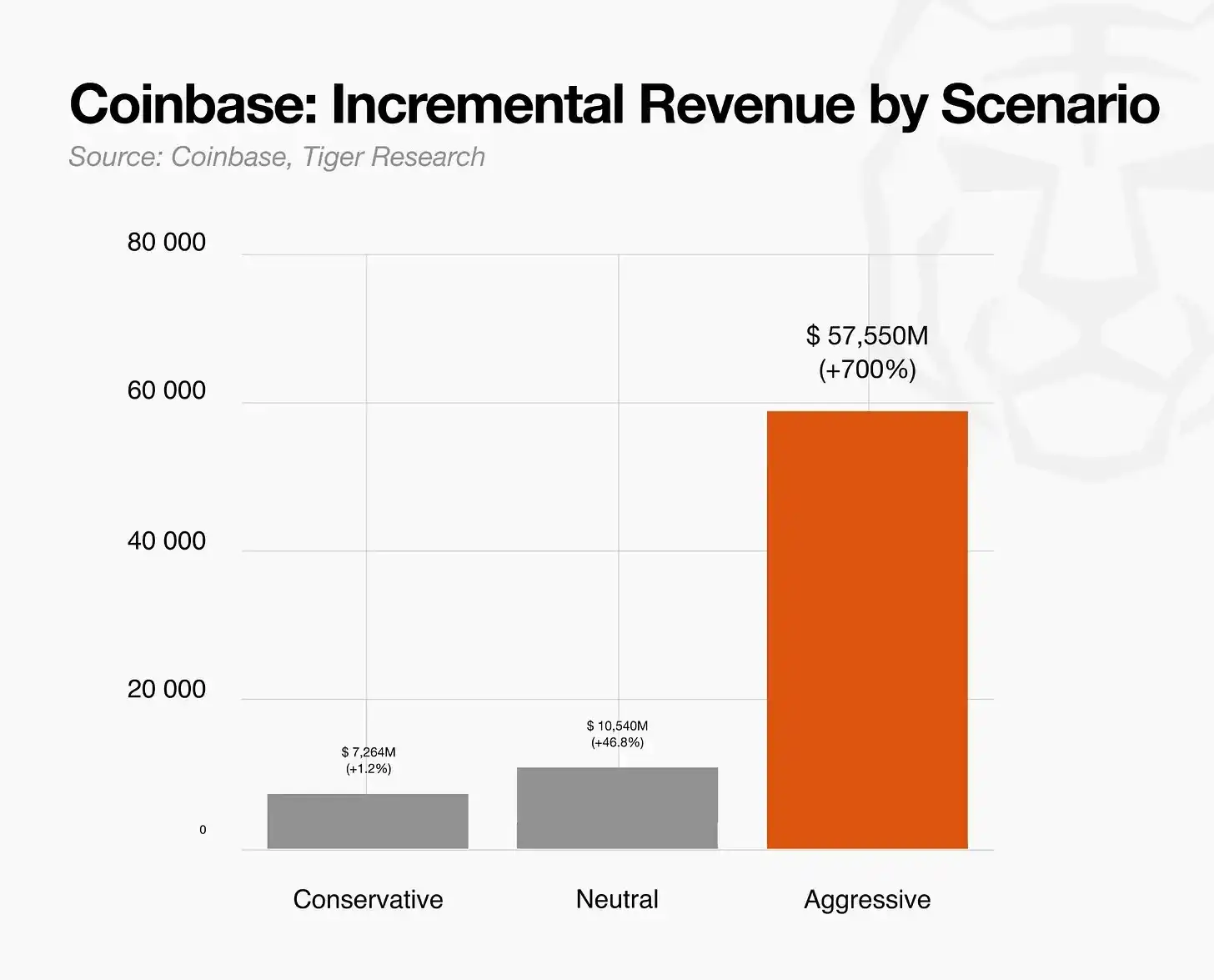
Coinbase revenue could reach $50.37 billion in an aggressive scenario
To estimate the potential impact, Tiger Research uses Coinbase’s disclosed figures and takes 9.2 million monthly transacting users, or MTU, as the base rather than its roughly 120 million registered users.
The model combines three variables: adoption rate, the number of agents per user and daily call frequency. It outlines three cases:
- Conservative case: 10% adoption, 1 agent per user and 50 calls per day, producing about $84 million in annual incremental revenue, or a 1.2% increase.
- Base case: 50% adoption, 2 agents per user and 200 calls per day, lifting additional revenue to about $3.36 billion, or 46.8%.
- Aggressive case: 100% adoption, 3 agents per user and 1,000 calls per day, pushing annual revenue to about $50.37 billion, roughly 7x Coinbase’s current total revenue.
One of the report’s main observations is that the spread between these scenarios is multiplicative, not additive. Moving adoption from 10% to 100% is a 10x change, but the revenue gap expands by about 600x, from $84 million to $50.37 billion.
That is because adoption, agents per user and daily calls are multiplied together. Even modest increases in one input can sharply increase total volume. On that basis, Tiger Research says revenue tied to agent usage could, at the upper end, reach around 7x Coinbase’s current total revenue. The report says this helps explain why Coinbase is still promoting agent wallet infrastructure even without meaningful revenue today.
Wallet data could support new financing models for agents
Tiger Research says the value of wallet infrastructure goes beyond payment execution. Payment histories stored in wallets could become a way to evaluate an agent’s financial health and operating performance.
If those data-based credit assessments mature, wallet providers could expand into next-generation financial services such as revenue-based financing, or RBF, designed for AI agents.
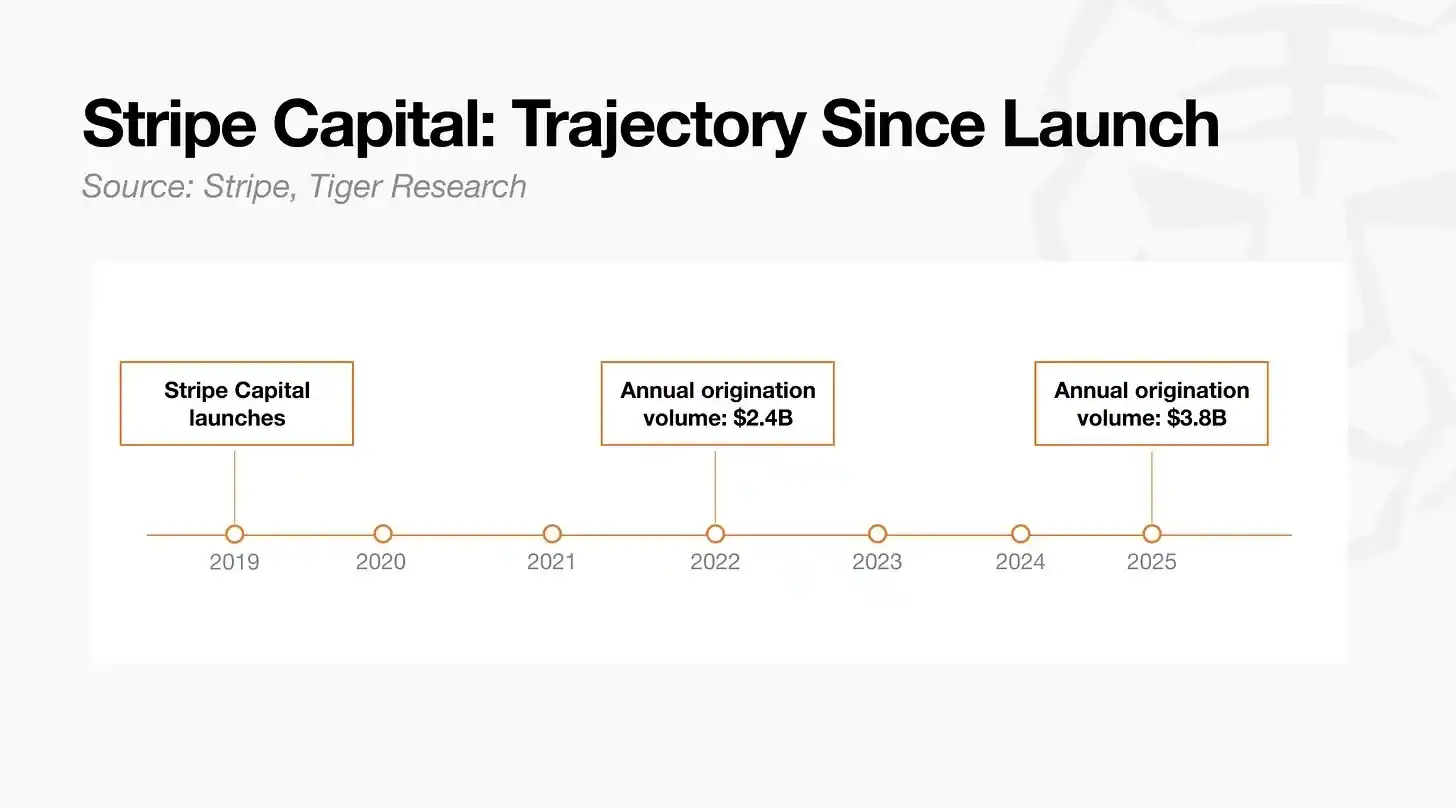
The report points to Stripe Capital as a precedent. When Stripe launched Stripe Capital in September 2019, it did not rely on outside credit bureaus or lengthy loan applications. Instead, it used real-time merchant sales data from its own payment network to assess eligibility and loan size.
For Tiger Research, that example shows how a company can build a high-value financial business on top of an existing operational data pipeline without adding a separate sales network or large marketing spending. Agent wallet providers could follow a similar route by collecting ongoing revenue data from agents, offering operating capital through RBF and developing into financial platforms focused on the agent economy.
The report adds one important condition. For such a business line to work, AI agents must evolve from simple payment executors into asset-holding entities that can generate real income and repay borrowing from that income stream.
The growth case remains unproven
Tiger Research says both the projection of Coinbase revenue rising as much as 7x and the possibility of wallet providers expanding into RBF depend on broad adoption of agent payments in the real economy. That has not yet been validated.
First, there are still major questions about conversion rates and payment reliability. The report says AI agents can hallucinate during autonomous purchases and make incorrect payments. Some transactions are also blocked by fraud detection systems, or FDS, at card issuers, leaving real-world payment completion rates low.
Second, payment protocols including x402, AP2 and MPP remain fragmented and have not converged around a common standard. AI agents also are not legal persons, and the lack of clear KYC and financial regulatory treatment adds another barrier to market expansion.
Because of those constraints, Tiger Research says wallet providers are not primarily fighting over short-term fee revenue. The report compares the timeline with other ecosystems: Apple’s App Store took 15 years to build a $10 billion annual fee market, while WeChat Pay took 7 years to establish its large mini-program ecosystem. Agent wallets, it says, are on a similarly long path, with participants building infrastructure and ecosystems rather than chasing immediate payoff.
In Tiger Research’s framing, the contest is not about today’s marginal revenue. It is about which company can capture fund-flow data once the agent economy takes shape over the next five to 10 years.