

Tiger Research says the crypto market is moving away from the old pattern in which one dominant narrative pulled in liquidity across the industry, and toward a phase where product-market fit, or PMF, matters more than story-driven token momentum. In the firm’s view, markets are starting to move on actual demand, user retention, and revenue instead of rotating endlessly from one theme to the next.
The report says mature sectors such as stablecoins, decentralized finance, real-world assets, prediction markets, and meme tokens have continued to hold up even in a weak market. Its main conclusion is blunt: projects that survive will be the ones that found real users, generated real revenue, and proved they can sustain demand beyond a narrative cycle.
Narratives used to define each major crypto cycle
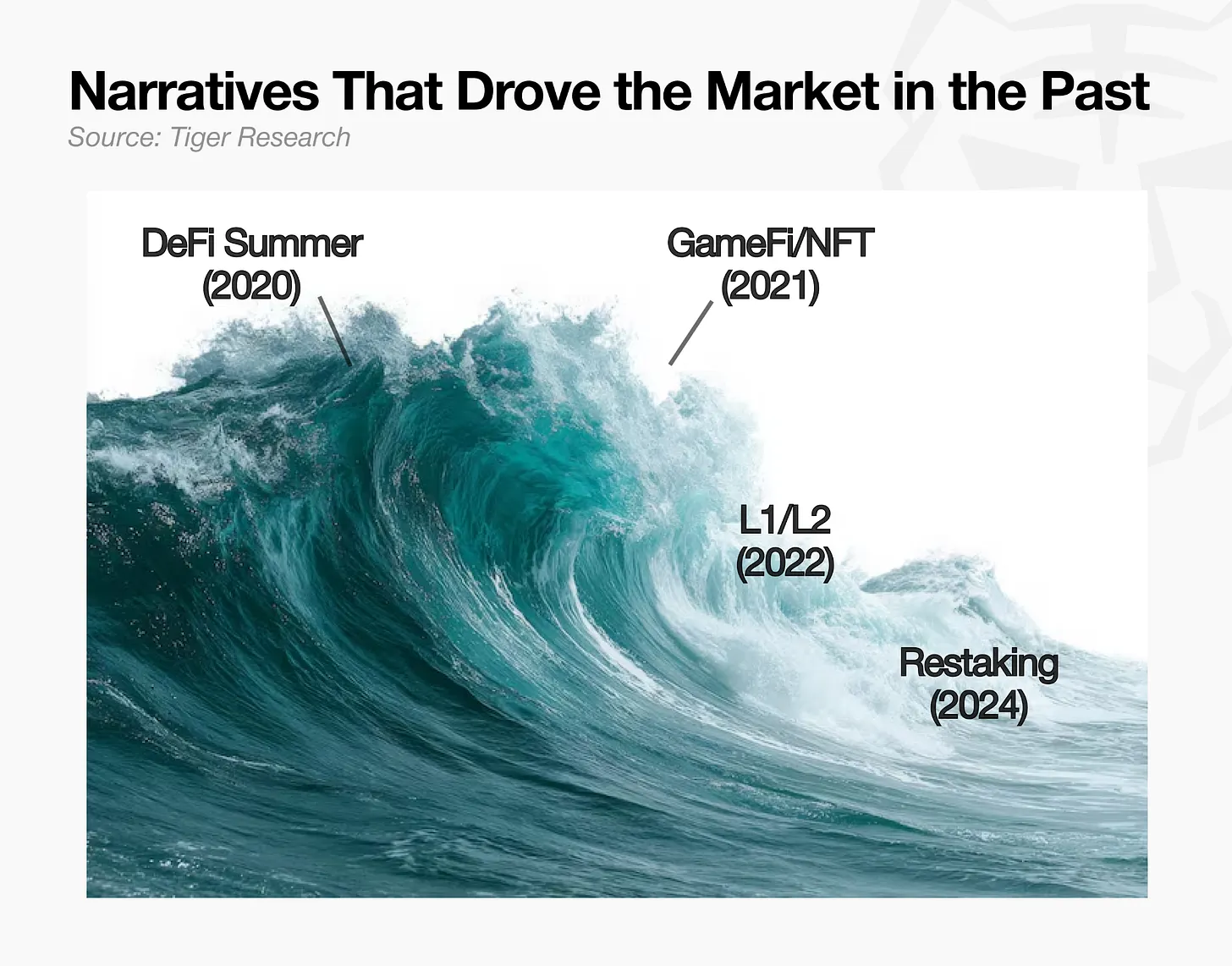
Tiger Research traces the market through four major phases led by a single theme: DeFi in 2020, NFT/P2E/GameFi in 2021, Layer 1 and Layer 2 competition in 2022, and restaking in 2024. In that structure, narrative concentration was the mechanism that focused attention and redirected capital. Once one theme faded, liquidity moved to the next one.
GameFi produced one of the clearest examples of how far that model could go. Traditional game publishers including Square Enix and Ubisoft entered the segment, and gaming drew $2.5 billion of inflows in the first quarter of 2022 alone. But Tiger Research says sectors that failed to demonstrate real PMF could not hold that momentum. It points to Axie Infinity, whose average monthly active players fell 99.7%, from a peak of 2.8 million in January 2022 to about 8,000 in May 2026. For the firm, that collapse shows how quickly a narrative built mainly on capital and justification can break apart.
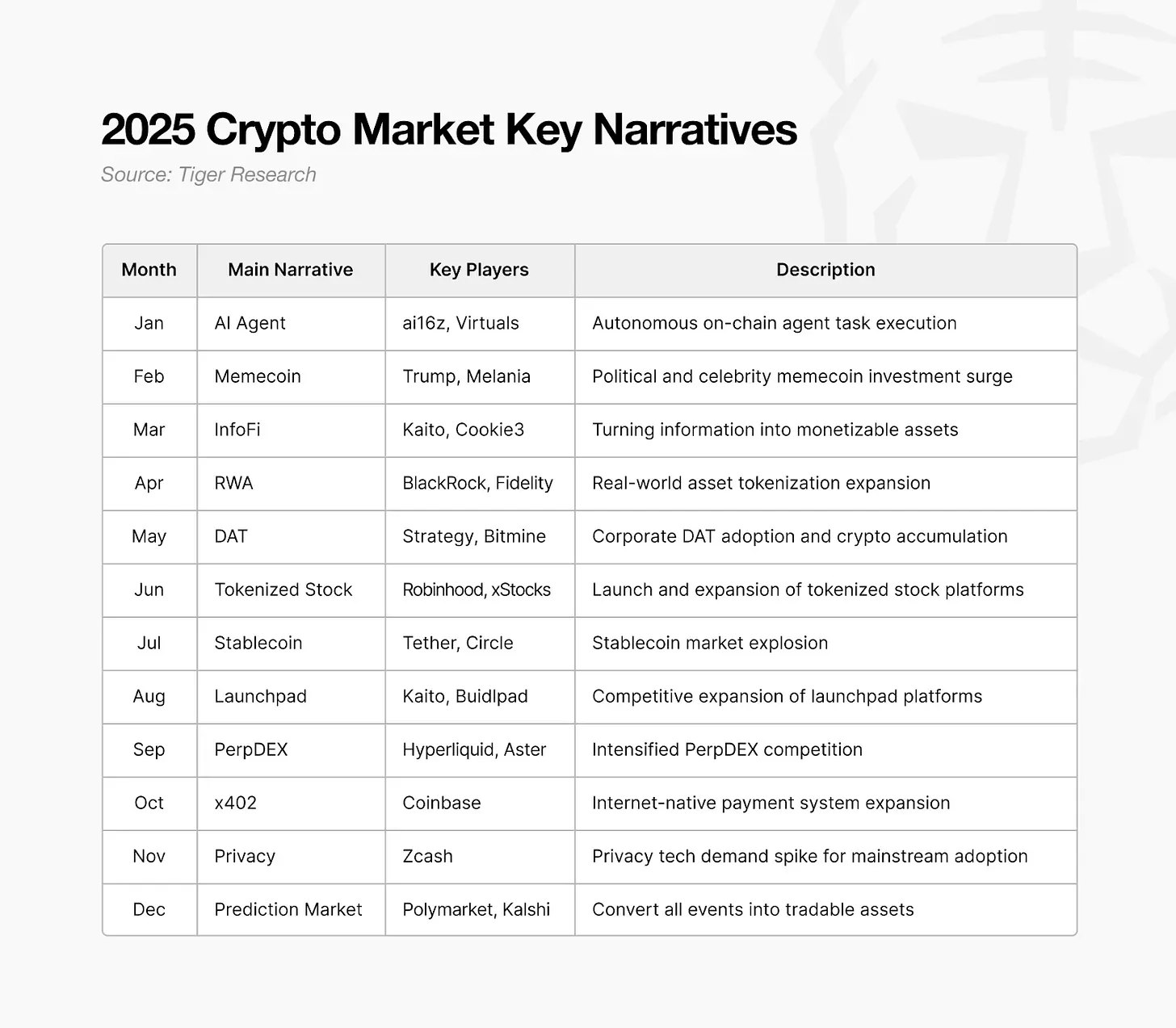
2025 marked the peak of rapid narrative consumption
According to the report, 2025 was the high point of that model. After the AI agent theme, a new narrative appeared almost every month, and the rotation sped up.
Tiger Research says the process looked wasteful on the surface, but it also helped keep retail attention in the market. Even so, the demand under many of those past cycles was aimed at the token itself, not at the underlying problem the product claimed it was solving.
Supply-side innovation without demand struggled to last
The report lays out a familiar pattern through the example of a decentralized social media project. A team launches with a pitch centered on platform monopolies, weak creator compensation, lower fees, and returning ownership and revenue to creators.
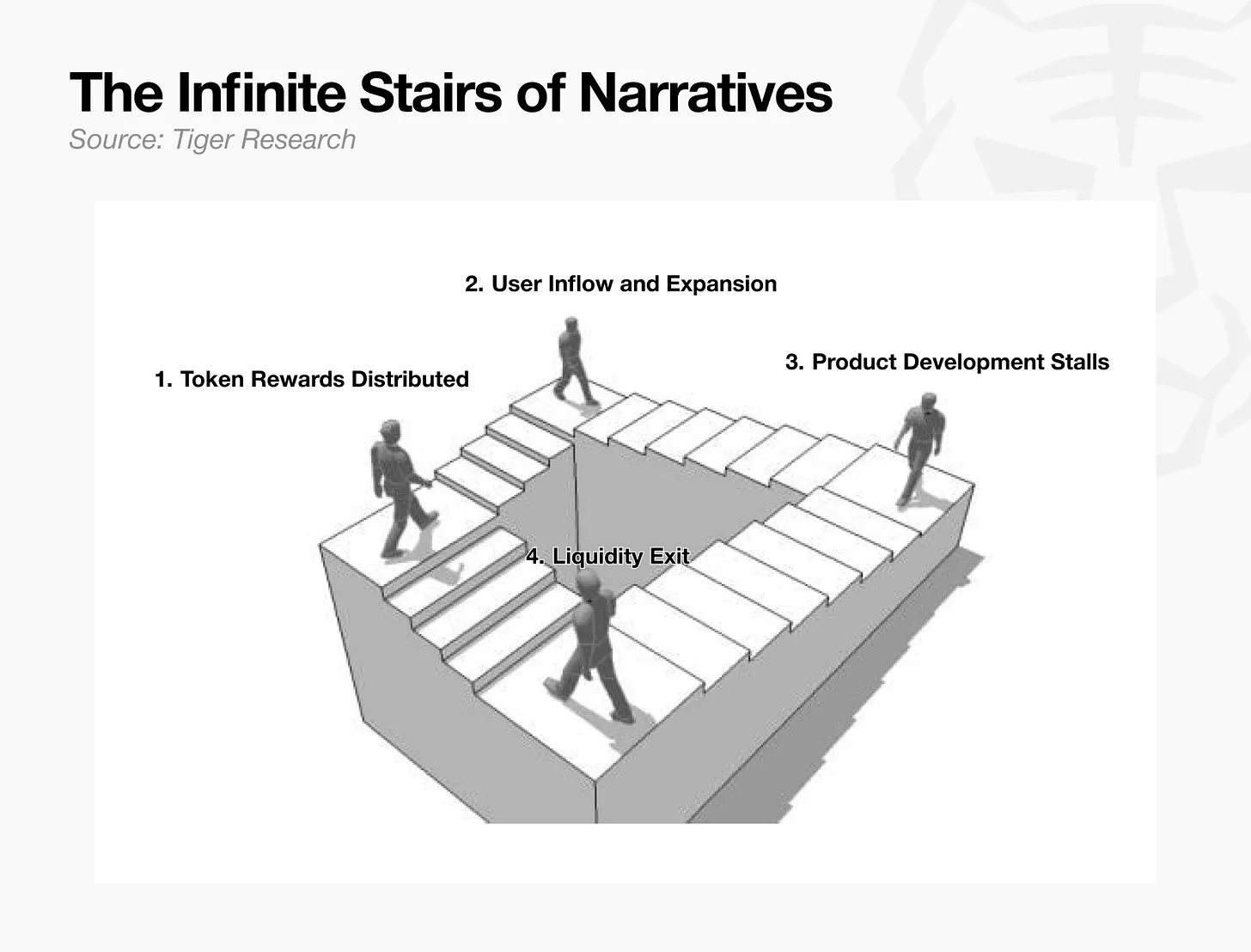
Early users are then rewarded with tokens. As the story spreads that people can earn simply by being active on the platform, market interest grows. Similar projects follow, issue tokens around a minimum viable product, and use airdrops and liquidity incentives to bring in users. Market caps and trading volume rise fast.
Then the imbalance appears. Token prices and rewards begin to overshadow the product itself. Once fundraising and initial distribution are done, product development and user growth stall, while the original issue of creator compensation remains unresolved. Tiger Research says the problem is that there was never a large enough user base that strongly felt the pain point in the first place. Capital came in to chase price appreciation, not product utility. Once the narrative peaked, users and liquidity left just as quickly.
The report says this pattern repeated across several sectors. That is why the market is now placing more weight on projects that can show real revenue, stable usage, and genuine PMF.
2026 is being framed as a PMF era
Tiger Research describes 2026 as a period in which markets are starting to reward products built for needs that already exist. In the older model, teams often built first, then tried to manufacture demand later. In a PMF phase, the order is reversed. Products are designed to match demand that customers already have.
That change is showing up in how the market measures growth. Instead of token market cap moving on its own, the report says stronger projects now show growth in users, revenue, product usage, and brand at the same time. Tiger Research selected five sectors using three criteria: first-half 2026 usage metrics such as volume and revenue, the trajectory of new participants entering each space, and growth in market capitalization. In the firm’s view, those factors are difficult to fabricate together over a short period.
Stablecoins are turning into settlement infrastructure
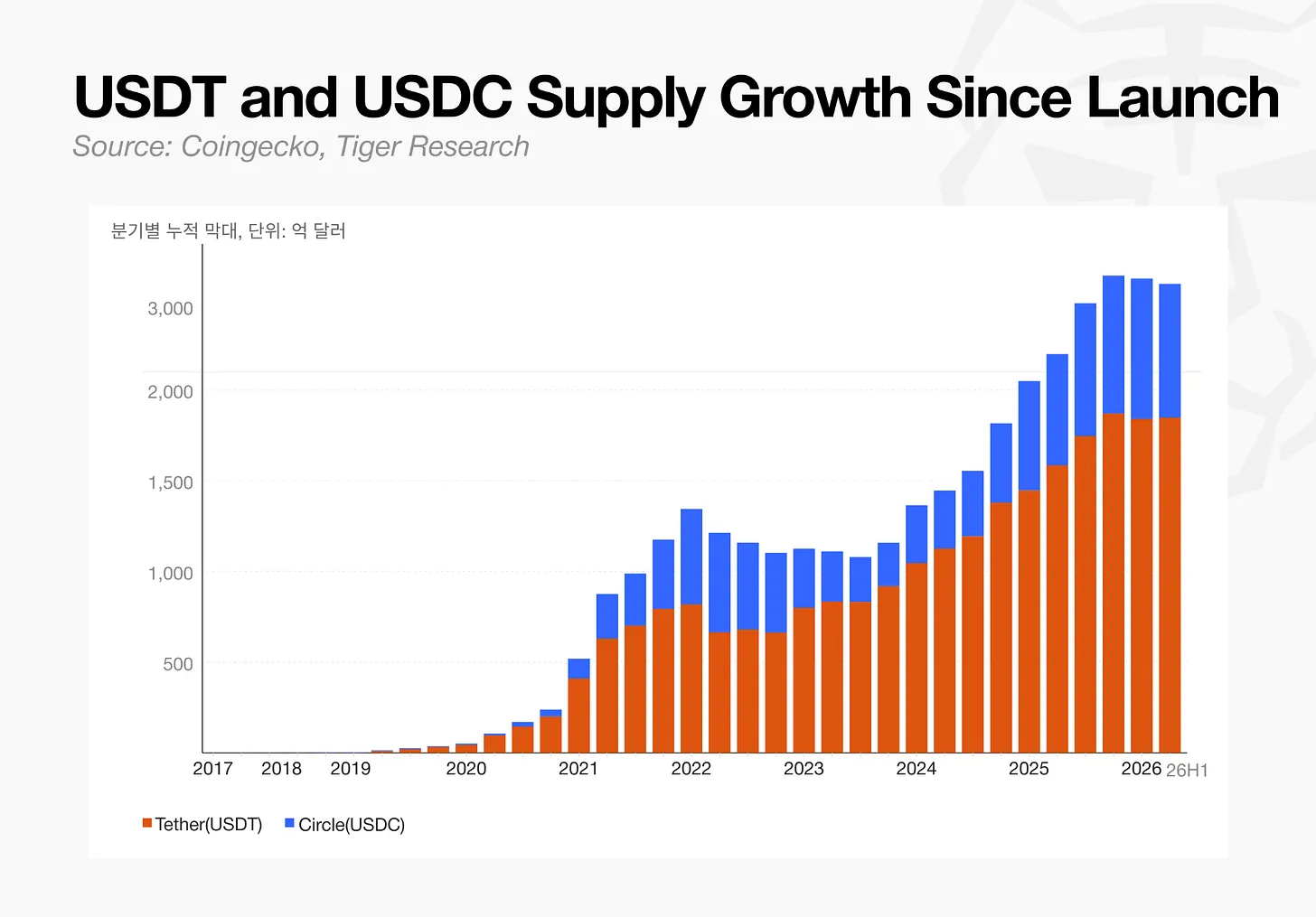
Tiger Research defines stablecoins as fiat-pegged tokens used for payments and settlement. It puts the category’s market capitalization at $304.2 billion, close to its record high of $321 billion.
Tether’s USDT stands at a $184.08 billion market cap, with monthly settlement volume of $1.79 trillion, up 63% month over month. Over the past 12 months, cumulative settlement volume reached $10.2 trillion. The report says Tether posted more than $10 billion in net income in 2025 and held $141 billion in U.S. Treasuries. Circle’s USDC has a market cap of $73.25 billion and serves as the default stablecoin for settlement channels used by major exchanges and institutions including Coinbase.
Stablecoins began as a way to trade crypto without taking on direct volatility. That role has expanded into cross-border remittances and on-chain payment rails.
The report says growth is now taking more varied forms. In June 2026, more than 140 traditional companies including Visa, Mastercard, Stripe, Coinbase, and BlackRock announced the OUSD alliance, or Open USD from Open Standard. Non-dollar stablecoins pegged to currencies such as the Korean won, Japanese yen, and euro are also becoming more common. Their total market cap remains small at $1.2 billion, but the number of wallets holding them rose 30-fold, from 40,000 in January 2023 to 1.2 million in March 2026.
For Tiger Research, stablecoins are no longer just fixed-value payment tools. They are developing into settlement infrastructure that operates across borders and time zones.
DeFi is shifting from ideology to infrastructure demand
The report describes DeFi as smart contract-based finance that enables lending, trading, and derivatives activity without centralized intermediaries.
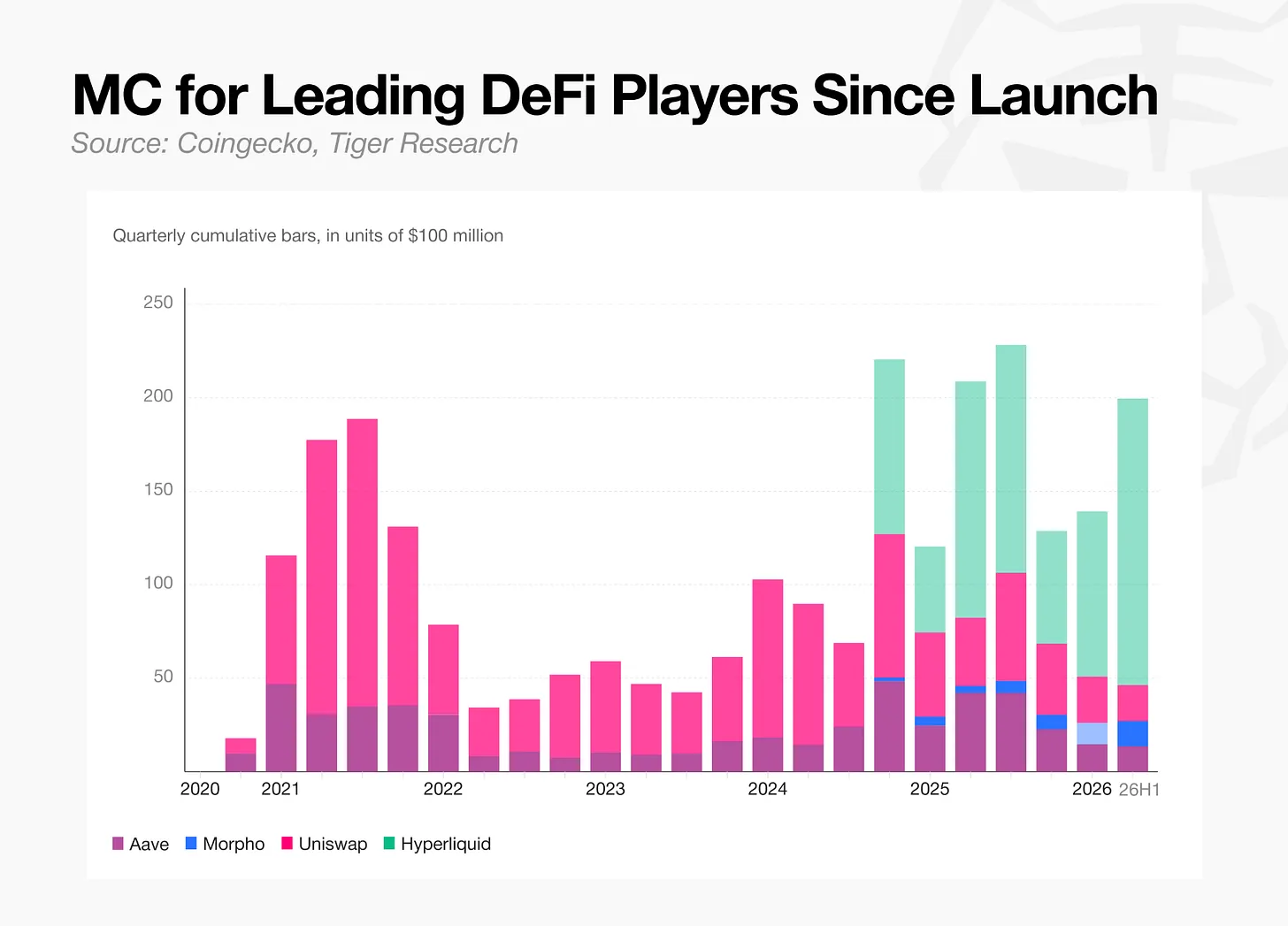
It lists Aave with a $1.397 billion market cap, $14.53 billion in total value locked, and $119 million in annual revenue, making it the leading DeFi lending protocol. Morpho is shown with a $1.302 billion market cap and $7.497 billion in TVL. Its annual revenue is listed at $0 because its $222 million in annual fees go entirely to lenders. Morpho briefly moved ahead of Aave by market cap between late May and June, before Aave retook the lead in July. Uniswap carries a $2.287 billion market cap, $3.14 billion in TVL, and $850 million in annual revenue. The report identifies it as the leading decentralized exchange, with $2.66 billion in 24-hour volume. Hyperliquid has a $13.47 billion market cap, $6.07 billion in TVL, and $874 million in annual revenue. Tiger Research says it accounts for about 76% of perpetual DEX market capitalization, roughly 20% of DeFi overall, and as much as 70% of the on-chain perpetuals market.
DeFi started in 2020 with a simple premise: remove banks and other middlemen, and return those profits directly to users. Tiger Research says what keeps the sector alive now is less about that ideological origin and more about institutional demand for on-chain financial infrastructure. Morpho and Aave offer treasury risk management and lending systems institutions want. Uniswap provides markets for the assets institutions want to trade. Hyperliquid is expanding into trading for traditional assets rather than crypto alone.
The report says these protocols are growing because they were willing to move toward real demand, even when that meant departing from their original ideological framing.
RWA is moving from democratization narratives toward efficiency
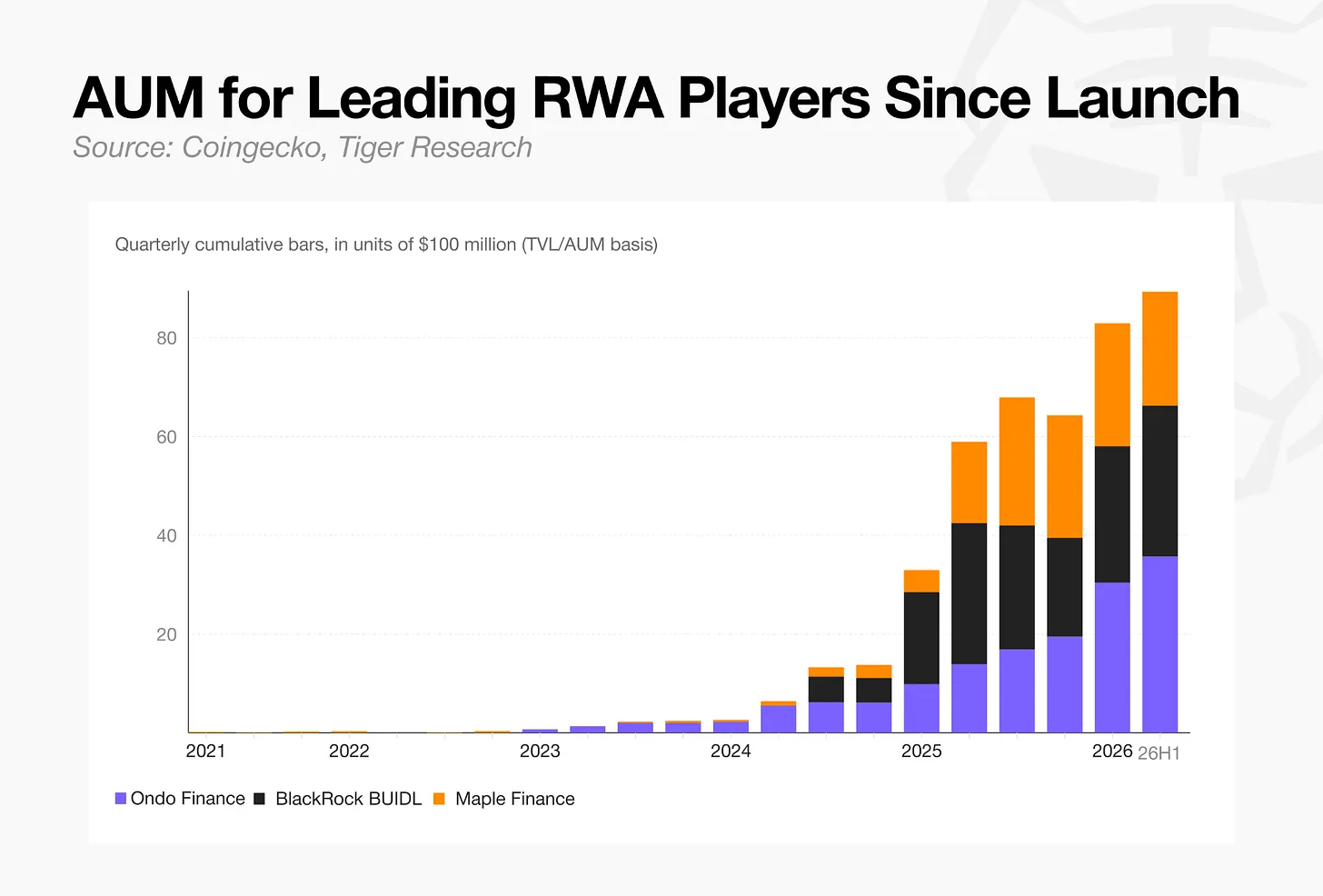
Tiger Research defines real-world assets, or RWA, as the tokenization and on-chain distribution of traditional assets such as Treasuries and private credit. It values the category at $65.2 billion, with tokenized Treasuries as the largest subcategory at $13.4 billion.
Ondo Finance has $3.52 billion in TVL, and its ONDO token carries a $1.75 billion market cap, making it a leading tokenized Treasury infrastructure provider. BlackRock’s BUIDL has $2.4 billion in assets under management. Because it is a NAV-linked fund token, it does not have a conventional market cap, but the report says it is the largest single tokenized Treasury fund. Maple Finance’s SYRUP token has a $218 million market cap, while private credit AUM stands at $4 billion, above BlackRock BUIDL.
The report says RWA began with an effort to bring traditional asset management on-chain to improve settlement speed and access. Institutions were not the original target group. Early projects started in synthetic asset exchanges, using the fact that on-chain markets sat outside existing regulatory structures to lower the barriers to trading real-world assets. Today, institutions make up the largest user base in the sector.
Tiger Research highlights tokenized stocks as a development worth watching. Adoption by traditional institutions such as Securitize and DTCC is increasing. In July 2026, DTCC began real-time trading of tokenized securities with more than 50 institutions. Securitize listed its own stock, SECZ, on the New York Stock Exchange and issued tokenized shares across multiple chains including Avalanche and Solana. Centralized exchanges are also expanding their offerings, with Binance through bStocks and Kraken through xStocks in several countries.
By mid-July 2026, the tokenized stock category had reached a market cap of $2.3 billion, nearly doubling since first passing $1 billion in March. Still, the report says trading volume for these assets on decentralized exchanges remains small compared with DeFi, and most collateral usage still depends on permissioned and whitelisted structures. Deeper on-chain integration comparable to DeFi composability may take longer. For now, the sector is still proving the utility of on-chain asset management.
Prediction markets are being measured by volume and revenue
Prediction markets are described as on-chain contract markets where participants bet on the outcomes of real-world events. Tiger Research values the category at $9.58 billion and calls it the newest among the five sectors covered.
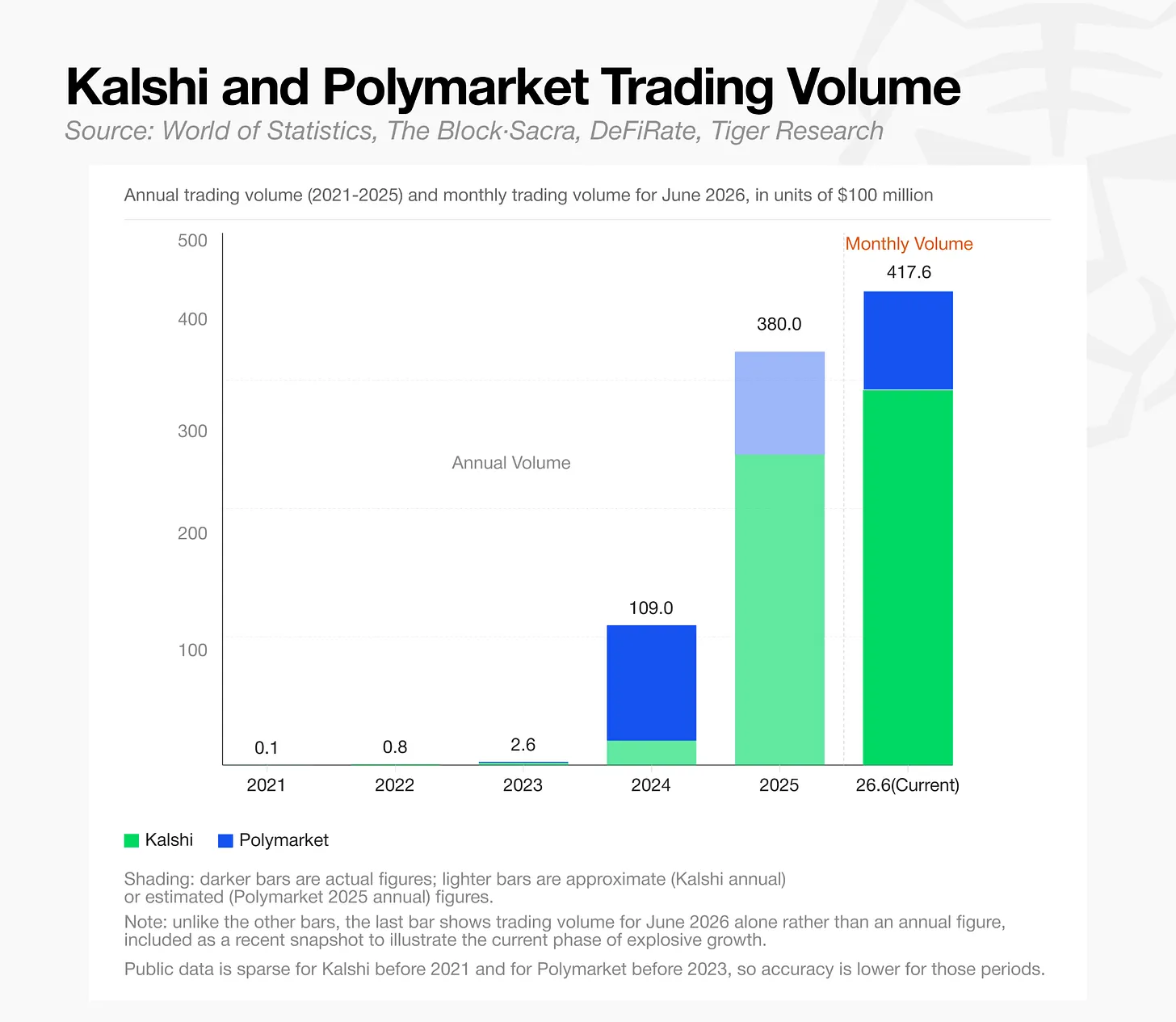
The firm also notes that the two platforms currently leading the industry, Kalshi and Polymarket, have not issued tokens. Kalshi has raised $2 billion in total and carries a $22 billion valuation, or 11 times its funding. Its June trading volume reached $31.5 billion, up 87.4% month over month, and exceeded that valuation. Polymarket has raised about $1.6 billion and is valued at $9 billion. In June, trading volume on its main non-U.S. platform reached $10.26 billion, up 45% month over month. Since receiving approval to operate in the U.S., its annualized revenue has topped $1 billion.
The report says the World Cup created both an opening and a stress test. It drove a sharp jump in June volume, but after the July 19 final, total open interest across the two platforms fell nearly 20% from an early July peak of about $2 billion. With sports contracts accounting for roughly 80% of total volume during the tournament, trading activity could stay weak until the next major event, the U.S. midterm elections.
Regulatory risk remains in play. On July 21, 2026, a Washington state court issued a preliminary injunction barring Kalshi from selling sports event contracts, saying they amounted to illegal gambling under state law.
Tiger Research says prediction markets did not even exist as an independent category before 2024. Now they are one of the fastest-growing segments in crypto. What sets them apart is that their expansion is being demonstrated not through token market caps or TVL, but through actual trading volume and revenue generated by bringing users from outside crypto onto on-chain platforms.
Meme tokens still matter as a fast liquidity on-ramp
The last sector in the report is meme tokens. Unlike the other areas discussed, they do not have clear utility. Their value comes from community and attention. Tiger Research puts the category’s market cap at $25.68 billion, larger than prediction markets.
Dogecoin leads at $11.22 billion, followed by Shiba Inu at $2.5 billion. Together they account for 53.4% of the total meme token market cap. The report says that once a token gains symbolic status in this segment, it tends to keep that position.
Tiger Research highlights Pump.fun and CASHCAT not because of where they rank by market cap, but because of what they represent. Pump.fun has a market cap of $806 million, and its public sale in July 2025 raised $600 million in 12 minutes. CASHCAT, a token on Robinhood chain, rose more than 2,100% in its first week, peaked above $200 million, and then fell about 75% from that peak to $59 million on July 17.
The report says the Robinhood chain case in July 2026 showed that a meme-token narrative can still pull liquidity across an entire chain for a short period, just as in prior cycles. Robinhood chain’s TVL jumped from $17 million on July 3 to $312 million on July 13. On July 10, daily DEX volume on the chain climbed to $846.8 million, driven mainly by CASHCAT.
Tiger Research says the practical role of meme tokens is to attract early users and lower onboarding friction. A new chain or application can use them to build a community quickly and encourage actions such as bridging assets or trading on a DEX. Some of the users brought in that way later remain active in other DeFi services or apps in the same ecosystem, which makes meme tokens an effective entry point and marketing tool.
Still, the report says meme tokens function more as an initial tool for gathering users and liquidity than as long-term holding assets. Whether early attention turns into lasting product use and ecosystem retention remains the deciding factor.
Crypto demand in 2026 is splitting across two ends
On the question of what it takes for a project to survive, Tiger Research says the projects still standing are the ones that found real demand strong enough to bring users back repeatedly, and proved it through performance indicators such as volume, TVL, and fee income.
The report says market demand in 2026 is concentrated at two different ends of the spectrum. One end is speculative demand for volatility and immediate returns. Meme tokens, perpetual DEXs, and prediction markets are absorbing that demand through fast trading cycles and high capital turnover. The other end is practical financial demand for stable custody, transfer, and efficient management of assets. Stablecoins, RWA platforms, and DeFi infrastructure are serving core financial functions including payments, collateral, yield generation, and risk management.
Once sustainable revenue structures and network effects are layered onto that base, Tiger Research says, real PMF emerges. Token prices can create initial attention. Long-term survival depends on usage frequency, retained capital, revenue, and operational execution.
KBW in late September will offer a closer look at the shift
The report closes by pointing to Korea Blockchain Week, scheduled for late September 2026, as a venue where this transition may become easier to see up close. Tether U.S. CEO Bo Hines, Hyperliquid co-founder Jeff Yan, Robinhood Crypto senior vice president Johann Kerbrat, and Apollo’s Christine Moy are listed among the executives set to appear together.
Tiger Research says conversations involving stablecoins, perpetual DEXs, asset tokenization, and RWA could give attendees a direct view of a market shift that, until now, has mostly been visible in data.