



Tiger Research says prediction markets are starting to be used as data sources rather than being viewed only as trading venues.
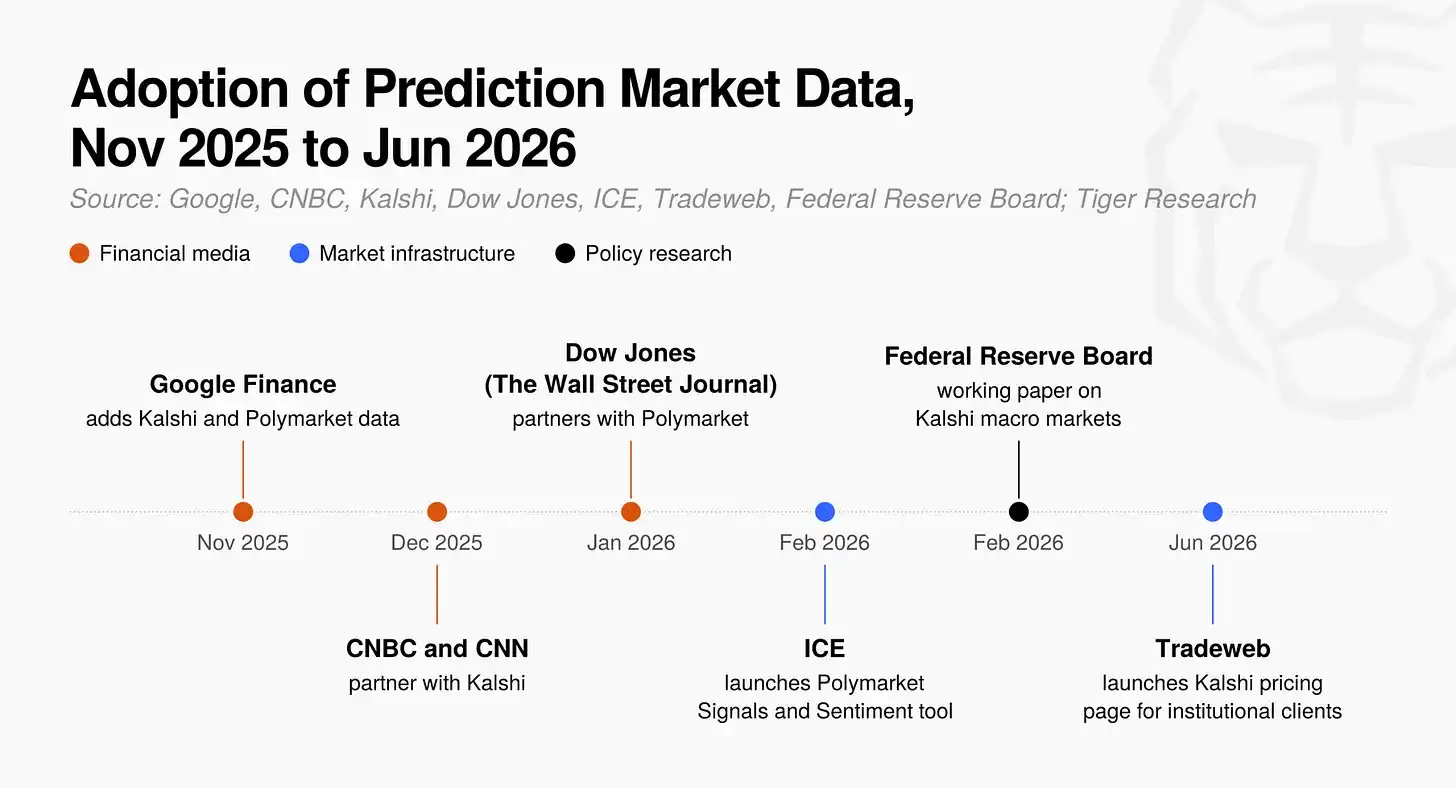
In its latest report, the firm argues that the core value of prediction markets is the data they produce. It points to adoption by Google Finance, CNBC, CNN and The Wall Street Journal, all of which have begun showing prediction-market probabilities. The report also says Intercontinental Exchange, the parent company of the New York Stock Exchange, and bond trading platform Tradeweb now distribute prediction-market data to institutional clients.
Tiger Research adds that a Federal Reserve working paper has treated prediction-market data as a benchmark for macro expectations in areas such as rate decisions, inflation, unemployment and GDP growth. The report quotes a Fed economist describing markets such as Kalshi as 「high-frequency, continuously updated, rich in distributional information, and highly useful for researchers and policymakers」.
From there, the report focuses on three questions: why prediction-market prices can become valuable data, where those data are being used, and whether current markets are capable of producing high-quality information.
Why prediction-market prices can function as useful data
The report starts with the basic structure of a binary contract. If an event happens, the contract settles at $1. If it does not, it settles at $0. A contract on 「rain tomorrow」 trading at $0.62 can therefore be read as a 62% market-implied probability.
Tiger Research says four features explain why those prices can be used in real decision-making rather than treated as little more than betting odds.
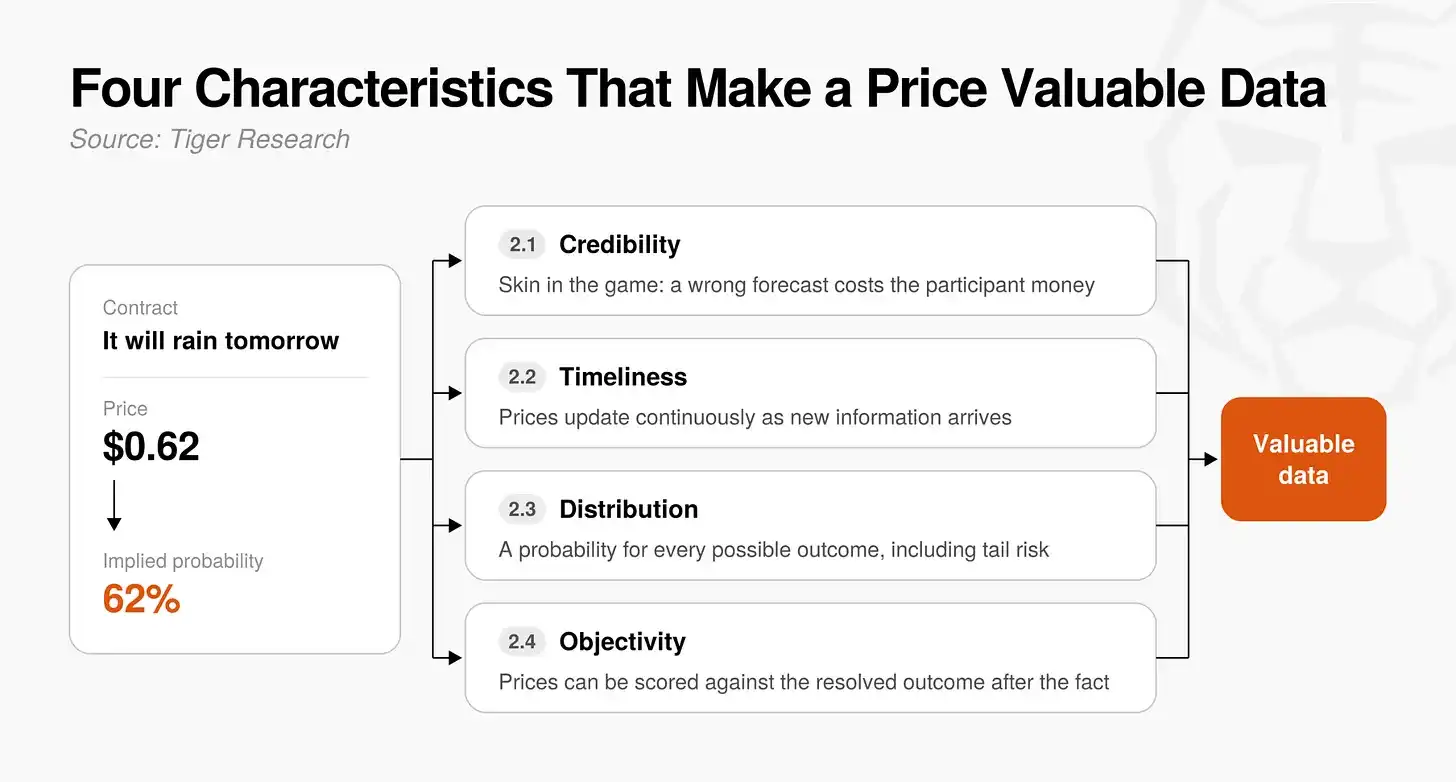
Skin in the game supports credibility
The report says prediction markets differ from casual opinion-sharing because traders put their own money at risk. A wrong call leads to a real loss. That creates an incentive to reflect verified information and genuine judgment in quoted prices. When enough capital is involved and liquidity is sufficient, the resulting market price can become a credible probability signal.
Continuous real-time updates
Traditional polls and expert surveys capture views at a fixed point in time. They are slower to absorb sudden changes. Tiger Research uses the example of a central bank meeting: if a major economic shock or policy statement appears shortly before the decision, a survey completed days earlier or an expert panel updated monthly may miss the shift. Prediction markets, by contrast, move as traders adjust positions when new information arrives.
Full probability distributions instead of a single point estimate
The report says many traditional indicators compress a wide range of views into one average or one most likely outcome. Prediction markets can show the probabilities attached to multiple outcomes at once. A rate decision, for example, can be expressed as a 20% chance of no change, a 70% chance of a 25-basis-point cut and a 10% chance of a 50-basis-point cut. Those probabilities can also be tracked through time. Tiger Research says that makes it possible to observe not only the base case but also tail risks.
Results can be checked after the fact
Another key advantage, the report says, is verifiability. Expert forecasts and polls can be reviewed later, but the standards used to judge them often leave room for interpretation. Prediction markets produce a clear numerical record, and settlement outcomes are binary: 0 or 1. Anyone can compare historical prices with realized outcomes and test accuracy directly. Tiger Research says that transparent record is one reason institutions are willing to treat prediction-market data as a serious input.
Where prediction-market data are being used
The report traces the public history of prediction markets back to the Iowa Electronic Markets, or IEM, in the 1980s. Election forecasting was the best-known use case for years. More recently, the range of applications has widened.
Elections: earlier and often more accurate than raw polling
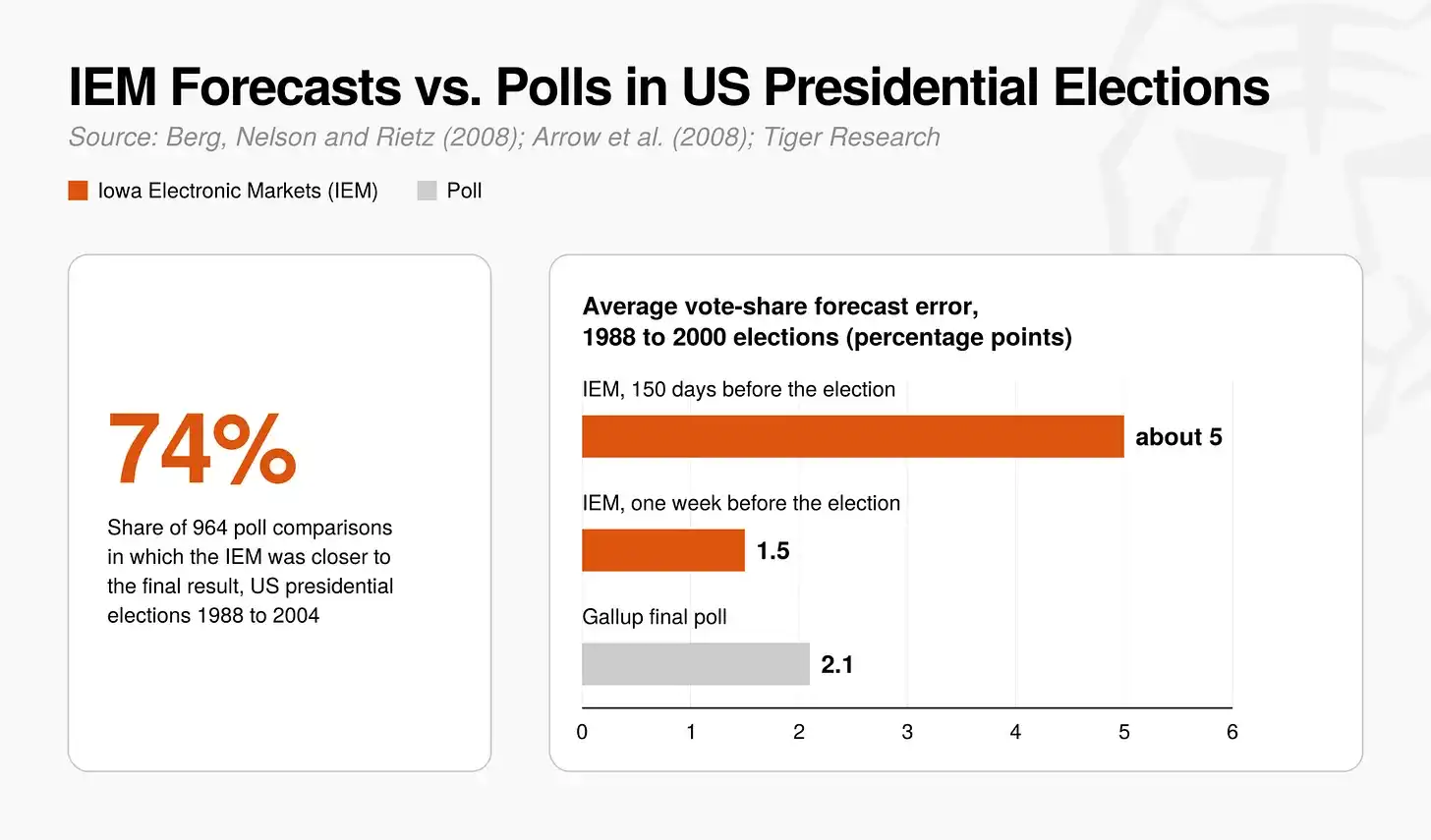
Tiger Research cites research comparing IEM with 964 polls across five U.S. presidential elections from 1988 to 2004. In 74% of cases, IEM produced more accurate forecasts than the polls.
The report says the edge was not limited to the final stretch of a campaign. In an analysis covering elections from 1988 to 2000, IEM’s mean vote-share error one week before Election Day was 1.5 percentage points, lower than the 2.1-point error in Gallup’s final poll. Even 150 days before the election, the average error was still only about 5 percentage points.
It also notes that the two measures are not identical. Polls answer the question of what would happen if voting took place today. Prediction markets estimate the final result on Election Day. Some studies, the report says, have found that polls adjusted for the time remaining in the campaign can outperform prediction markets. Another analysis of the 2008 election found that once biases in prediction markets were corrected, those markets outperformed adjusted polls in the early stages of the race and in tight contests.
Tiger Research’s summary is that prediction markets tend to beat unadjusted raw polling and perform at a level similar to carefully calibrated polls, while offering a separate advantage: they update every day, even months before the vote.
Macroeconomics: a live read on market expectations
The report says it is especially valuable to know market expectations before official releases on rates, inflation and employment. Traditional approaches rely on expert surveys or prices from conventional financial products. Surveys update slowly. Futures prices usually imply only one expected value. Options-implied distributions cover only a limited set of variables. Prediction markets can generate live probability distributions directly from contract prices tied to different outcomes.
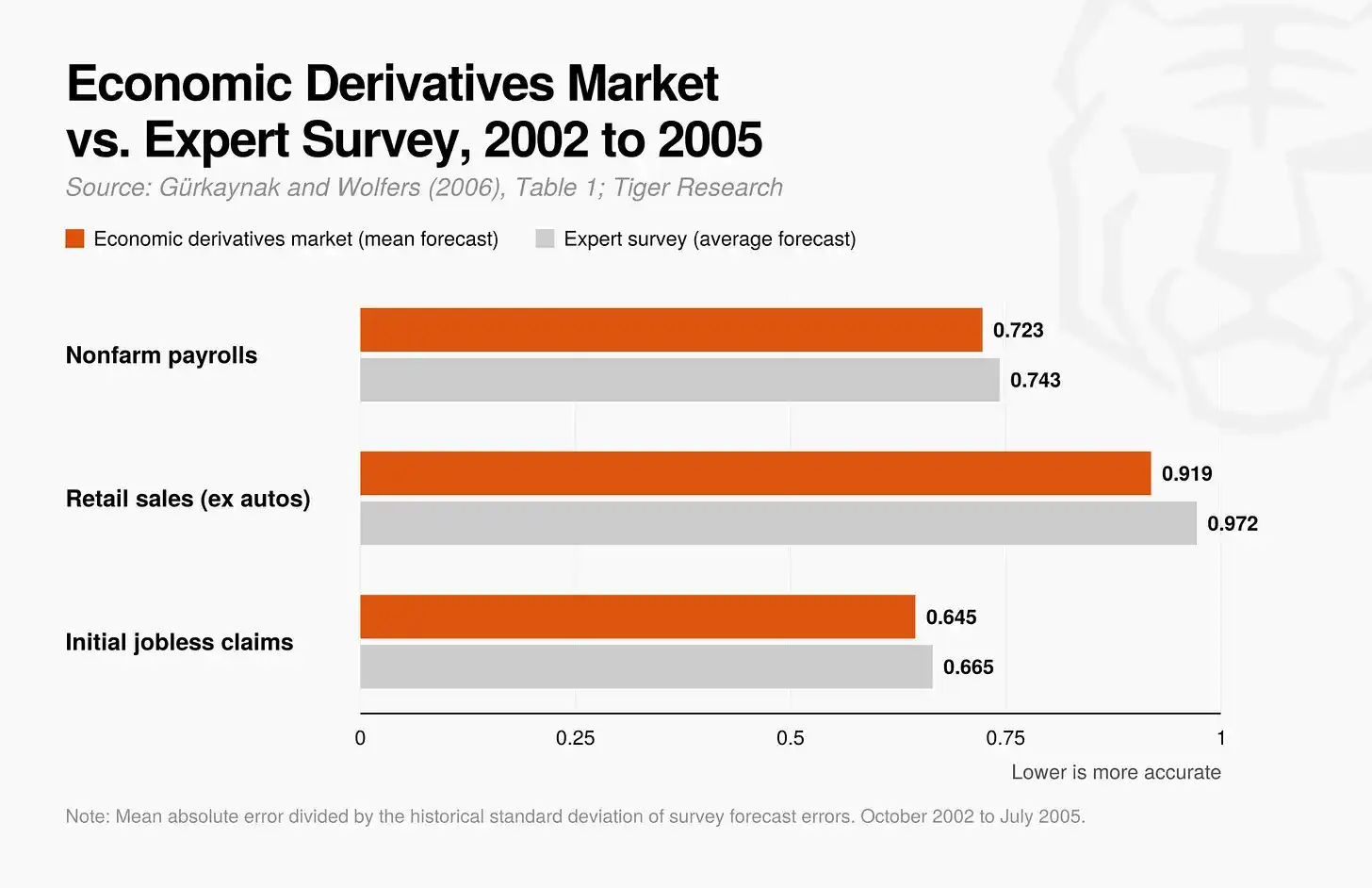
Tiger Research says that value was already visible in economic derivatives markets from 2002 to 2005. Research on binary options tied to nonfarm payrolls, retail sales and initial jobless claims found that market-implied expectations were as accurate as, and sometimes more accurate than, the average expert survey. The probability distributions from those markets also matched realized frequencies closely.
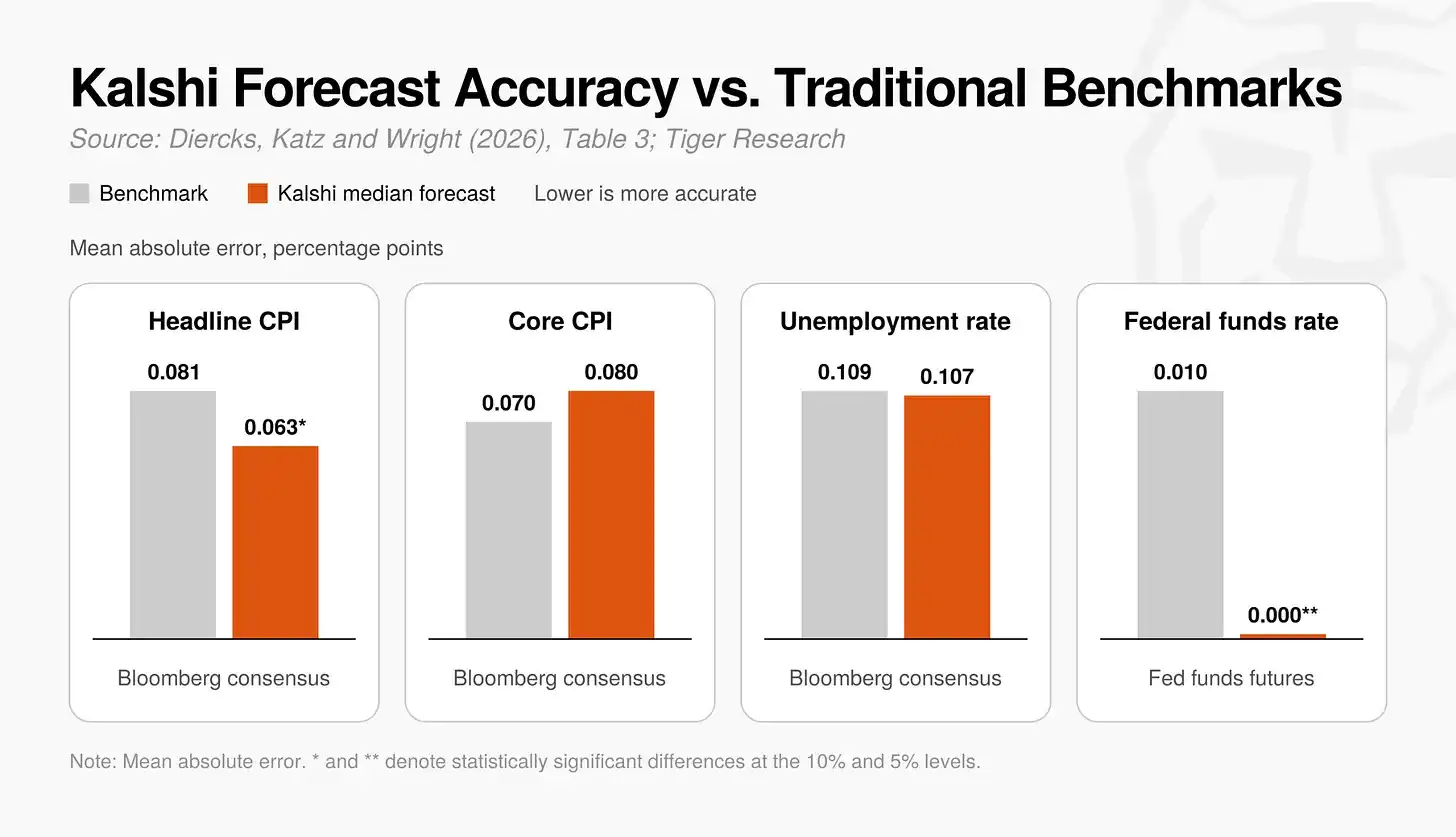
The report then points to a recent Federal Reserve working paper comparing Kalshi with mainstream benchmarks. On the day before an FOMC meeting, Kalshi’s median and modal forecasts for the federal funds rate were exactly correct, and the report says that performance was clearly better than federal funds futures. Against the Bloomberg consensus, Kalshi showed significantly higher accuracy for headline CPI inflation. For core CPI inflation and unemployment, its accuracy was statistically similar to Bloomberg consensus forecasts.
Tiger Research says the broader implication is that prediction markets can fill gaps where liquid derivatives benchmarks have been missing, including GDP growth, core inflation, unemployment and nonfarm payrolls. In the report’s framing, prediction markets can outperform some traditional benchmarks in some areas, match them in others, and provide real-time probability distributions that conventional markets often do not offer.
Public health: flu warnings 2 to 4 weeks earlier
The report also highlights a public-health example. Because the U.S. Centers for Disease Control and Prevention publishes official flu statistics weekly, there is a lag in tracking actual spread. To address that, researchers at the University of Iowa built a pilot flu prediction market in which healthcare workers traded based on voluntarily reported clinical information. According to Tiger Research, the market was able to anticipate flu activity in Iowa 2 to 4 weeks in advance.
The report says that kind of signal can help with treatment planning, disease-control measures and public policy, while noting that the pilot was limited to Iowa.
Companies and intelligence work: bypassing reporting layers
Inside companies, Tiger Research says bad news and uncertain expectations often get softened as they move up a reporting chain. Internal prediction markets can capture frontline information more directly by letting employees trade on revenue, product launch timing, hiring targets and other internal events.
- At Hewlett-Packard, one internal sales forecasting market had 20 to 26 active traders. In 6 of 8 comparable cases, the market was more accurate than management’s official forecast, and in all 8 cases it correctly identified the direction of the official forecast’s bias.
- At Intel, more than half of 979 internal prediction markets run from 2006 to 2013 were more accurate than the company’s official forecasts.
- At Ford, the company used signals from an internal feature-prediction market in 2011 to decide against adding a Ford-branded bicycle rack and an in-car vacuum cleaner to later vehicle models.
- At Google, an executive said at an all-hands meeting that a hiring target for an executive role had been missed for six straight quarters, something the internal prediction market had already anticipated.
- At Siemens, a software project’s conventional schedule showed on-time delivery, but an internal prediction market warned of a 2- to 3-week delay. The project was ultimately completed 13 days late.
The report says prediction markets have also been tested in geopolitical and national-security forecasting. It cites the Intelligence Advanced Research Projects Activity, or IARPA, which ran forecasting tournaments from 2011 to 2015. Across two experiments, more than 2,400 participants made forecasts on 261 events. Prediction markets beat the simple average of survey responses, but they did not outperform a team-based forecasting approach that used historical accuracy weighting and statistical correction.
Tiger Research says the corporate examples show that prediction markets can capture information missed by formal reporting and official forecasts. In intelligence forecasting, they beat a simple survey average but lagged an optimized team method. It also notes a clear limitation: some corporate cases, including Hewlett-Packard and Siemens, involved only 20 to 60 traders.
What current on-chain markets look like
The report then asks whether today’s live prediction markets are already capable of producing data of this kind. To answer that, Tiger Research analyzes public API data from the on-chain prediction platform Limitless as of October 2026.
Broader market coverage
At the time of analysis, the platform had 556 active markets. Tiger Research says the list goes well beyond sports and entertainment, covering central bank rate decisions, elections, geopolitical variables, technology IPOs and quarterly earnings.
That expansion matters in the report’s view because it suggests that the properties validated in earlier studies, accuracy, timeliness and verifiability, are no longer confined to a narrow set of use cases. They are extending into global economic and policy events.
Calibration against realized outcomes
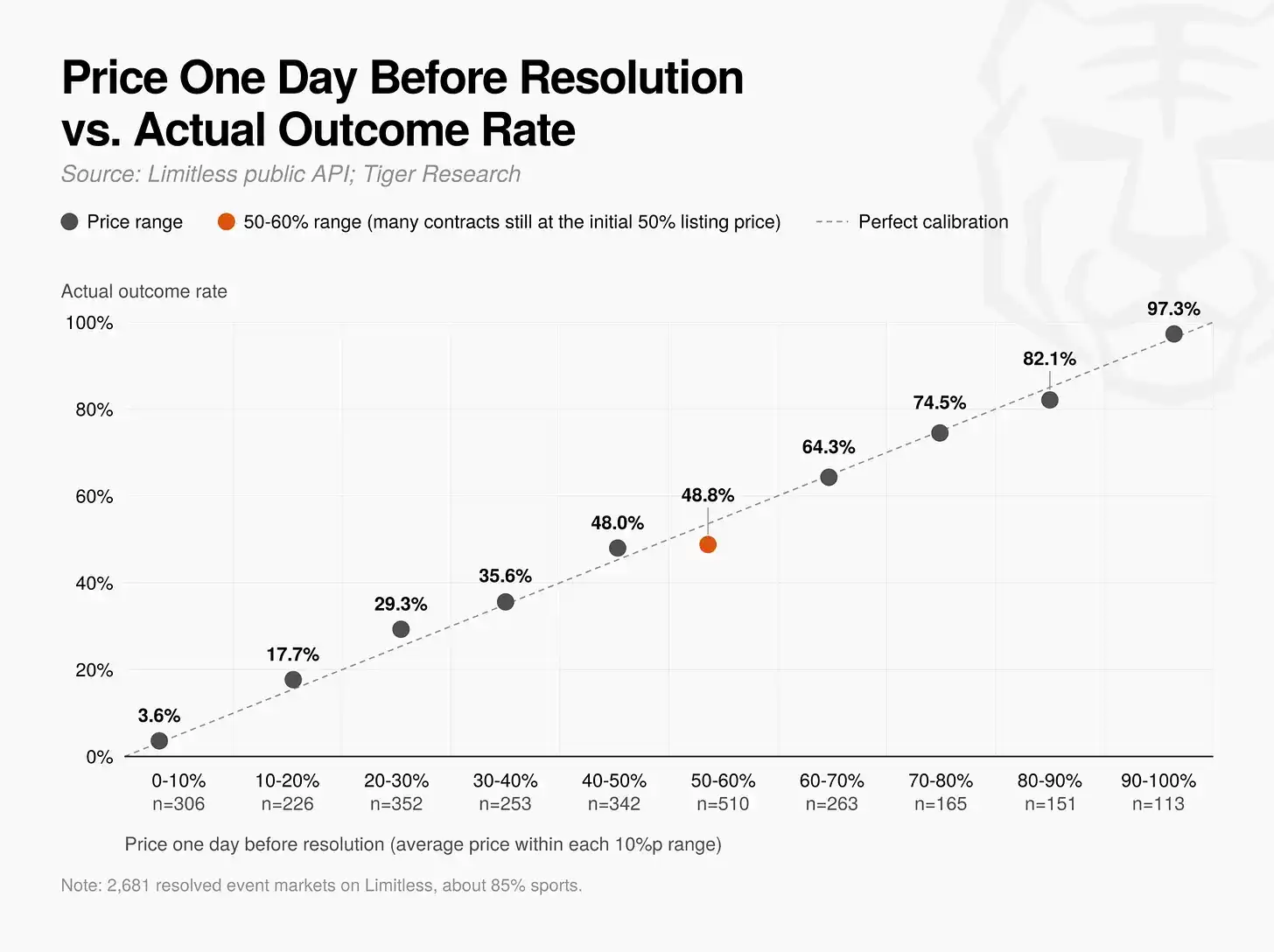
To test whether market prices matched real-world probabilities, Tiger Research examined 2,681 settled contracts, about 85% of them sports markets, and compared prices one day before settlement with final outcomes.
Across 10 price buckets, 9 showed a gap of no more than 4 percentage points between realized frequency and market pricing. Among 165 contracts priced in the 70% to 80% range one day before settlement, the realized payout rate was 74.5%. Among 113 contracts priced above 90%, the realized payout rate was 97.3%.
The one bucket with a larger error was 50% to 60%, where the realized rate was 48.8%. Tiger Research says the main reason was poor liquidity: about one-third of the contracts in that range, mostly sports events, were still sitting at their initial 50% listing price even one day before settlement. Excluding low-liquidity, low-attention sports contracts, the report says, prediction-market prices can reflect real event probabilities with high precision.
Response to new information
Tiger Research also tracked the price path of contracts tied to a Federal Reserve rate decision. The report says the probability of no rate change was about 70% in mid-August. By late August and early September, after major indicators were released, that probability had fallen below 50%. After inflation data on Sept. 11, the probability dropped to around 20%, then moved into the 10% range on the day before the decision.
At the same time, the probability of a 25-basis-point hike rose to 86% to 89% on the day of the decision, close to the roughly 90% implied by CME FedWatch federal funds futures. Tiger Research says similar real-time reactions were visible in Limitless markets tied to other major central bank decisions.
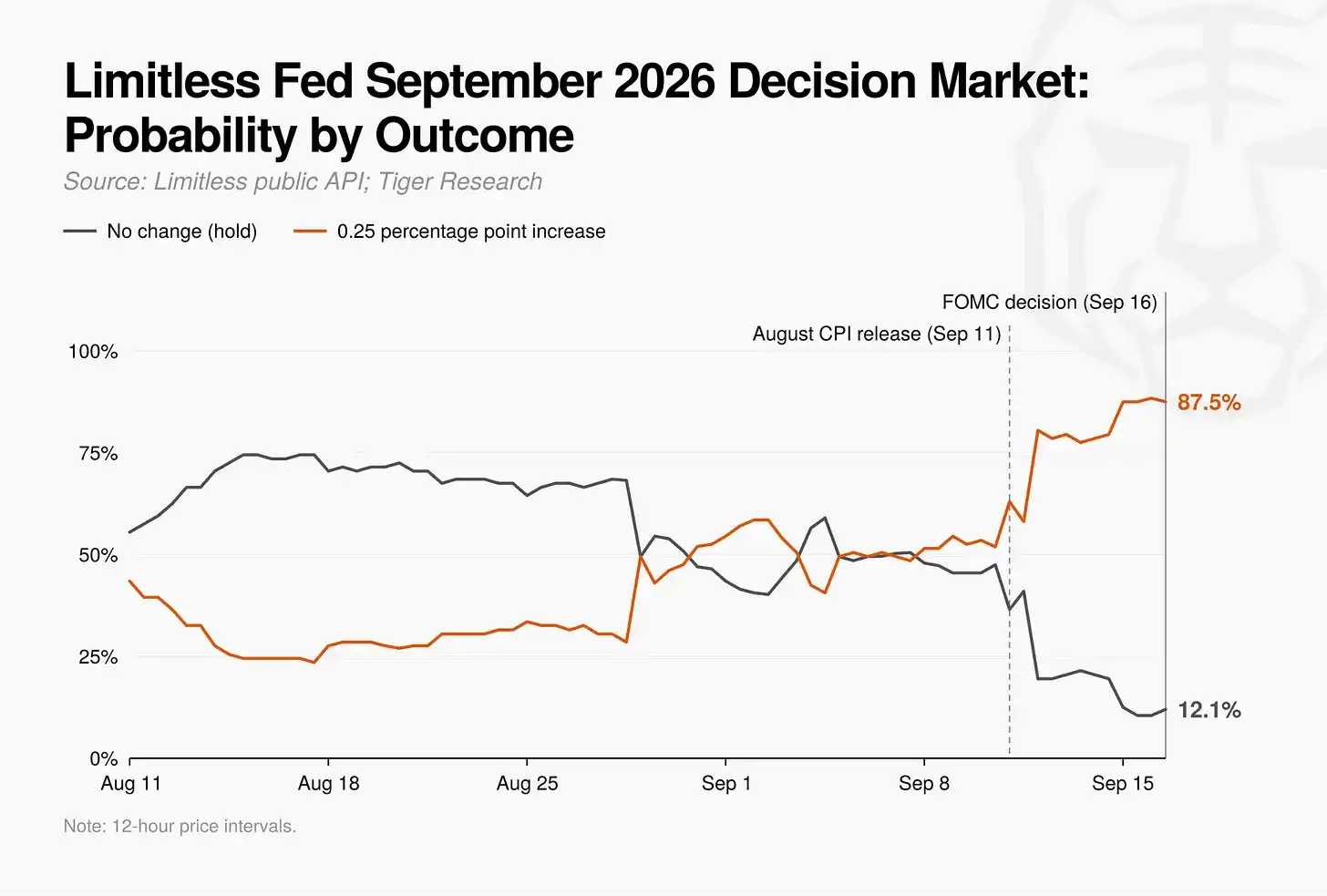
On that basis, the report says current on-chain prediction platforms already meet the timeliness and accuracy needed for high-quality data production.
Regulation and liquidity remain the main constraints
Tiger Research closes by saying the main value of prediction markets is not speculation or trading profit, but the probability data they generate. Drawing on academic work and its own analysis, the firm says prediction markets can outperform traditional surveys and expert forecasts in some settings, or at least serve as a useful complement, in elections, macro indicators and corporate expectations. It says the adoption of these data by major financial media and market infrastructure providers reflects that practical value.
The report also says that in many Asian countries and other regions, prediction markets are still commonly treated as gambling. It notes that platforms such as Limitless already list contracts tied to major regional policy and economic events, including Bank of Korea and Bank of Japan rate decisions, but liquidity in those markets remains weak.
Tiger Research says three steps are needed if prediction markets are to become trusted decision infrastructure on a broader global basis, including in Asia:
- Use market design to reduce price distortion and guard against manipulation, while improving liquidity in major macro and political contracts and expanding the base of rational traders.
- Engage regulators directly and work to change the policy view of prediction markets, building cooperative frameworks with regulators in major Asian economies so that these markets are seen as tools for aggregating collective information rather than only as targets for restriction.
- Keep data transparent and open, publish regular accuracy metrics and time-series datasets, and support research by specialist groups such as Limitless Research so that academics, media organizations and policy institutions can access the data and evaluate it on evidence.
The report’s final point is that prediction markets are at an inflection point. In its view, they are moving from pure trading venues toward the role of next-generation data infrastructure. If they can keep producing transparent, verifiable, real-time probability data on policy and economic events around the world, Tiger Research says, they can become a practical decision tool in uncertain environments.