

Prediction markets move into the mainstream
Prediction markets have become a mainstream industry after spending years as a niche concept, Tiger Research said in a new report. The firm wrote that monthly trading volume now exceeds $14 billion, while major platforms carry a combined valuation of roughly $40 billion.
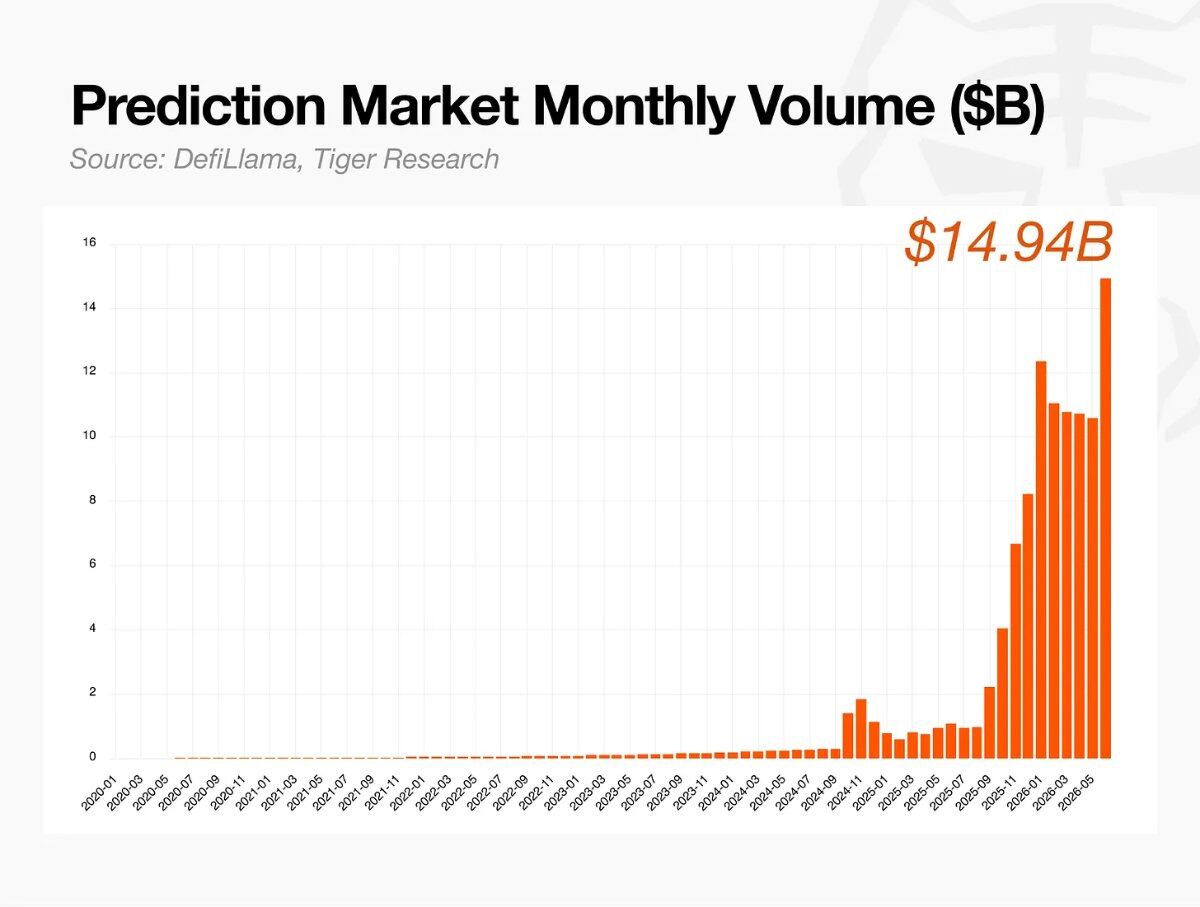
Tiger Research also pointed to Meta’s reported push into the sector as evidence that the business model is no longer experimental. The New York Times recently reported that Mark Zuckerberg is personally leading development of a prediction market app called Arena. In Tiger Research’s view, that level of commitment from a large technology company shows the category has matured into a validated commercial market.
From political betting to academic research
The report says prediction markets long predate crypto. Before blockchain widened access and helped turn the model into an industry, similar systems had already been used informally in academia and finance for decades.
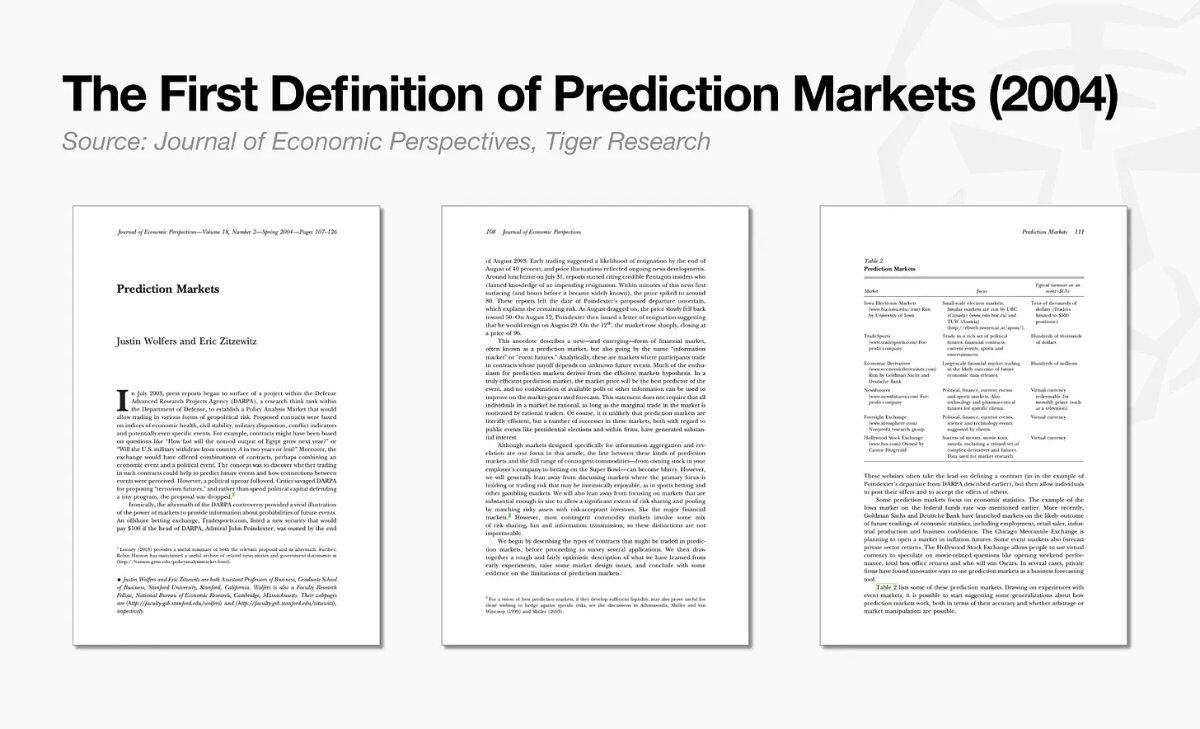
The label itself came later than the practice. By the 1980s, similar mechanisms were described as information markets or decision markets, and Tiger Research said the term “prediction market” was only fixed in place by a 2004 economics paper. The practice, though, goes back much earlier. In 18th-century London coffeehouses, people wagered on parliamentary scandals and changes in prime ministers. In 19th-century New York, informal futures markets near Wall Street were active around US presidential election outcomes.
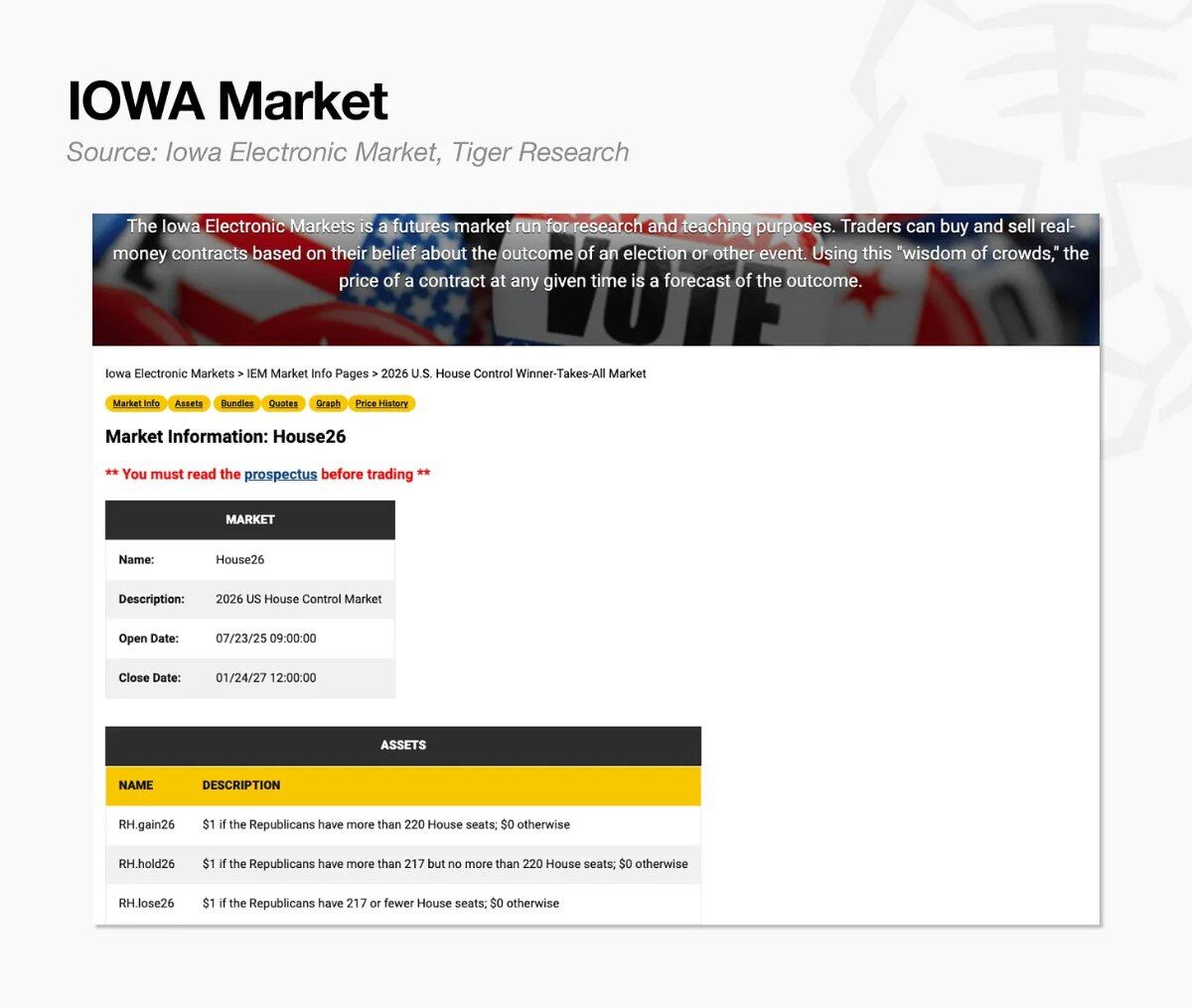
On the academic side, the report traces the starting point to 1988, when three economists at the University of Iowa built a market to let participants trade election outcomes directly after polling failed to predict Jesse Jackson’s win in the Michigan primary. That project became the Iowa Electronic Markets, or IEM. In 1992 and 1993, the Commodity Futures Trading Commission approved IEM for research use, and anyone could participate with $5. From 1988 to 2004, Tiger Research said, IEM outperformed traditional polls about three-quarters of the time, even though no regulatory framework yet existed for it to operate as a public market.
How binary contracts produce live probabilities
Tiger Research compares early prediction markets with binary options in traditional finance. The structure is the same: a contract pays $1 if an event happens and $0 if it does not.
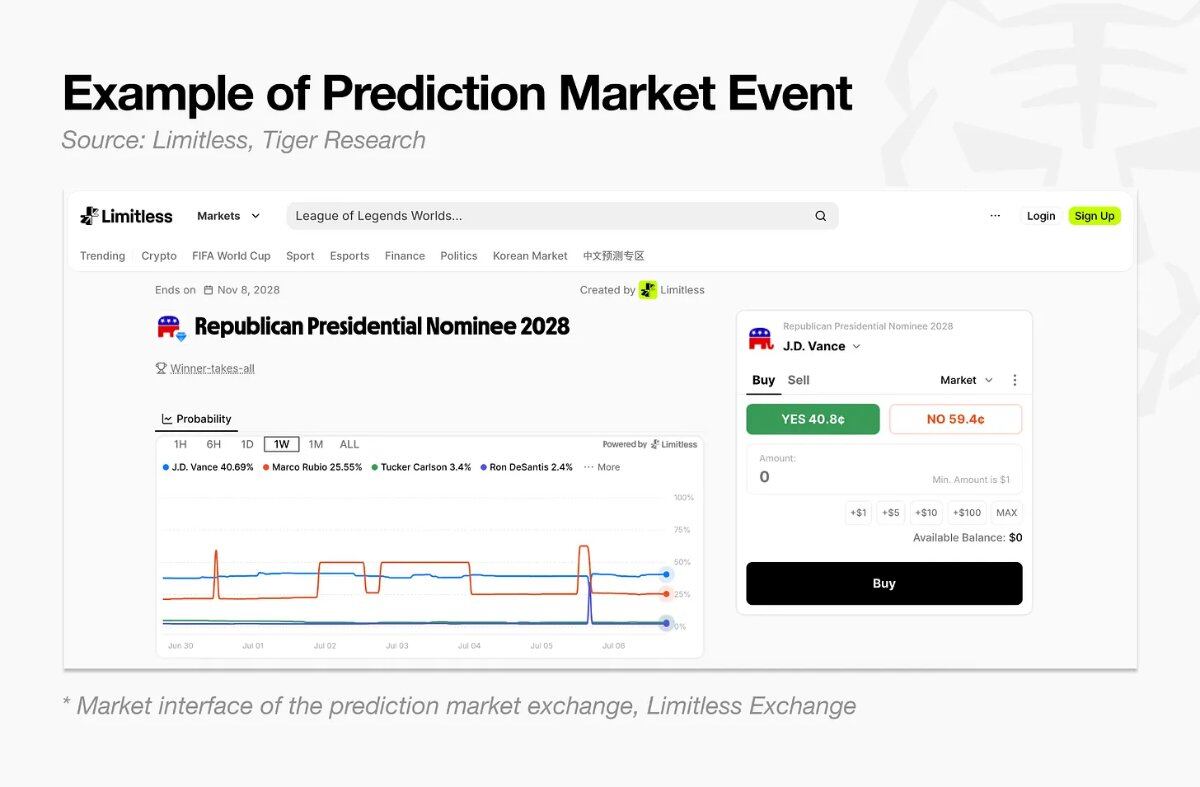
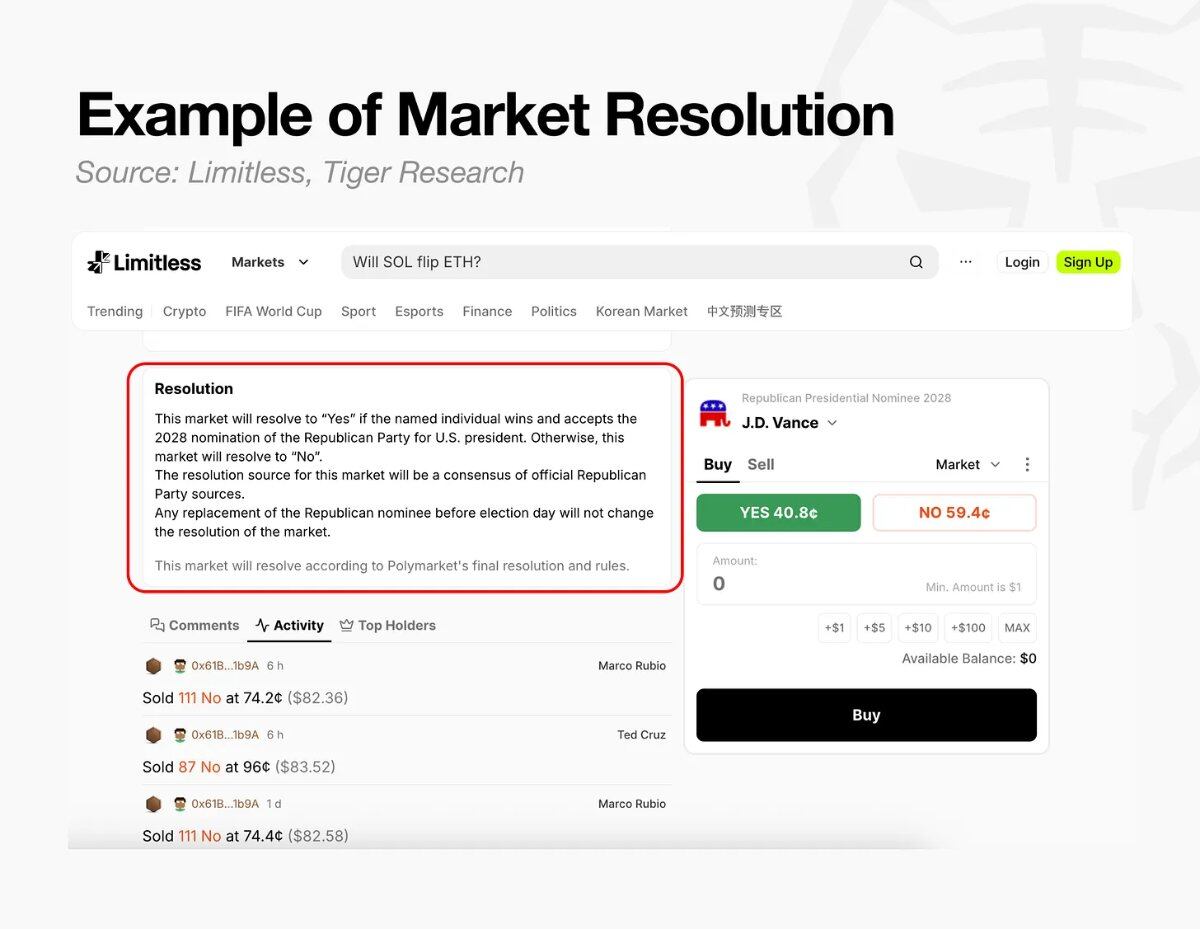
That remains the foundation of prediction market trading today. The report gives the example of whether J.D. Vance will become the Republican presidential nominee in 2028. If Vance is confirmed as the nominee, the “yes” side pays $1. If not, the “no” side pays $1. Read this way, $1 equals 100%, so a contract trading at 40 cents implies a 40% probability, excluding bid-ask spreads and trading costs.
Prices are formed through an order book rather than by a central authority. Buy orders and sell orders stack at different prices, and trades execute when those orders meet. Traders can also exit positions before expiry to lock in gains or cut losses.
The report notes that binary options also reached regulated exchanges in the US. The American Stock Exchange launched fixed return options in 2007, and the Chicago Board Options Exchange listed S&P 500-based binary options in 2008. Still, repeated fraud on offshore platforms led many major jurisdictions to ban sales of such products to retail investors between 2017 and 2021.
Oracles handle final settlement
Tiger Research describes prediction markets as information systems that compress many individual views into a single price, then settle the result according to pre-set rules once the event is over. No matter how precise trading appears beforehand, someone still has to determine whether the final answer is yes or no. That is the job of the oracle.
The report breaks oracle systems into two models. In a decentralized model, a proposer posts collateral and submits a proposed outcome. If no one disputes it within the specified period, that outcome becomes final. If there is a challenge, the process moves into re-proposal, and only further disputes push it to a vote. In a centralized model, the exchange sets the decision rules in advance and applies official results directly once the event ends.
Limitless is cited as one example. After the market deadline passes, the platform finalizes the result under pre-defined rules. Oracle services report real-world outcomes to the blockchain: most markets tied to crypto prices or stocks are reported automatically through Pyth Network, while custom sports or political markets are decided manually by the operating team within 24 to 72 hours.
“Skin in the game” as an information filter
Tiger Research argues that prediction markets differ from polling and expert forecasts because participants must put capital behind their views. A wrong position loses money. That direct cost, the firm said, makes market prices more credible as a form of information.
The report points to several examples. One is a February 2026 study by a Federal Reserve economist, which said prediction-market rate expectations ahead of Federal Open Market Committee meetings had been statistically close to actual outcomes since 2022 and outperformed fed funds futures and the Bloomberg consensus. Another is South Korea’s June 2026 local elections, where Polymarket correctly called 14 winners out of 16 major cities and provinces. Tiger Research also cited a March 2026 episode involving a cap on stablecoin interest income, when a prediction market priced the probability of a Coinbase share-price decline at 97.6%.
Academic work is included as well. A 2015 study of internal prediction markets at companies such as Google and Ford found forecast error fell by as much as 25% compared with official forecasting models, according to the report.
Tiger Research does not present the market as immune to weakness. It cites a January 2026 case in Venezuela in which someone used confidential information for insider trading. The report says the episode exposed a real vulnerability, but also showed that attempts to distort prices can be detected and prosecuted as crimes.
The US moves toward finance while much of Asia stays with gambling rules
Regulatory treatment has diverged sharply by region, Tiger Research said. In the US, much of the uncertainty was addressed through litigation. The CFTC had tried to classify Kalshi’s election contracts as gambling and sanction the platform, but a court ruled that election prediction was not a game of chance and that the regulator had no authority to ban it. Tiger Research said that decision changed the regulatory posture and became a key catalyst for traditional financial institutions such as ICE, Robinhood, and CME to enter the sector.
Across major Asian jurisdictions, by contrast, regulators still tend to treat the binary settlement structure of prediction markets as equivalent to conventional gambling. The dominant policy lens remains gambling control and public order rather than financial policy, the report said. It added that prediction markets still sit outside formal policy debate in most of the region, with India and Indonesia named as exceptions.
Three risks Tiger Research sees for Asia
Tiger Research argues that current policy approaches in major Asian jurisdictions are producing a widening gap with the global direction of travel, and it lists three main problems.
Regulatory arbitrage
Because prediction markets run on borderless digital networks, blocking platforms or restricting local users does not remove demand, the report says. Users instead migrate to offshore venues with less oversight and more risk. That sends capital out of the jurisdiction and strips regulators of market visibility and related tax revenue.
Loss of information sovereignty
The report frames prediction markets as advanced information infrastructure that converts complex social questions into numerical estimates. It says recent elections in Asia showed that prediction markets can read public sentiment faster and more accurately than traditional polls. If those systems remain outside domestic regulatory structures, the most revealing local sentiment data accumulates on foreign servers, leaving overseas media and institutions with a clearer picture of local society than domestic analysts.
Weak user protection
Tiger Research says users are left in a blind spot when policymakers simply deny the market without a proper prior discussion or institutional framework. In that setting, participants get pushed outside the system without meaningful safeguards.
The debate, Tiger Research says, should shift to responsible integration
The report says the central question is no longer how to block prediction markets, but how to use their data responsibly inside a formal system. Research and policy discussion on that point remain limited, according to Tiger Research.
It names Limitless Research as one participant working to fill that gap by processing prediction data from Asian markets including South Korea and Japan into information assets. The report ends by arguing that Asia does not need stricter enforcement as much as it needs forward-looking discussion, transparent oversight, and a formal framework that can keep the resulting data within domestic institutional systems.