

Every bear market quietly reshapes the listing logic of centralized exchanges (CEX). When liquidity tightens and retail enthusiasm cools, each exchange's listing decision becomes more deliberate and thus carries greater signaling value. We systematically tracked new spot listings on six major exchanges—Coinbase, Binance Spot, ByBit, OKX, Bithumb, Upbit—plus Binance Perpetual, from 2026 to mid-May. The dataset comprises 207 listing records covering 92 unique tokens. The data clearly reveals one core fact: listing is a highly structured path of verification and liquidity transfer.
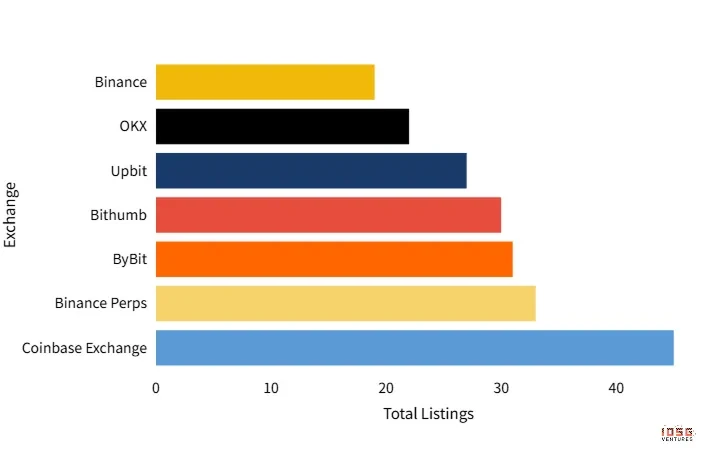
In terms of volume, the exchanges show clear stratification. Coinbase led with 45 new listings, followed by Binance Perps (33) and ByBit (31). Bithumb (30) and Upbit (27) formed the second tier, while OKX added 22 and Binance Spot only 19—the fewest among all observed platforms. January was the peak listing month, with Binance Perps launching 15 tokens and ByBit 14 in a single month. From February, the pace slowed markedly, with monthly averages dropping to 5-8, entering a more cautious selection phase. Coinbase, however, displayed a counter-cyclical rhythm, with two concentrated waves (13 tokens each) in February and April, illustrating its independent and swift decision-making.
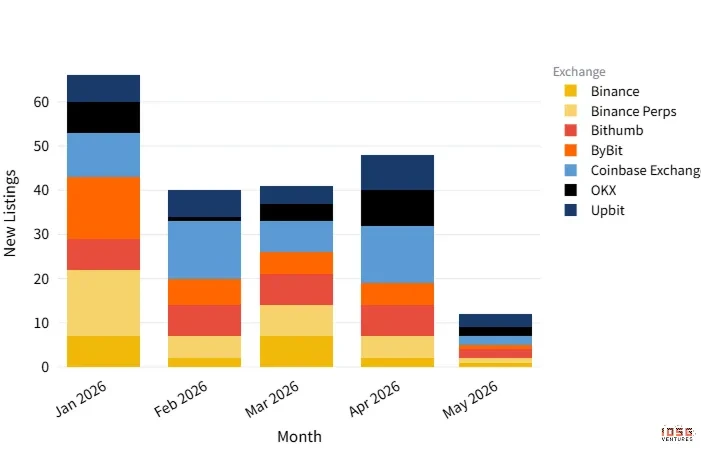
Exchange Role Differentiation: First Listing, Verification, and End-of-Chain Bag-Holding
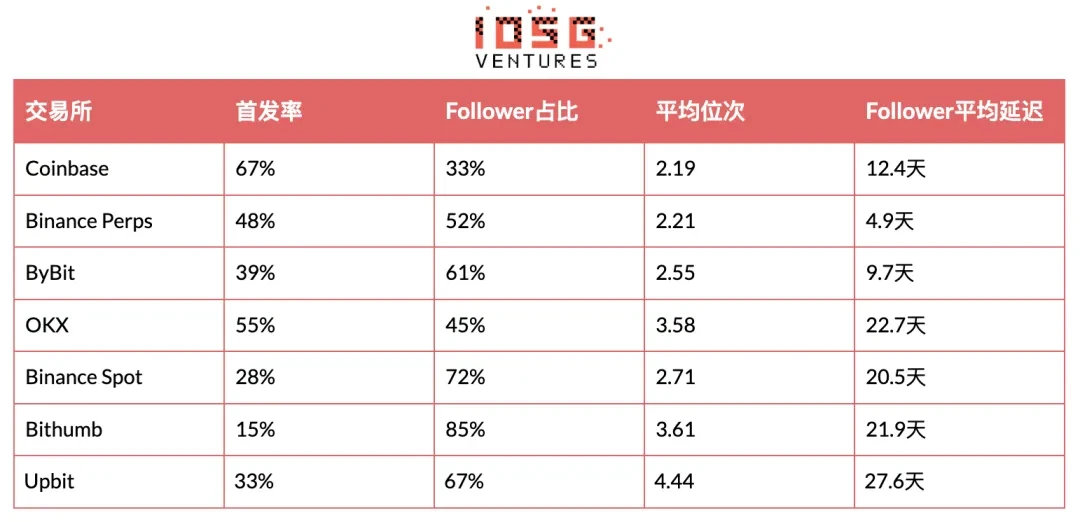
Among tokens listed on multiple exchanges, a clear sequence emerges. We define the first exchange as the "first listing" and the rest as "followers." Coinbase stood out as the dominant first-listing venue in 2026, with 67% of tokens making their debut there among the tracked exchanges, serving as the primary price-discovery arena. ByBit had a 39% first-listing rate and Binance Perps 48%; these three frequently launched the same token within the same week, forming the first tier for new projects.
Korean exchanges (Bithumb and Upbit) systematically sit at the end of the listing chain. Bithumb had an 85% follower ratio, while Upbit averaged a sequencing rank of 4.44 and had a high probability of being the last to list, with an average delay of about 28 days from the first listing. This is closely tied to longer regulatory review processes and a local preference for introducing tokens only after broad consensus has formed. Within Binance, a clear funnel-like division of labor exists: Binance Perps acts as a first mover in about half of cases and, when following, does so with extreme speed (average 4.9 days), primarily to test liquidity and demand via the derivatives market. Binance Spot, in contrast, listed the fewest tokens (only 19) and had a 28% first-listing rate, clearly preferring to wait for sufficient market validation. OKX demonstrated strong independent selection ability with a 55% first-listing rate, yet maintained a restrained total of 22 listings and an average rank of 3.58, indicating high screening thresholds and a more cautious approach.
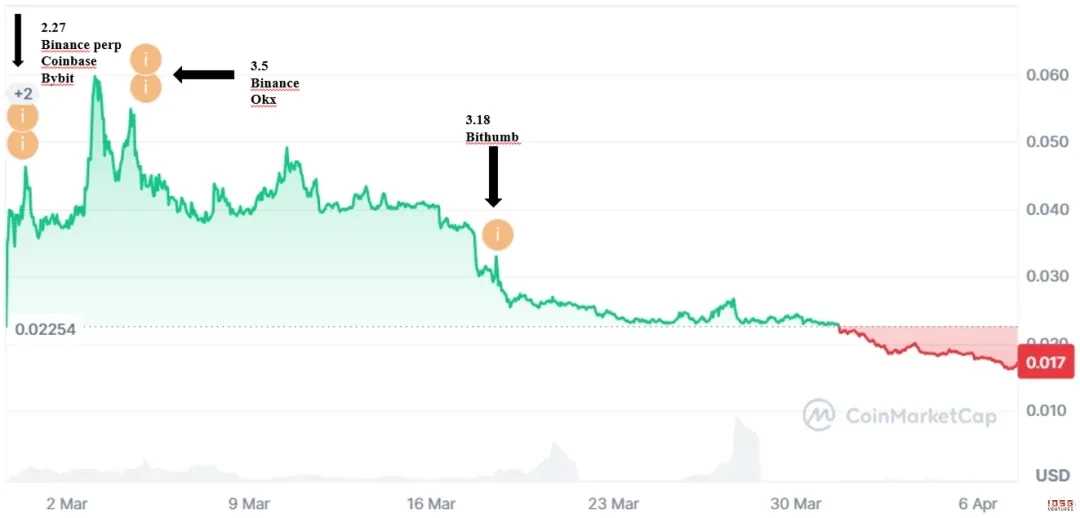
Case Study: ROBO's Complete Listing Path
On March 5, Binance Spot listed ROBO, with the daily quote reaching $0.0493, which turned out to be the token's cycle high. When OKX entered later, the opening price was already below Binance Spot's price. Bithumb listed ROBO on March 18 at $0.0303, triggering a brief spike but then a continuous decline to below the first-listing price. From first listing to Bithumb, ROBO traversed the entire 2026 listing path in just 20 days: Binance Perps, Coinbase, and ByBit first → OKX and Binance Spot confirming at the peak → Korean exchanges taking over at the tail. In the first five months of 2026, 28 tokens achieved listings on three or more exchanges, and their sequencing patterns were highly consistent with the ROBO model. The path is stable and predictable, reflecting differing risk appetites across exchanges.
Binance Perps Screening Logic
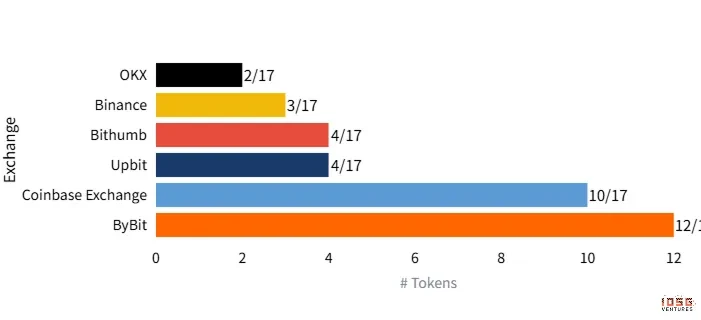
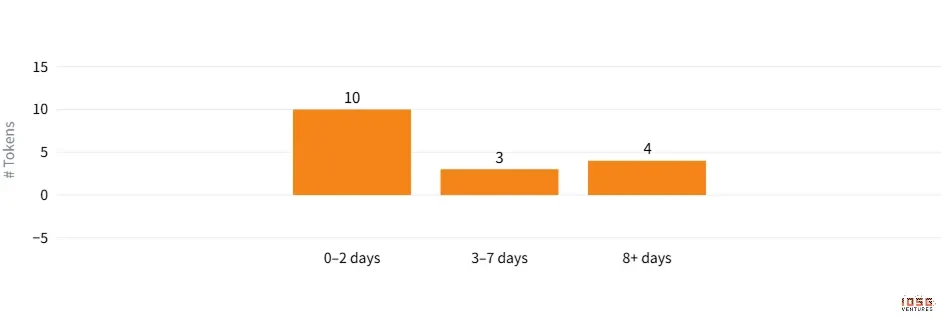
As a key derivatives gateway, Binance Perps' listing decisions directly influence the flow of leveraged capital. Of the 33 tokens that entered Binance Perps, 17 were first listed on other spot exchanges before being added. Coinbase and ByBit serve as the strongest leading signals: 75% of tokens listed on Coinbase eventually entered Binance Perps, and 70% for ByBit. When a token simultaneously gains support from Coinbase and ByBit and maintains relatively stable price performance, it is highly likely to land on Binance Perps within a week—one of the most potent and observable signals in the current market.
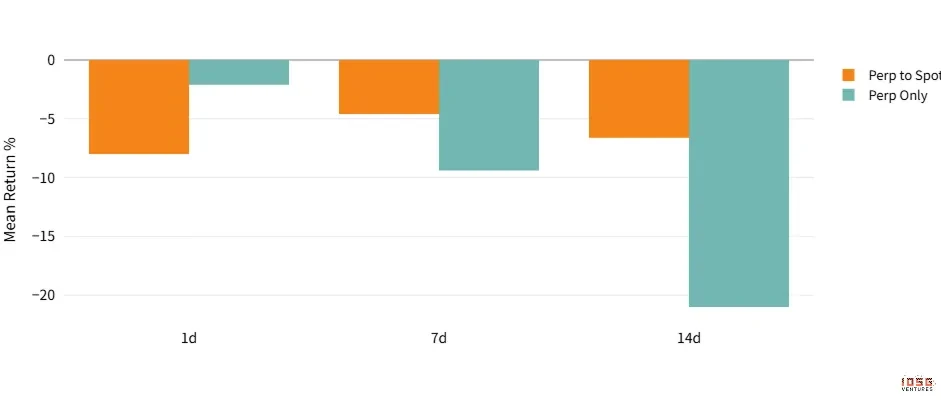
Tokens listed on Coinbase and ByBit usually open with a fully diluted valuation (FDV) above $100 million, so FDV itself is not a differentiating factor. The true determinant for Perps inclusion is post-listing price performance. Data shows that tokens that eventually converted to Binance Spot (the Converted group) had a 7-day return of -4.6% and a 14-day return of -6.6% after Perps listing, while the Perp-Only group registered -9.4% at 7 days and a steep -21.0% at 14 days. Although both groups displayed negative returns under bear-market conditions, the Converted group's significantly stronger price maintenance indicates that Binance factors in "sustainability" during the Perps phase.
Entry Price Position: First-Mover Advantage and Tail-End Premium
Price discovery occurs primarily in the first-listing window. When ByBit and Coinbase act as followers, their entry prices are roughly equal to or slightly below the first-listing price, demonstrating rapid price convergence among first-tier exchanges. Binance Perps, when following, shows an average price 11.5% above the first-listing price, yet thanks to its extremely fast follow-up (4.9 days), it still occupies a relatively early position. Binance Spot's Price Position is -10%, indicating a tendency to list after a price correction, giving users a relatively better entry price. Korean exchanges face the most unfavorable entry positions: Bithumb averages 19.4% above the first price, and Upbit jumps to 27.4%. With an average delay exceeding three weeks, users frequently buy at significantly elevated levels.
Return Structure: Early High Elasticity vs. Late-Stage Inefficiency
Under the 2026 bear market, post-listing price performance was generally weak, with no exchange averaging a positive 30-day return. The decline deepened from the 7-day to the 30-day mark, indicating that the downward trend after listing is persistent rather than a short-term fluctuation. New listings primarily served as liquidity release events—providing exit windows for early holders—rather than attracting sustained new capital inflows.
Although final 30-day returns were uniformly negative, the initial rebound peaks (Peak Return) displayed a markedly different distribution. First-listing exchanges held decisive advantages: ByBit averaged a peak of +86%, while Binance Perps posted the highest median at +49%. The first-tier group (ByBit, Coinbase, Binance Perps) captured the greatest price elasticity, granting early participants extremely high liquidity premiums. In contrast, late followers saw capped potential: Bithumb and Upbit peaks were compressed to around +35%, and OKX to just +25%. Due to delayed timing, buying pressure on these platforms mainly absorbed profit-taking rather than initiating new moves.
Combining Price Position, Peak Return, and Mean Return reveals that users on different exchanges face entirely different risk-return profiles. First-listing exchange (Coinbase/ByBit) users also suffer negative returns, but they enjoy the best cushion: with the lowest entry prices (-10% to -5.9%) and the market's highest peak amplitudes (average above +70%), absolute losses from the first-listing price remain relatively controllable, even if they fail to time the top perfectly. Korean exchange users, by contrast, face a classic "high entry + deep drawdown" scenario, with limited upside and wide-open downside, resulting in the deepest 30-day declines across the market. Binance Spot occupies a unique position: although its 30-day return is as low as -24.6%, its tendency to list after a 10% price correction means actual principal loss is smaller than the headline figure—a strategy of trading time for space, avoiding first-listing volatility but enduring a longer grinding downtrend.
Conclusion: Structured Path and Alpha Source
In the 2026 bear market, CEX listing logic is shifting from "traffic-driven" to "verification-driven." Exchanges are no longer simply chasing hot narratives but have built a structured screening and liquidity-release pathway through clear role division: Coinbase and ByBit act as early discoverers, Binance Perps provides rapid verification and liquidity testing, Binance Spot serves as the final confirmation checkpoint, and Korean exchanges offer exit liquidity at the tail. This path is not random but the result of rational gaming among participants. It offers quality projects a ladder from early exposure to mainstream recognition, while providing early investors and institutions with orderly exit windows.
In an environment of tightening liquidity, listing events function more as a redistribution of existing funds rather than catalysts for incremental growth. As macro conditions improve, this pathway may gradually shift from "defensive screening" to "offensive expansion," with higher first-listing premiums and shortened verification cycles. Regardless of market evolution, understanding and following this path cannot guarantee every listing succeeds, but it can significantly improve decision-making certainty. In crypto markets, information asymmetry is ever-present, and a structural understanding of the listing chain is one of the few sustainable alpha sources.