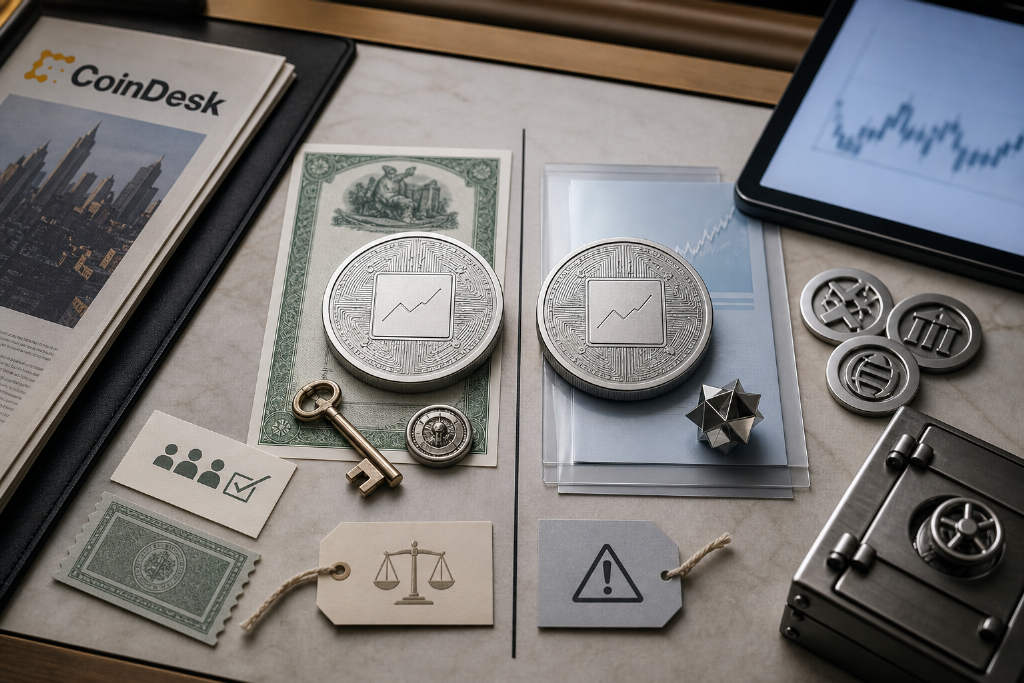
CoinDesk columnist Joshua DeVos said in this week’s Crypto Long & Short that demand for tokenized equities is rising quickly, with perpetual futures tied to the segment growing from $16 billion to more than $590 billion in a single year. But the sharp increase in headline volume does not answer what he framed as the more important question: what sits underneath the trade. DeVos argued that two tokens can trade under the same ticker while giving holders very different rights. In practice, the legal and economic structure matters more than the label on the product. Whether a token represents real ownership or a synthetic claim determines the risk profile and the protections a holder actually receives. His point was that headline growth alone does not tell investors what they truly own when they buy a tokenized equity product.
In this week’s Crypto Long & Short, CoinDesk’s Joshua DeVos wrote that demand for tokenized equities is accelerating rapidly. He pointed to perpetual futures in the category, which grew from $16 billion to more than $590 billion in a single year.
DeVos said the surge in headline growth masks the question that matters most: the model underneath the trade.
Same ticker, different rights
He wrote that two tokens can trade under the same ticker while granting entirely different rights to holders.
That underlying structure, he said, is what determines the risks and protections a holder actually has. The distinction turns on whether the token conveys real ownership or a synthetic claim.
Structure, not just growth, is the key issue
In DeVos’ framing, the central issue in tokenized equities is not only how fast demand is growing, or whether products appear similar on the surface. What matters is the structure beneath them. A token tied to real ownership and a token offering synthetic exposure may trade under the same market label, but they do not give holders the same legal or economic position.
This article was originally published by Bit.Fan. For more cryptocurrency news and market insights, visit www.bit.fan. Disclaimer:
The market information, project data, and third-party content displayed on this platform are for industry information sharing only and do not constitute any form of investment advice or return commitment.
Cryptocurrency trading carries high risks. Users should fully assess their risk tolerance and make independent decisions. All profits, losses, and legal responsibilities are borne by the users themselves.