

Tokenized stocks are taking shape as the next major battleground in real-world assets, or RWA, as growth in tokenized U.S. Treasuries starts to flatten. The source article argues that while tokenized Treasuries were the asset class that first pushed tokenization into the spotlight, tokenized equities are now expanding faster in both scale and market participation.
Written by 100y_eth
Translated by AididiaoJP
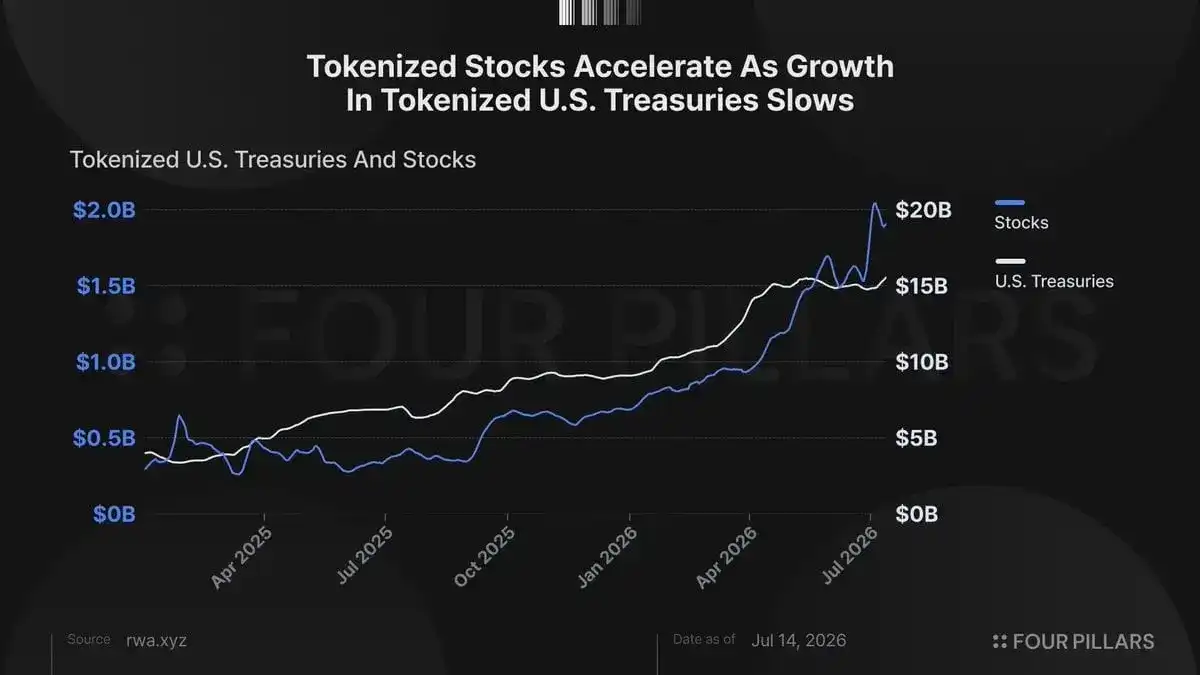
Tokenized Treasuries surged first, then slowed
The article says tokenized U.S. government debt grew quickly because of three factors: the perceived safety of U.S. sovereign debt, the relatively simple structure required to tokenize it, and the higher yields available at the time.
That market expanded from $701 million on Jan. 1, 2024 to more than $15 billion on April 17, 2026, when it crossed that threshold for the first time. The article places its compound annual growth rate at roughly 3.81x. After clearing $15 billion, though, the market remained around that level and growth slowed sharply. Since a large share of demand came from DeFi protocols and exchange margin use cases, the article says weaker recent market conditions made a stall in demand less surprising.
At the same time, tokenized stocks have been moving in the opposite direction. The market grew from $291 million on Jan. 1, 2025 to about $1.9 billion in roughly a year and a half, a 6.5x increase. The list of active or preparing participants is broad: Web3-native names such as Securitize and Ondo Global Markets, financial companies such as Robinhood and Coinbase, and core market infrastructure operators such as DTCC, the New York Stock Exchange and Nasdaq.
The SEC framework behind tokenized securities
The source article says the U.S. Securities and Exchange Commission released a statement in January this year laying out a classification framework for tokenized securities.
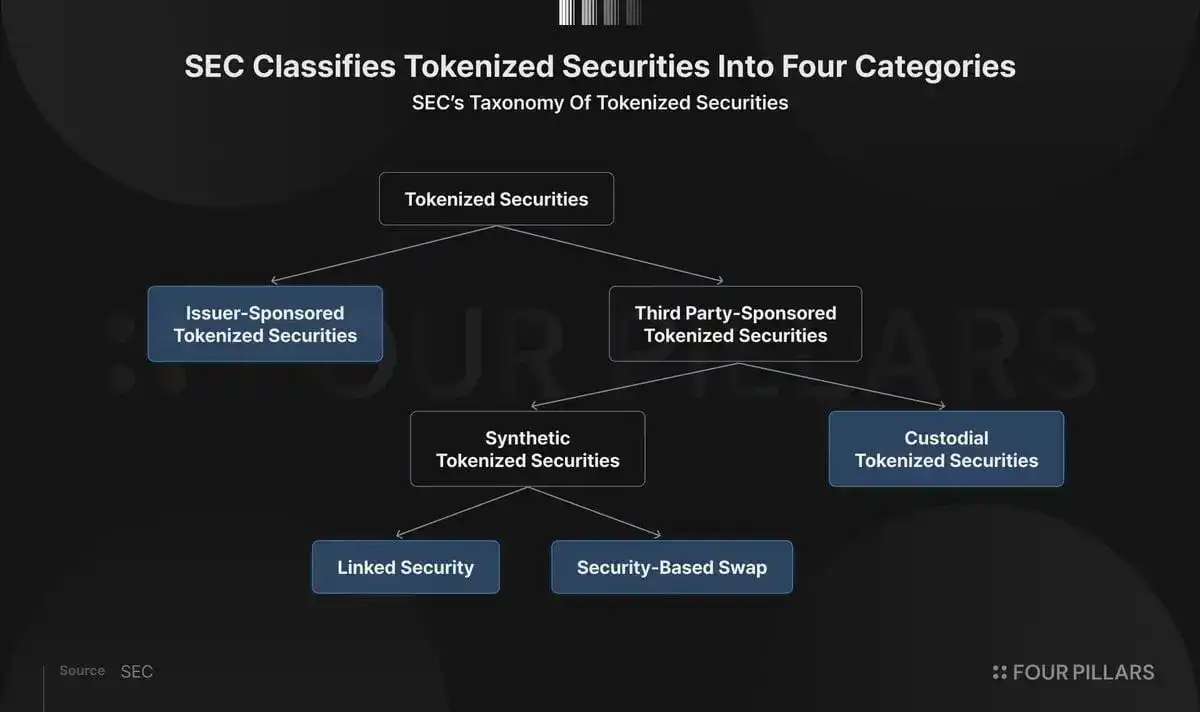
The first split is based on who conducts the tokenization. If the issuer of the security itself, or its designated agent, tokenizes the asset, the product falls under issuer-sponsored tokenized securities. If a third party does it, the product falls under third party-sponsored tokenized securities.
Third party-sponsored structures are then divided again. If the token represents the rights tied to the underlying security itself, the article describes it as a custodial tokenized security. If the issuer creates a separate tokenized product whose value is tied only to the underlying security’s price, yield, corporate events or other characteristics, it is treated as a synthetic tokenized security.
Synthetic tokenized securities then branch into two more categories. A separate tokenized security issued by a third party, such as a debt security, is classified as a linked security. A derivatives contract that provides exposure to the underlying stock is classified as a security-based swap.
Applied to tokenized stocks, the article groups the market into four structures:
- Issuer-sponsored tokenized securities: the stock issuer or its designated agent, such as a transfer agent, directly tokenizes the shares and connects blockchain or other distributed ledger technology systems to the official shareholder register. The token can carry the full set of shareholder rights, including ownership, but compliance requirements are strict and usability is narrower. The article lists Securitize, Superstate and Figure as key examples.
- Custodial tokenized securities: a third party tokenizes security entitlements held at a depository institution such as DTCC or at a broker. These products can also carry the relevant rights, but they remain heavily dependent on the existing stock market plumbing and ownership stays indirect. DTCC is listed as the main example, while Ondo recently used the same model to tokenize IVV and MU.
- Linked securities: a third party issues and tokenizes an independent security, typically a debt instrument, backed by the underlying stock. Holders get price exposure rather than the full bundle of shareholder rights. The article points to Ondo, xStocks and Robinhood Stock Tokens.
- Security-based swaps: a third party issues a derivatives contract that creates synthetic exposure to the underlying stock, then tokenizes that contract. As with linked securities, users receive price-related exposure without other shareholder rights. The article says Robinhood Classic Stock Tokens are the main case in this category.
Securitize and the direct-tokenization route
Securitize is described as the largest tokenization platform by market share, with $5.1 billion in tokenized RWA. Its flagship product is BlackRock’s money market fund BUIDL. The article says Securitize holds SEC-registered broker-dealer, transfer agent and ATS licenses, and uses that regulatory base to pursue direct tokenized securities, which fall into the issuer-sponsored category.
That same model has now been extended to tokenized stocks. When Securitize took its own stock public through a SPAC listing under the ticker SECZ, it used its in-house setup to tokenize and issue $180 million worth of SECZ onchain.
The appeal is straightforward. Existing shares can be tokenized as they are while staying within current securities law. Investors first use DRS to convert shares previously held through DTCC or a broker into directly registered ownership. Securitize then tokenizes those shares in its role as transfer agent. The tokenized shares and the existing shares share the same CUSIP, and the token inherits not just economic rights but voting rights and claims on residual assets in bankruptcy as well.
That same design also brings constraints. Since the tokenized stock is still the same stock in another form, compliance requirements remain tight and onchain use is limited. Unlike stock tokens issued by Ondo or xStocks, Securitize’s tokens can move only between whitelisted wallets that have passed KYC and AML checks, and onchain interaction is restricted to a limited set of smart contracts approved in advance by the team.
The article says Securitize enforces those requirements through DS Protocol, a suite of smart contracts that applies compliance rules across issuance, transfer, use, voting and dividend distribution. It also notes that Superstate and Figure use broadly similar approaches. The difference lies in what gets tokenized: Securitize and Superstate tokenize shares identical to the existing stock through the DRS system, while Figure issues a separate blockchain-native class of shares and tokenizes that class.
Ondo and xStocks focus on broader access
Ondo and xStocks use a different structure. When a user orders a stock token, an offshore SPV acquires the underlying shares and then issues a tokenized debt security backed by those shares.
The article uses xStocks as the example. Its setup includes a Jersey-regulated SPV called Backed Assets (JE) Limited. When a user requests minting of a stock token, the SPV buys the underlying stock through U.S. broker Alpaca Securities and holds it in a segregated account with a regulated custodian. The SPV then issues a separate debt security backed by those shares and tokenizes that debt instrument before delivering it to the user.
Under the SEC framework described in the article, that structure is a linked security.
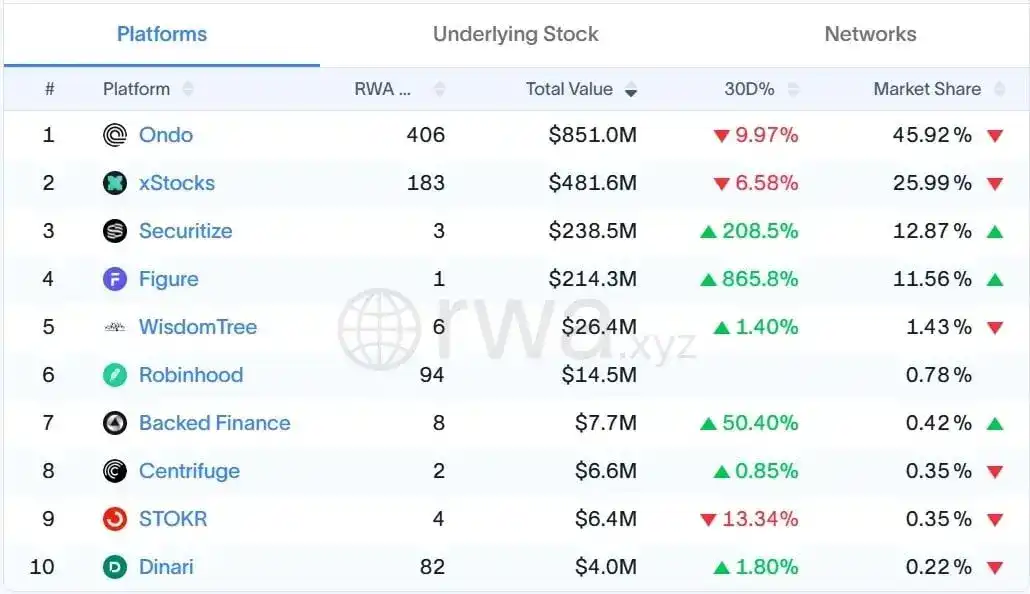
As of the figures cited in the article, Ondo has tokenized 406 different stocks worth about $851 million, while xStocks has tokenized 183 worth about $482 million. Their market shares in tokenized equities stand at 45.9% and 26.0%, placing them first and second.
The article attributes their growth to the broader accessibility that comes with this structure. Strictly speaking, these platforms are not tokenizing the stocks themselves. They are tokenizing third-party debt securities backed by those stocks. Compared with issuer-sponsored models that directly tokenize existing shares, this approach faces looser requirements in distribution and secondary trading, giving users greater freedom to trade and use the assets on centralized exchanges and in DeFi.
xStocks is used as the example again. Users can trade the tokens with a Web3 wallet through Jupiter DEX, or deposit them into lending protocols such as Kamino and borrow stablecoins against them as collateral.
The model has drawbacks. Even when the same stock sits underneath, tokens issued by different platforms are not interchangeable, which fragments liquidity. The article gives Nvidia as the example: Ondo issues NVDAon and xStocks issues NVDAx, and the two are not compatible. The other clear limitation is reliance on Regulation S, which means U.S. investors and U.S. persons cannot use the products.
To address those limits, Ondo recently acquired Oasis Pro, gaining broker-dealer, ATS and transfer agent licenses. The article says that has pushed Ondo toward a more compliance-friendly tokenization model. It has already used those licenses to tokenize IVV ETF shares and MU stock held in brokerage accounts through the custodial tokenized securities route, showing that more than one structure can coexist on the same platform.
Robinhood adds a new structure and its own chain
Robinhood has become another significant player in this market. The article says it had already offered tokenized stock exposure to European investors through Classic Stock Tokens, but that product falls under the security-based swap category in the SEC framework. Robinhood signs a derivatives contract with the user based on the stock, then tokenizes the contract into a receipt token. The whole system is closed and usable only inside the Robinhood app.
On July 1, 2026, Robinhood launched a new Stock Tokens service. According to the article, the structure now follows the linked security model, making it broadly similar to Ondo and xStocks, with many of the same strengths and limits.
Robinhood’s edge, in the article’s view, comes from product design and its large installed user base. Alongside Stock Tokens, the company launched the Robinhood Chain mainnet centered on those assets. U.S. users can also deposit stablecoins through the Robinhood app into Morpho on Robinhood Chain and earn 7% interest.
Even though Robinhood entered later than Ondo and xStocks, the article says its product iteration ability and ecosystem expansion potential could still help it scale quickly.
DTCC, NYSE and Nasdaq move tokenization into market infrastructure
Platforms and broker apps are not the only ones moving. The article points out that core settlement and trading infrastructure providers in the stock market are pushing into tokenization as well.
DTC, a DTCC subsidiary, has received a no-action letter from the SEC allowing some securities held at DTC to be tokenized on pre-approved blockchains. DTC expects the arrangement to improve collateral mobility, extend trading hours, raise operational and settlement efficiency, and enable programmability and real-time auditability. On July 15, DTCC also carried out limited tokenization of securities including QQQ and SPY in a live securities infrastructure environment, and completed trades and collateral transfers.
The New York Stock Exchange filed a proposed rule change with the SEC in April 2026 to support DTC’s tokenization pilot and allow stocks to settle in tokenized form. The article also says the NYSE is developing a new regulated exchange called Digital Trading Platform with the goal of enabling 24/7 trading in U.S. stocks and ETFs on blockchain infrastructure, while also supporting stablecoin funding. In March 2026, the NYSE signed a memorandum of understanding with Securitize and named it as the first potential digital transfer agent for that new platform.
Nasdaq received SEC approval in March 2026 for a rule change allowing stocks in DTC’s tokenization pilot to trade and settle in tokenized form. Nasdaq is also working with Payward, the parent company of Kraken, on a gateway service that would let issuers and investors move stocks between regulated Nasdaq markets and permissionless blockchain environments.
Coinbase has not launched yet, but its structure matters
Coinbase has not released a tokenized stock product so far, but the article says it has repeatedly signaled interest since last year. In February, Coinbase launched 5x24 trading in traditional stocks in the United States. At an event in June, it said tokenized stocks would be offered soon.
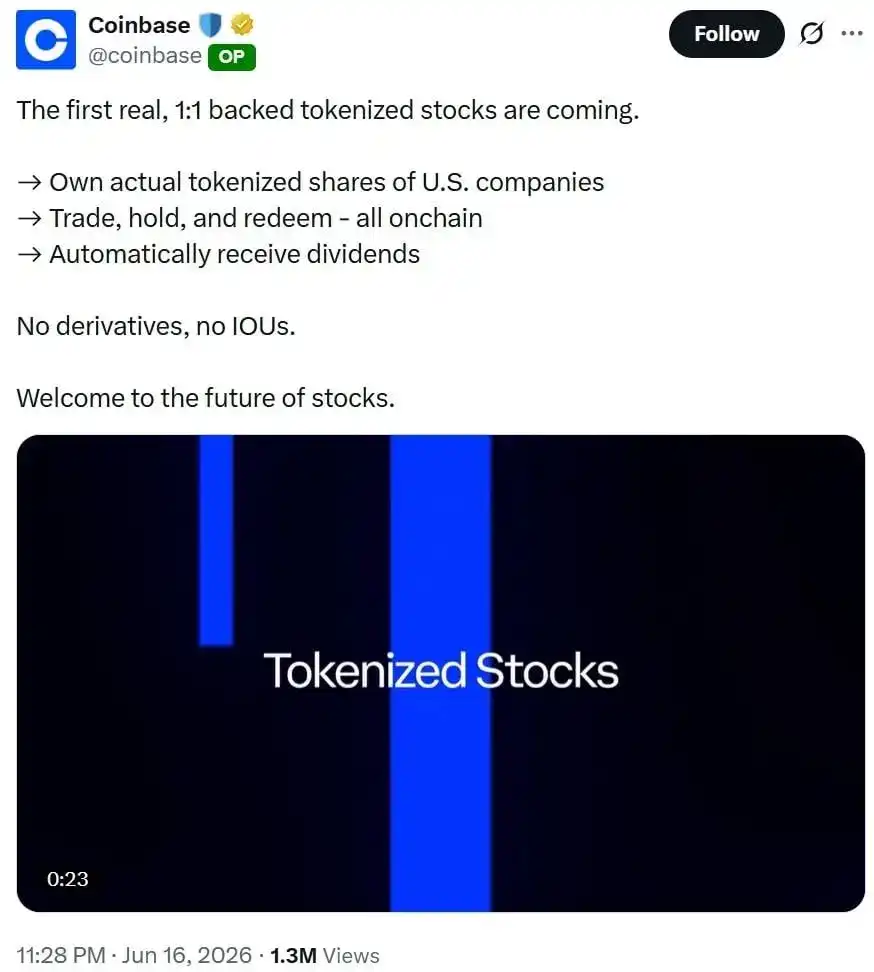
The key question is what structure Coinbase will choose. The article says Coinbase has stated that its service will provide 1:1 backing between tokens and real shares, and that shareholder rights will be included, though it has not disclosed the exact structure in detail. It also said the stock tokens will be usable onchain while remaining unavailable to U.S. customers.
That combination has drawn close attention. If Coinbase were to use an issuer-sponsored structure, the tokens would typically inherit the full set of shareholder rights and could be open to U.S. customers, but onchain utility would likely be narrower. A structure that combines broad onchain use with exclusion of U.S. customers looks more like a third-party model, especially linked securities. Which route Coinbase ultimately chooses, and how it may use its exchange infrastructure to grow a tokenized stock ecosystem, remains an open question in the article.
Different structures, one competitive arena
The article closes by describing a common target across financial services: a system in which any user can trade any type of asset, from anywhere and at any time, through a single backend and frontend. It argues that today’s financial system may look close to that goal on the surface, but most of the integration exists only at the frontend, while the backend remains fragmented.
Stocks are only one asset class within that larger picture. Robinhood, which came from stock trading, Coinbase, which came from crypto trading, traditional infrastructure groups such as DTCC, the NYSE and Nasdaq, and Web3-native firms such as Securitize, Ondo and xStocks are taking different paths, but they are all moving toward the same focal point: tokenized stocks.
The next areas to watch, according to the article, are how the United States and other jurisdictions classify tokenized stocks, how regulatory frameworks are implemented, and how those changes reshape competition across the field. It also raises a broader question: whether tokenized stocks can become the next major catalyst for RWA expansion after tokenized Treasuries.
The article also singles out South Korea as a market worth following. Retail trading activity there is high, but RWA development has been relatively slow, leaving open questions about how discussion around tokenized stocks will develop.