
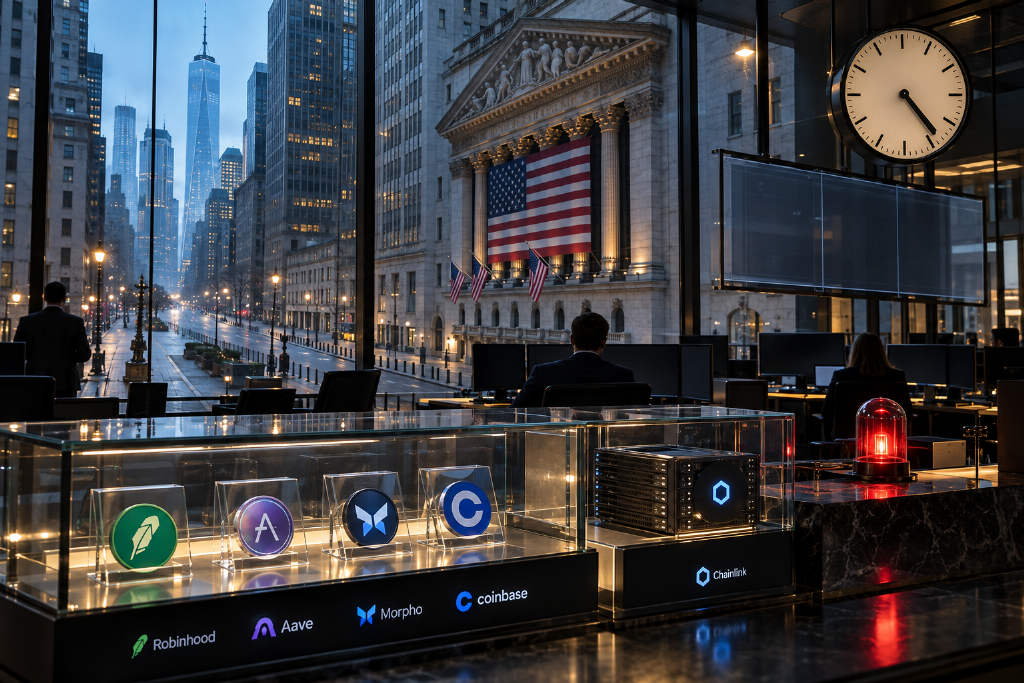
Frozen oracle prices during U.S. stock market closures are emerging as the central risk in lending markets built around tokenized equities. Onchain lending protocols run 24/7. Borrowing, interest accrual, and liquidations do not stop. The underlying shares on Nasdaq and the New York Stock Exchange do, and that leaves every protocol that accepts tokenized U.S. stocks as collateral exposed to a hard timing mismatch.

The piece was written by Prathik Desai for The Token Dispatch and translated by TechFlow. It argues that crypto lending protocols are moving into a business long controlled by traditional brokers, from Aave’s rollout of lending against Coinbase stock tokens to Morpho’s launch of tokenized stock collateral pools on Robinhood’s chain. For many overseas investors who cannot open compliant U.S. margin accounts, onchain collateralized loans give tokenized holdings such as Nvidia and Apple a form of liquidity utility that was previously unavailable.
Trading in stock tokens is already concentrated outside regular U.S. market hours
Robinhood’s stock tokens now trade around the clock. Even when Nasdaq is closed for the weekend, users can still buy and sell tokenized shares such as Apple or Coinbase on Robinhood’s chain.
From Sept. 24 to Oct. 23, about 60% of stock-token trading on Robinhood took place outside regular U.S. equity trading hours. Total volume reached $3.7 billion for the month, with roughly $2.2 billion traded outside the regular session and about $532 million changing hands on weekends and public holidays.
The lending use case only became fully real last week. On Oct. 22, Morpho launched a lending market on Robinhood’s chain, allowing holders to borrow stablecoins against tokenized stocks. Earlier, on Sept. 25, Aave had already introduced a similar product for Coinbase’s tokenized shares.
The article says simple ownership and trading are not enough to make tokenized stocks a superior way to hold equities. In most cases, they still do not carry full shareholder voting rights. What changes their financial profile is collateral utility. Once tokenized shares can be pledged for loans, they move from being static access products for global buyers to productive financial instruments onchain.
That is also where the main risk begins. Loans continue to run and accrue interest through the weekend, while the underlying stock prices do not update. The gap creates room for price-driven arbitrage and manipulation.
A new credit channel outside the broker model
Borrowing against stocks is one of the most basic functions attached to high-quality financial assets. In the U.S., that privilege has long sat with traditional brokerages. Opening a standard Reg T margin account usually requires a $2,000 minimum, and investors can typically borrow up to half the value of their stock holdings. Charles Schwab’s pledged asset line, or PAL, starts at $100,000, with an annual borrowing rate of about 8.27%.
All of these products share the same premise: the lender must custody the collateral, and the broker decides whether the client qualifies for credit.
Outside the U.S., that framework often breaks down. The article points to India, where the Reserve Bank of India’s Liberalised Remittance Scheme restricts residents from speculative trading overseas. Vested Finance, a popular app for Indians buying U.S. stocks, supports only cash accounts. Interactive Brokers’ India unit also bars local residents from using margin products in foreign markets.
That leaves investors in an odd position. Someone in India may hold $20,000 worth of Nvidia shares through those channels and still be unable to borrow against them. The same stock becomes a less useful asset once it sits in the hands of an offshore investor.
The article notes that the picture is not uniform everywhere. Interactive Brokers serves clients across many countries and regions, and in the third quarter of 2026 it generated an average 4.25% return from its margin lending business. In Nigeria, retail investing app Trove began offering 2x buying power for U.S. stock trading in August.
Still, those services usually come with high minimums, paperwork, and centralized discretion. Tokenization changes the control layer. Once the collateral sits in a user’s own wallet, any decentralized lending protocol that accepts the token can provide liquidity against it.
Haircuts and liquidation thresholds vary sharply across venues
How much a user can borrow depends on the haircut and liquidation settings chosen by each platform.
Kraken began accepting 10 xStocks as futures and margin collateral on July 3. Its framework is tiered by volatility. SPYx, which tracks an index, gets a 10% haircut. Single-name blue chips such as Nvidia get a 20% haircut. More volatile names, including Robinhood’s own stock, get a 30% haircut.
On Aave, borrowers can pledge seven Coinbase stock tokens to borrow USDC. Microsoft can support borrowing up to 79% of market value, Nvidia 70%, and Tesla and Meta 65%. The article notes that on Aave the borrowing cap often sits close to the liquidation line, which means users borrowing at the maximum start near the edge of liquidation.
Paboxo joined Robinhood’s chain on Oct. 19, and Morpho followed three days later. Morpho set the liquidation threshold for Nvidia token loans at 62.5%, while the threshold for tokenized SPY is 77%, giving lower-volatility index exposure a wider risk buffer.
On Aave, the number of active wallets using tokenized U.S. stocks as collateral rose from eight initially to 144 by Oct. 18. Three-quarters of those users had never used Aave on Base before.

LlamaRisk found that most borrowing against tokenized U.S. stocks happens after the traditional equity market closes. In other words, new onchain users are drawing liquidity during hours when traditional brokers generally would not lend.
Tokenization does not remove gatekeepers entirely. It replaces brokers with issuers. Robinhood and Coinbase both bar sales of their stock tokens to U.S. persons.
The rights attached to the tokens are also thinner than those attached to real shares. Robinhood’s stock tokens are debt-like securities issued by Robinhood Assets (Jersey) Limited, a Jersey-registered entity. Its filings state that holders do not receive legal or beneficial ownership in the underlying companies. Coinbase’s tokens are certificates issued by a special purpose vehicle, or SPV, and dividends are generally reinvested rather than paid out in cash.
Even so, the article argues that stock tokens still offer advantages, including no lengthy credit application, final settlement onchain within minutes, and access to cash even on a Saturday afternoon. The deeper advantage is that they provide credit in markets where traditional brokers do not.
It also makes a broader point: any asset accepted as collateral is inherently more valuable than one that cannot be pledged. U.S. Treasuries are the clearest example, because their safety and liquidity make them easy to finance almost anywhere. Tokenized stocks do not have that sovereign-grade credit foundation, which is why their haircuts run from 10% to nearly 40%. Those discounts are the market’s risk premium for weaker legal protections and shallower liquidation depth.
Leverage loops, derivatives margin, and savings vaults are building a full stack
The article breaks the value chain into several layers.
The first is basic liquidity demand. Aave founder Stani Kulechov said borrowing rates in Aave’s tokenized stock lending market are about 5%. That is somewhat higher than rates at top traditional brokers such as Interactive Brokers, but the product is not competing on price. It is competing on instant access, no asset review, and no broker approval, even on a Saturday afternoon.
The second layer is leverage recursion. Pendle’s PendleLoop lets users post stock tokens on Aave, borrow USDC, buy more stock tokens, and repeat the cycle. With that setup, users can build 2.6x to 4.2x leveraged positions in Nvidia or Microsoft, with platform fees waived through Dec. 31. By comparison, retail investors at traditional U.S. brokers are usually limited to 2x margin. The article says Aave’s risk parameters define the ceiling, while Pendle’s front end turns that ceiling into an accessible leverage product.
The third layer is derivatives margin. Kraken allows xStocks to be used as collateral for contract trading, with credit lines ranging from $100,000 to $1 million per stock. As of September, more than 300,000 people held xStocks. That means tokenized Apple shares in those accounts can support Bitcoin futures margin without being sold.
The fourth layer is a funding loop that runs from savings into lending. Robinhood’s Earn product allows eligible U.S. savers to deposit USDG into a Morpho vault managed by Steakhouse Financial. Steakhouse acts as curator and decides how the pooled capital is allocated.
As of this week, the vault held about $543.6 million from roughly 75,000 wallets. Steakhouse has approved the vault to provide loans against Robinhood stock tokens, with each submarket initially capped at 1 million USDG.
The article highlights the irony in that structure. Dollar savings deposited by U.S. users into Robinhood Earn are helping fund loans against tokenized U.S. stocks that Americans themselves are legally barred from buying. Total dollar exposure remains manageable for now, but the architecture is already in place.
At the top of the stack sit the issuers. Robinhood issues the stock tokens, runs the dedicated chain where they circulate, and controls the super-app entry point for depositors supplying the underlying loan capital. Borrower collateral and lender funds are pulled into the same commercial loop.
Issuers can also take a share of reserve economics. The article says Paxos shares the underlying Treasury yield generated by USDG reserves with partners in the Global Dollar Network. Coinbase is following a similar model on Base, while Kraken fully owns Backed, the issuer behind xStocks.
Then comes the packaging layer. Pendle does not supply loan principal. It controls the one-click interface for retail users seeking leverage and routes the resulting demand into Aave.
The base lending protocols earn the spread between borrower rates and saver yields. At current scale, that remains a relatively thin business. Aave caps total lending in its tokenized stock market at $21 million. Even if the full amount were lent out at 5%, annual interest income would be only about $1 million, and most of that would still flow to liquidity providers.
Risk curators and risk teams monetize judgment. Steakhouse decides how much of the $543 million savings vault it manages can be exposed to stock-backed lending. LlamaRisk determines parameters on Aave, including a maximum 5.5% liquidation discount for liquidators seizing defaulted collateral.

Chainlink controls the most important dimension of all: time. It supplies real-time prices for Coinbase and Robinhood stock tokens and determines when those prices move and when they freeze.
The article says no participant is making extraordinary profits from this segment yet. Robinhood has not separately disclosed revenue from its stock-token business, and its formal third-quarter earnings report was due after the U.S. market close that night.
The addressable market, however, is large. By the end of September, Interactive Brokers had $105.2 billion in client margin loans and generated more than $1.15 billion in net interest income in a single quarter. Total U.S. margin debt hit $1.48 trillion in September. Against that, Aave’s tokenized stock lending market had only $4.08 million in total borrowing as of Oct. 18, or about 0.004% of Interactive Brokers alone.
Weekend oracle freezes create two distinct failure modes
Every collateralized credit system depends on accurate real-time collateral values. Chainlink’s U.S. stock price feeds are active only from Sunday 8 p.m. to Friday 8 p.m. Eastern Time. Through the weekend and U.S. public holidays, they remain frozen at Friday’s close.
Onchain lending markets do not pause. Borrowing channels stay open, liquidation auctions remain available, and interest keeps compounding.
The article says that mismatch creates two major vulnerabilities. The first is stale-price borrowing after bad weekend news. If a listed company is hit by a major negative event over the weekend, a borrower can still draw stablecoins against Friday’s higher oracle price, knowing the stock may gap sharply lower when the market reopens. The protocol and the lending vault are left holding collateral worth less than the loan.
The second risk appears if protocols try to solve the problem with 24/7 decentralized exchange prices. Weekend liquidity in tokenized stocks is thin. Aave’s own risk assessment found that stock-token depth on Base can absorb only about $300,000 to $1.1 million of selling before slippage exceeds 2%. In that kind of market, a whale can push prices down and trigger liquidations against otherwise healthy borrowers.
The article points to a precedent from July 28. In Korea’s pre-market session, a single SK Hynix trade printed 30% below the previous close. An oracle passed that price to Hyperliquid, triggering liquidations across 960 leveraged accounts worth $57.4 million. Minutes later, the stock rebounded after the regular market opened.
Even without manipulation, the timing gap can still hurt honest borrowers. Market pressure that builds through the weekend can be released all at once when the oracle resumes updating on Sunday night.
The article gives an example from January 2025, when Nvidia fell 17% at the open after bearish sentiment built over a weekend tied to DeepSeek-related news, then later stabilized. On Aave, a borrower running at a 60% loan-to-value ratio with a 70% liquidation line could be liquidated immediately on that single gap move, with no chance to add collateral and no opportunity to wait for a rebound.
Protocols are testing workarounds, but the weekend gap remains
Protocols are trying several responses.
One is to impose strict caps on pool size so total exposure stays manageable. Another is the approach used by Paboxo, which freezes liquidations when the traditional U.S. stock market is closed. That protects borrowers for a time, but it also pushes the risk into the moment when the market reopens.
Jupiter’s Offerbook is testing fixed-term loans with maturities from one to 30 days. That model abandons real-time mark-to-market liquidations and instead prices liquidity risk directly into higher borrowing rates.
Starting Dec. 6, U.S. exchanges are set to move to a near-round-the-clock schedule of 23 trading hours a day, five days a week. The article says that will shrink the overnight gap to one hour, but the weekend will still remain an opaque valuation window.
The author’s conclusion is that oracle design alone cannot fully solve the weekend timing problem. Lenders will ultimately have to price unseen tail risk into stricter haircuts. That means tokenized stocks will support less leverage than real shares inside the traditional broker system.
For global investors who were excluded by Wall Street brokers in the first place, though, even discounted liquidity can still be transformative. Lending protocols will keep charging for time value by the hour or locking in loss limits against market impact. The rebuilding of a tokenized capital market has only just begun.




