
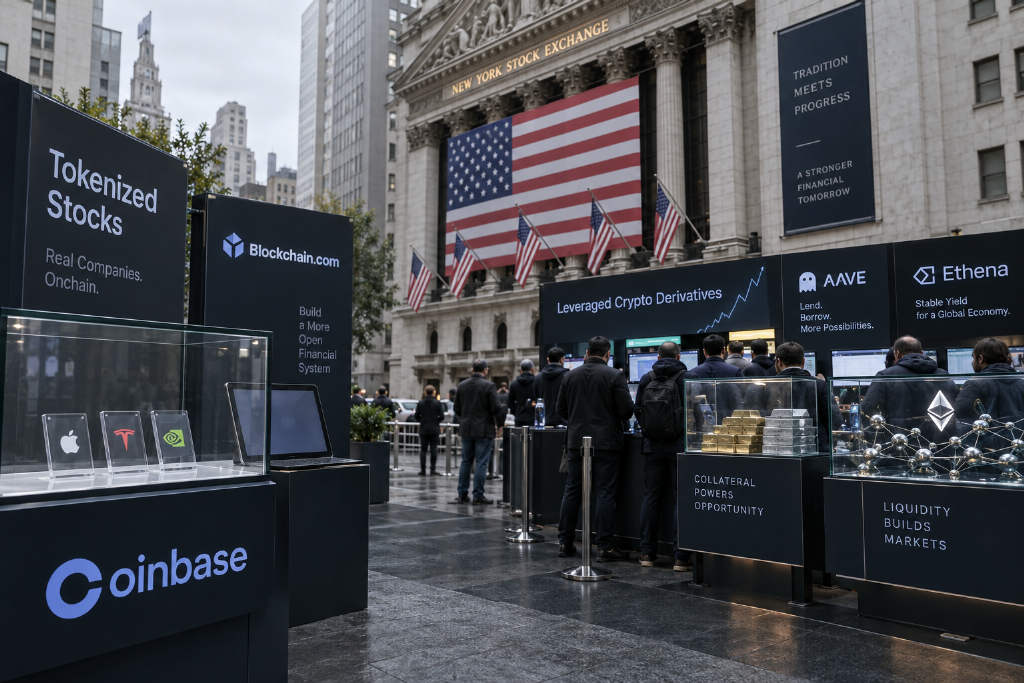
On Sept. 17, the U.S. Securities and Exchange Commission gave tokenized U.S. stocks a five-year green light, allowing them to trade on public blockchains through liquidity pools. Distribution is moving quickly as well. Coinbase’s 10 stock tokens launched on Base in August have already passed $1 billion in cumulative trading volume, and on Sept. 23 the New York Stock Exchange signed a memorandum of understanding with Blockchain.com to bring tokenized U.S. equities to 44 million crypto accounts.
Regulatory access is there. Products are live. Distribution is being built. But demand for the spot tokens themselves remains weak. In a Sept. 18 report, TD Cowen analyst Reid Noch pointed to two samples that cut against the broader narrative. Figure’s stock trades in both a traditional listed format and a tokenized format, and over a 24-hour observation window, 99.9% of volume went through the traditional stock while the tokenized version accounted for 0.1%. In Binance’s Nvidia-linked product set, perpetual futures represented 96% of trading volume, while spot tokens made up just 4%.
Noch’s conclusion was direct: U.S. investors already have efficient ways to buy stocks, so tokenized platforms need to offer a clear advantage if they expect users to tolerate thinner liquidity. After speaking with dozens of issuers, he found that outside firms such as Figure, whose business is already tied closely to crypto, interest was limited.
Perpetuals are drawing the first wave of capital
The first major destination for capital has not been spot tokenized stocks. It has been U.S. stock perpetual futures.
Binance recorded $342.9 billion in stock perpetual volume in August. Over the same period, Token Terminal put 30-day decentralized exchange volume for the entire tokenized stock market at $20.9 billion. By that comparison, leveraged trading volume was 16 times larger than spot. The jump has been sharp: Binance stock perpetual volume was only $410 million in January.
Open interest has climbed as well. Kairos Research estimated on Aug. 26 that one-sided open interest in Binance U.S. stock perpetuals stood at $2.14 billion. By Sept. 25, Ethena said that figure had moved above $2.9 billion.
Why pay up for perpetuals instead of buying spot? Funding rates explain much of it. In perpetual futures, longs periodically pay shorts, and the more crowded the long side becomes, the higher the rate goes. Ethena said that from May 20 to Aug. 11, the average annualized funding rate for Binance U.S. stock perpetuals was 17.5%, with 97% of days positive. Over the same stretch, Bitcoin perpetuals were running at an annualized 2.2%.
In practical terms, traders going long Nvidia perpetuals were willing to pay close to 18% a year for round-the-clock trading, leverage, and exposure without having to hold the stock itself. By late August, the funding rate on the Binance names tracked by Kairos had fallen back to around 7%, and two instruments had turned negative, a sign that enthusiasm was cooling.
The product set is still expanding. On Sept. 18, Coinbase also applied to the U.S. Commodity Futures Trading Commission to offer single-stock perpetuals to U.S. users, with plans to cover 50 to 60 stocks and ETFs including Apple and Nvidia.
Aave opened a lending market, but weekend pricing creates a gap
The second destination for capital is collateralized borrowing against stock tokens.
On Sept. 25, Aave V4 launched a market on Base where seven Coinbase stock tokens, including Nvidia, Apple, and Tesla, can be posted as collateral to borrow USDC. The market is limited to qualified users outside the United States. The USDC borrowing cap is $21 million, the maximum loan-to-value ratio is 79%, and liquidators can earn up to a 5.5% bonus.
The issue is timing. U.S. stocks close at 4 p.m. on Friday, and Chainlink’s price feed then holds the last quoted price from 8 p.m. Eastern on Friday until updates resume at 8 p.m. on Sunday. During that 48-hour window, deposits, borrowing, and liquidations continue to operate, but everyone is looking at Friday’s stale price.
Consider a simple case. If negative news hits after Friday’s close and a stock gaps down 10% when the market reopens on Monday, a position borrowed to the full 79% loan-to-value threshold could become liquidatable as soon as the oracle updates on Sunday night. Liquidators would then need to sell the token into a market that may not be deep enough. A Sept. 17 snapshot showed that the seven tokens had only $270,000 to $1.08 million of depth at 2% price impact. If the gap were 20%, the 5.5% liquidation bonus might not cover both the gap and slippage, leaving the shortfall with USDC lenders.
For now, that remains a risk window rather than a realized bad-debt event. As of Sept. 28, the Aave front end showed $6.2352 million in USDC supplied to the market, $425,200 borrowed, 6.8% utilization, and about $1.91 million in stock-token collateral. The scale is still small, but the mechanism is already live.
Ethena is redirecting USDe toward retail demand for stock leverage
The third destination is the yield engine behind a stablecoin strategy.
Also on Sept. 25, Ethena said it would extend USDe’s basis trade to Binance by holding Binance stock tokens, or bStocks, on the spot side while shorting the matching U.S. stock perpetuals on the same exchange to collect funding paid by longs.
The shift reflects pressure on Ethena’s earlier model. USDe had relied on funding rates from crypto perpetuals, but the annualized rate on Bitcoin perpetuals fell from 11% in 2024 to 2.2% over the first eight months of this year. USDe’s supply followed the same direction, shrinking from about $14.8 billion at its peak in October 2025 to about $4.9 billion on Sept. 25.
The menu of usable instruments is limited. Kairos Research, which built the framework for Ethena’s risk committee, screened names by open interest and funding-rate history. Out of 67 Binance pairs, only 17 passed. OKX had three. Bybit and Kraken had none.
There are also three visible weak points in the structure. First, returns to USDe holders now depend on how eager retail traders are to go long U.S. stock perpetuals, and the funding rate has already dropped from about 18% in late July to about 7% by late August, with two names turning negative. Second, Binance is the only counterparty in the setup. Third, BTech, the issuer behind bStocks, still needs to have its control over the underlying shares constrained by a supplemental letter that was still under negotiation. Kairos recommended approval only after that document is signed, and public reporting has not said whether that has happened.
Spot tokens are increasingly serving as inventory for leverage
Viewed together, the three capital flows make the role of spot tokenized stocks easier to see. The total value of tokenized equities issued by the market’s main providers has only just moved above $2.3 billion. Coinbase’s 10 stock tokens, despite generating more than $1 billion in cumulative volume, have only $12.97 million combined in their USDC pools on Aerodrome.
Those tokens are being used as hedge inventory for perpetuals, as collateral on Aave, and as the spot leg in Ethena’s strategy. When they are treated as stocks to be bought and sold in their own right, pricing and liquidity problems become harder to ignore.
One example came on the night of Sept. 3, seven hours after the U.S. stock market had closed. Robinhood’s AMC stock token on Uniswap jumped from $2.55 to $23.16 within an hour, roughly nine times the New York Stock Exchange closing price, then fell back to $3.26 in that same hour. Volume in the pool reached $10.5 million, yet the issuer’s authorized participant neither minted nor redeemed tokens during the move.
The premium lasted through the weekend. IOSG researcher Mario Chow said that over the three days after the close, the issuing agent expanded token supply from 152,100 to about 2.8958 million, a 19-fold increase. The issuing agent is estimated to have bought about $7.6 million worth of AMC shares before the price came back down.
Writing in CoinDesk, Bullish employee Tram Doman said that when the stock market is closed there is no securities lending mechanism, and only one authorized participant can create or redeem. Even with full collateral, the on-chain and off-chain markets can still trade at separate prices.
AMC Chief Executive Officer Adam Aron said on X on Sept. 4 that Robinhood should stop the trading, calling it 「a quasi fake market created on Jersey Island」. Robinhood Chief Legal Officer Dan Gallagher replied: 「We know a little bit about U.S. securities law.」
The regulatory channel was built for stocks, but the market is using it for leverage
Look at the participants on each side. Traders opening U.S. stock perpetuals do not need the stock itself. USDC lenders on Aave, and holders of yield products such as USDe, may never have bought a single share either, yet losses from a Monday gap or from funding rates turning negative can still end up with them.
Regulators opened a channel for stocks. The market has used it to build a leverage route.
Robinhood is set to hold a summit in Houston on Sept. 29. Vlad Tenev said 「it’s been too long since our last product announcement」, and Morgan Stanley expects the company may use the event to unveil perpetual futures for U.S. users.
A year ago, the pitch for tokenized U.S. equities was that anyone in the world could buy Apple or Nvidia at any time. What has moved on-chain is not the stock itself. It is leverage.