
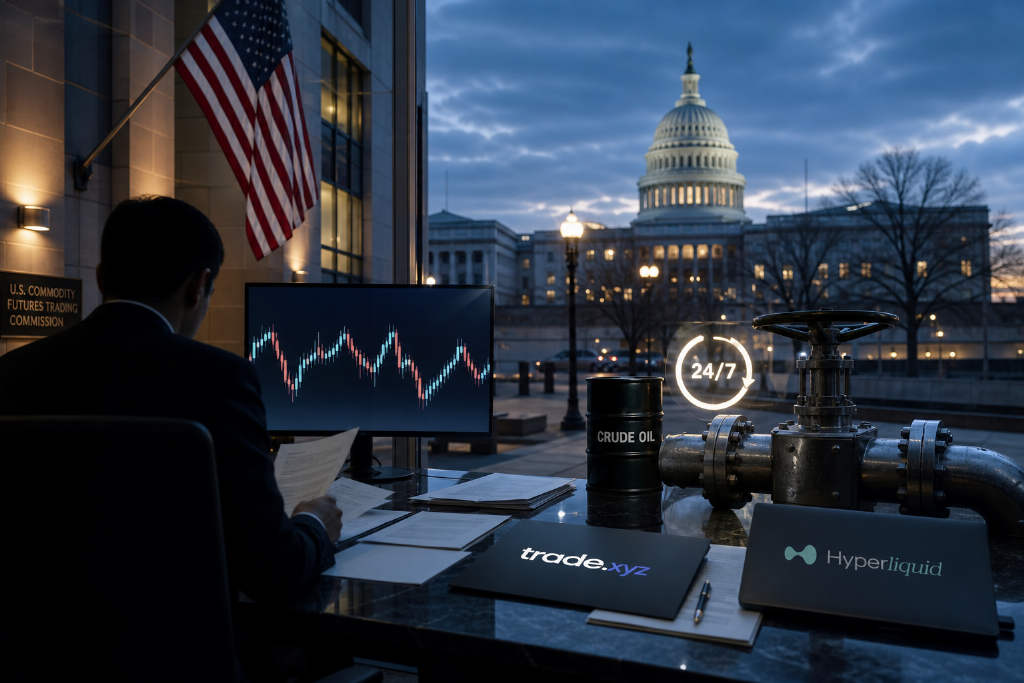
trade.xyz said on X that it has joined @HyperliquidPC in submitting a comment letter to the U.S. Commodity Futures Trading Commission, urging the agency to establish a regulated U.S. market path for energy perpetual contracts and 24/7 trading.
The company said that during this year’s oil-market shock, energy markets stayed open while benchmark markets were at times closed. Over several weekends, trade.xyz said it became a main venue for price discovery.
The letter cites oil-market disruption during benchmark closures
According to the comment letter, conflict in the Middle East on Feb. 28 interrupted energy exports from the region and disrupted global supply chains. While the oil market was closed, U.S. airlines, refiners, and fund managers with crude exposure lacked a regulated venue to respond until futures markets reopened on Sunday evening.
On March 9, Brent crude briefly approached $120 per barrel, and jet fuel prices doubled within a matter of weeks.
The letter also says that in the first weekend after the conflict, market participants outside the United States were able to manage crude exposure through crude oil perpetuals on Hyperliquid. From the Friday close to the reopening of benchmark markets, about two-thirds of the total price move had already taken place on-chain.
CFTC has already sought feedback on energy perpetuals
The CFTC had previously allowed the first digital asset-based perpetual contracts to trade on U.S. exchanges in futures form, and has sought comment on contract design, reference pricing, market integrity, clearing, customer protection, and continuous trading issues tied to energy perpetual contracts.
trade.xyz includes volume figures and policy recommendations
The letter says trade.xyz is the first and largest third-party perpetual market deployer on Hyperliquid. It adds that cumulative trading volume in its WTI, Brent crude, and Henry Hub natural gas markets has exceeded $500 billion since launch in October 2025.
It also says that in its research sample, during roughly 75% of weekend closure periods, weekend prices for crude oil perpetuals were closer to the benchmark market’s Friday close than to its Sunday reopening price. Since crude oil perpetuals went live, the reopening quality of CME WTI has not shown a statistically significant deterioration.
The letter recommends asset-class-based leverage limits for U.S. participants trading energy commodity perpetuals, plain-language disclosure of funding rates and liquidation mechanisms as market-integrity protections, and allowing compliant markets to use on-chain infrastructure for trade execution, margin management, clearing, settlement, and recordkeeping.