
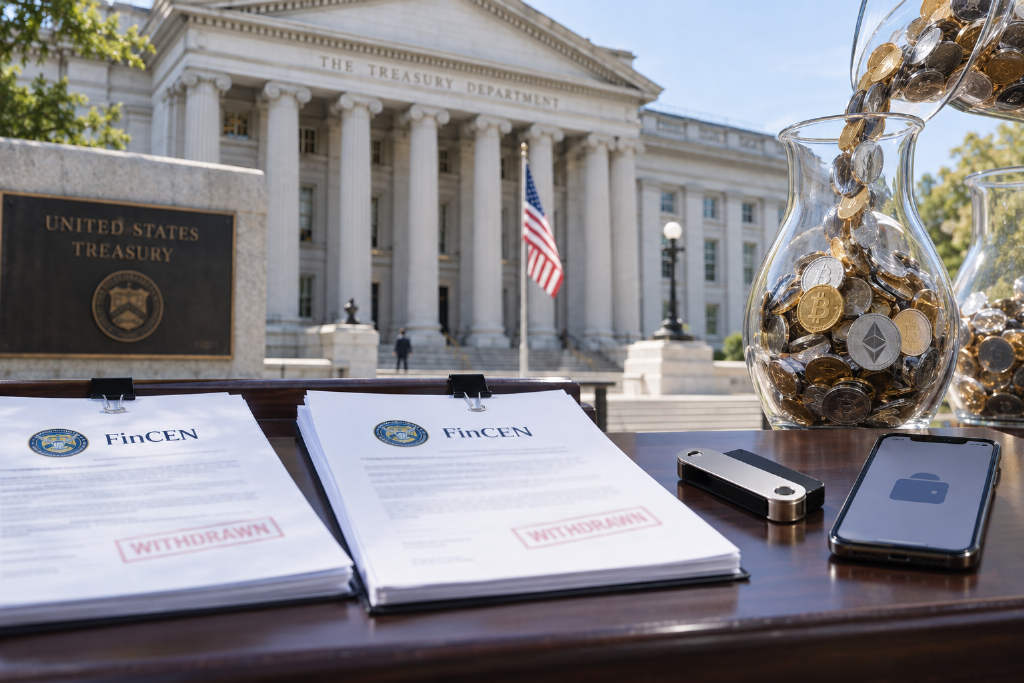
The U.S. Treasury Department's Financial Crimes Enforcement Network, or FinCEN, has withdrawn two long-disputed crypto surveillance proposals, one aimed at unhosted wallets and another aimed at crypto mixers. The notices were filed Monday and are scheduled for publication in the Federal Register on Tuesday.
Unhosted wallet proposal dropped
Unhosted wallets, also known as self-custodial wallets, are controlled by users directly rather than by an exchange or a bank. FinCEN's December 2020 proposal, released in the final weeks of President Donald Trump's first term, would have required banks and money services businesses to keep records on customer transactions involving such wallets above $3,000 and to report transactions exceeding $10,000, including information about counterparties.
Decrypt had reported at the time that the proposal would effectively extend Bank Secrecy Act requirements to personal wallets. In its notice, FinCEN said, 「FinCEN will take no further action on this NPRM.」 NPRM refers to a notice of proposed rulemaking.
2023 mixer proposal also withdrawn
A second notice rescinds a 2023 proposal from the Biden era that would have designated international crypto mixing as a class of transactions of 「primary money laundering concern」 under the USA PATRIOT Act.
Mixing services pool and shuffle coins to obscure their trail. According to the notice, that proposal would have required financial institutions to report wallet addresses, transaction hashes, and IP addresses tied to suspected mixing. At the time, the measure sought to treat mixers as a national security threat.
FinCEN said commenters had warned that the proposal's broad definition of mixing could chill legitimate activity. The agency added that it will continue monitoring mixers for illicit finance and may take steps in the future.
White House report cited in both notices
Both withdrawal notices cite the White House's July 2025 digital asset report. The mixer notice quotes the report as saying that the administration 「supports the ability of lawful users of digital assets to privately transact on a public blockchain.」
Coin Center welcomes the move, with a warning
Coin Center, the Washington-based crypto policy group that opposed both proposals for years, welcomed the withdrawals. Executive Director Peter Van Valkenburgh wrote on X, 「It's been a hard month for privacy and your right to use crypto. There's a bright spot.」 He also cautioned that 「the underlying statutory authority to create new, similar bad rules remains.」
The policy fight over self-custody is not over. Early last year, the Consumer Financial Protection Bureau floated an interpretive rule that would have brought wallets such as MetaMask under consumer payment law, drawing pushback from industry stakeholders.