
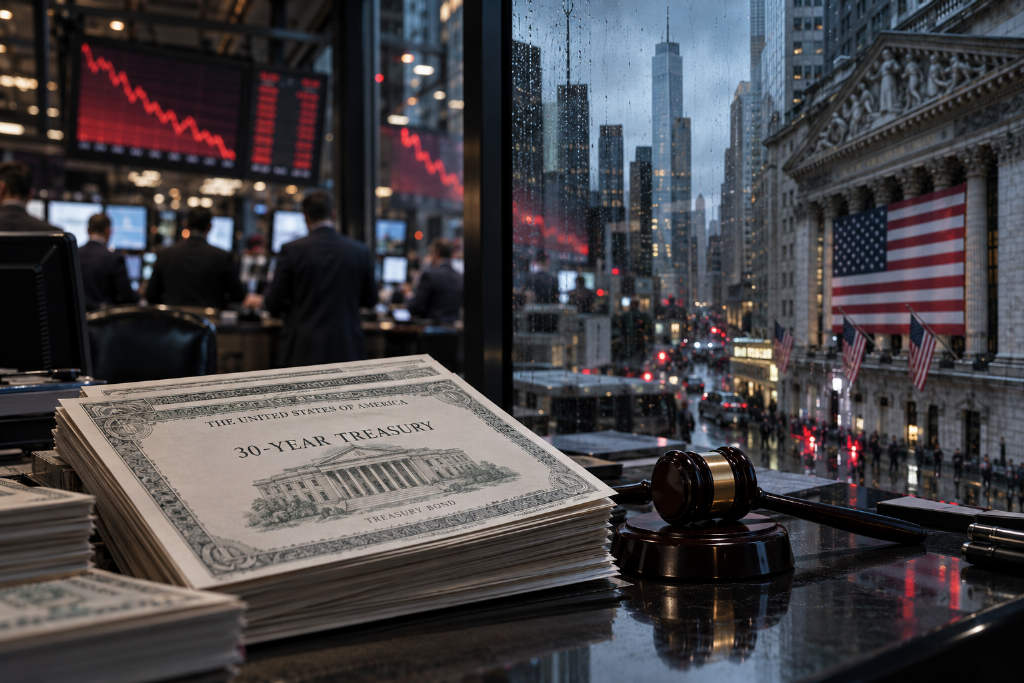
Long-end Treasury yields drove the session
PANews said Wall Street came under pressure as U.S. long-dated Treasury yields pushed to their highest levels since 2002, ending the recent advance in major stock indexes. The Dow Jones Industrial Average fell 0.66%, the S&P 500 lost 0.22%, and the Nasdaq Composite slipped 0.22%, snapping a five-session winning streak. The Russell 2000 dropped 1.31%, with smaller and more rate-sensitive stocks taking the brunt of the move.
The bond market set the tone. The 10-year U.S. Treasury yield touched 5.36% intraday, the highest since 2002, and finished near 5.28%. The 30-year yield climbed as high as 5.732%, also a peak not seen since May 2002. Pressure was not limited to the U.S. France’s fiscal worries resurfaced, widening the spread between French and German 10-year bonds to about 140 basis points, while the U.K. 30-year gilt yield briefly reached 6.04%, a 28-year high. PANews said the selloff in global bonds lifted discount rates across markets.
A $39 billion 10-year sale offered only brief relief
The day’s one clear pause came from a $39 billion auction of 10-year Treasuries. The high yield was 5.300%, the highest since November 2000, but demand was strong: the bid-to-cover ratio reached 2.77, the best since 2016, overseas demand came close to a record, and the share taken by non-dealers hit an all-time high. Yields eased briefly after the sale, and stock losses narrowed.
Even so, the market’s focus quickly shifted to the next test. Goldman Sachs rate strategy head William Marshall still expects yields to fall back to 4.75% by year-end. Barclays, by contrast, raised its forecast for the 10-year yield in the third quarter of 2027 to 5.25% and said it sees almost no catalyst for a move below 5% while the economy remains resilient.
PANews identified the next key event as the $22 billion 30-year Treasury auction scheduled for 1:00 a.m. on Oct. 9. If demand disappoints, long-end yields could rise again and put fresh pressure on U.S. equities.
Fed minutes stayed hawkish as inflation concerns persisted
The Federal Reserve’s September meeting minutes were described as hawkish. All 19 officials supported a 25-basis-point rate increase to 3.75%-4%, and most participants said another increase before year-end could be appropriate. The minutes said inflation remained elevated, with geopolitical tensions lifting oil prices and a surge in AI investment adding to the pressure.
A New York Fed survey showed one-year inflation expectations rising to 3.9%, the highest in more than three years, while household financial expectations deteriorated as well. Markets are now pricing roughly a 22% chance of a rate increase in October, with a relatively high probability still assigned to another move before year-end.
Oil held firm, the dollar strengthened, and metals fell
PANews cited U.S. media reports saying the Pentagon had instructed Central Command to prepare for the possible resumption of large-scale operations against Iran, while Donald Trump was weighing the timing. The report said action could come before the Nov. 3 midterm elections or even before Israel’s election, with potential targets including energy, infrastructure and nuclear facilities.
Brent crude stayed above $100 a barrel, while WTI traded in an $88-$90 range. International Monetary Fund Managing Director Kristalina Georgieva warned that even if fighting in the Gulf ends quickly, high oil prices could persist through 2027. Tanker attacks hit a weekly record, and the cost of sending very large crude carriers to Asia jumped to $77 million, sharply increasing supply-chain costs.
The U.S. dollar index rose about 0.4% to around 102.27, while the euro approached 1.12, a 17-month low. A stronger dollar and higher rates weighed on precious metals. Spot gold fell about 1.3% and touched an intraday low of $4,066, the weakest level since Aug. 5. Spot silver dropped about 2.6%.
As gold pulled back, China’s central bank increased its gold holdings for a 23rd straight month, taking reserves to 77.47 million ounces at the end of September. Zaner Metals strategist Peter Grant said the market was signaling that rates would stay higher for longer, supporting both the dollar and Treasury yields, while official-sector buying remained a medium-term support for gold.
Defensive sectors outperformed as flows turned cautious
Healthcare, consumer staples and utilities stood out on a relative basis, while industrials and materials lagged. Goldman Sachs’ trading desk said flows were clearly skewed to selling, with long-only fund activity at -25% and concentrated in macro products and technology shares. Hedge fund short ratios rose to the highest level in nearly two weeks.
At the same time, baskets of higher-quality companies rallied, while short baskets fell to their lowest level in more than two months. PANews said the market was starting to reward companies with healthier balance sheets. Healthcare rose 1.06% and led the U.S. market on the day.
Barclays initiated coverage of medtech with an overall bullish stance. Christopher Pasquale named Stryker and Edwards Lifesciences as large-cap top picks, with price targets of $375 and $110, respectively. He set targets of $120 for Abbott, $85 for GE HealthCare and $485 for Intuitive Surgical. He argued that medtech valuations are at a 10-year low and trading at the biggest discount to the S&P 500 since the peak of the tech bubble. The IHI ETF has fallen nearly 19% over the past five years, while the S&P 500 has gained nearly 77%.
AI financing kept expanding across chips and infrastructure
Capital demand tied to AI remained intense. Broadcom is seeking more than $50 billion to finance custom AI chips for OpenAI, with Apollo and Blackstone among the firms in talks. The internal project name is “Nexus,” and the first- and second-generation chip codenames are Jalapeño and Serrano.
Oracle is also in talks with Apollo and Goldman Sachs on chip financing. SpaceX is seeking about $40 billion to buy Nvidia chips, including roughly $10 billion in bank loans and $30 billion in investment-grade bonds. Apollo is expected to lead, with Pimco participating. Dan Ives of Yorkville Ives gave SpaceX an “outperform” rating and a $225 price target, saying debt financing to lock in Nvidia chips could strengthen the company’s launch, Starlink and AI flywheel.
Goldman Sachs data showed Micron is expected to contribute 19% of S&P 500 earnings growth in the third quarter, while Nvidia contributes 15%. Combined, their incremental contribution is roughly equal to that of the other 490 index members. Citadel’s Scott Rubner said, “The stock market is not the economy, and it is becoming increasingly obvious that the S&P 500 is not representative of ordinary stocks.” Deutsche Bank’s Henry Allen warned that bonds and equities are pricing “fundamentally different macro regimes,” a divergence he said is unlikely to last.
Samsung, TSMC and AMD kept HBM in focus
Samsung Electronics reported preliminary third-quarter operating profit of about KRW 107.4 trillion, up 783% from a year earlier and above KRW 100 trillion for the first time, marking a fourth straight quarterly record. Revenue came in at about KRW 195 trillion, up 127% year over year but below expectations. The memory upcycle remained central: supply of conventional DRAM and NAND stayed tight, while HBM demand remained strong. Counterpoint raised its forecast for third-quarter DRAM price gains to 10%-20% from 5%-10%. Douglas Kim of Douglas Research estimated Samsung’s third-quarter HBM bit shipments rose nearly 50% from the prior quarter. Samsung is due to release full earnings on Oct. 29.
TSMC was scheduled to report September revenue at 13:30. Its August revenue was about TWD 514.8 billion, up 53.3% year over year and 10.1% from July. Citi placed TSMC on a 90-day positive catalyst watch, expecting strong results.
AMD CEO Lisa Su visited South Korea for the second time in seven months and publicly confirmed for the first time that SK hynix will supply HBM4 for AMD AI accelerators. The MI455X carries 432GB of HBM4 per chip, up 50% from the previous generation. Su said AMD is seeking “three to five years or even longer” of cooperation with Samsung and SK hynix. Samsung wants to extend that relationship into foundry work, but AMD remains cautious.
Models, devices and AI agents kept rolling out
OpenAI formally launched GPT-6, using Sol for paid users and Luna for free users, with improved jailbreak defenses and a higher rejection rate for high-risk requests. Anthropic released Claude Haiku 5.5, cutting average operating cost by about 75% versus Haiku 4.5.
Microsoft introduced the Surface Laptop Ultra with Nvidia RTX Spark, starting at $2,599 and shipping on Oct. 16, and also launched an AI agent product called Scout. Nvidia and Microsoft said they are working together to let AI agents run natively on Windows PCs. Nvidia is also planning an additional $1 billion investment in humanoid robotics company Figure.
Single-stock moves ranged from Micron to Wolfspeed
Micron rose 4.06%. D.A. Davidson analyst Gil Luria raised his price target to $3,000 from $2,100, citing a memory shortage that he expects to last through 2027 and 2028. Memory names were mixed: SanDisk gained 1.92%, SK hynix fell 2.36%, and Western Digital dropped more than 1%.
Caterpillar sank 5.77%, the worst performer among blue chips, after the U.S. Federal Trade Commission and the Department of Agriculture jointly announced an investigation into the market behavior of agricultural machinery manufacturers. Industrials fell 2.14%, with Honeywell down 2.24% and Sherwin-Williams off 1.95%.
TSMC fell 2.09% as the Philadelphia Semiconductor Index lost 1.15%. Intel rose 0.55%, ARM fell 2.71%, Qualcomm dropped 2.16%, ASML lost 1.59%, and AMD slipped 0.55%. Broadcom added 0.19% as its OpenAI chip financing effort stayed in focus. Optical communications stocks were broadly lower, with Coherent down 1.12%, Lumentum off 1.97% and Corning down 3.39%.
SpaceX fell 2.51% while pursuing $40 billion in financing for Nvidia chips. Dan Ives maintained an “outperform” rating and a $225 target. The aerospace and satellite theme remained active, with Jeff Bezos saying Blue Origin could go public in the coming years and an FCC auction of “golden spectrum” seen as potentially positive for Amazon and SpaceX.
Apple rose 0.91%. Dan Ives named Apple his top technology pick for 2027 and set a $400 target, expecting AI to drive device upgrades and services growth. Microsoft added 0.09%, and Ives set a $650 target. Nvidia fell 0.74% after Jensen Huang and Satya Nadella unveiled preview versions of RTX Spark and DGX Station for Windows; the company is also considering another $1 billion investment in Figure. Ives set a $300 target for Nvidia and called it the “foundational compute platform for the AI economy.”
Intel CEO Chen Liwu said the company would continue working with Elon Musk on the Terafab project, though Musk is also discussing cooperation with TSMC, which hurt investor confidence. Wolfspeed jumped nearly 20% after hours after the U.S. Department of Defense proposed a $1.5 billion loan in exchange for warrants covering up to 7.5% of equity to support domestic production of silicon carbide and power devices.
South Korea faced a “liquidity vacuum”
PANews said the South Korean market ran into a “liquidity vacuum” after Samsung and SK hynix ended roughly $40 billion in buybacks earlier than expected. Over the previous two months, the two companies alone had absorbed more than $25 billion in selling pressure. On the first day without that support, the KOSPI fell 2% and dropped below 7000, foreign investors were net sellers of $1.9 billion, Samsung lost 1.3%, and SK hynix fell 2.8%.
Goldman Sachs strategist Heather Oh warned that earnings guidance, semiconductor ETF rebalancing, options expiry and the end of buybacks could combine to trigger significant volatility in Samsung shares. Cho Junkee of SK Securities also said volatility could rise after the buyback program ended.
What markets are watching next
For Oct. 8, PANews highlighted TSMC’s September revenue release, the reopening of China’s A-share market, the People’s Bank of China’s CNY 1.2 trillion outright reverse repo operation with a net injection of CNY 200 billion, the Ministry of Finance’s CNY 150 billion auction of five-year special government bonds, U.S. weekly jobless claims through Oct. 3, and the announcement of the Nobel Prize in Literature.
For Oct. 9 at 1:00 a.m., the U.S. Treasury is set to auction $22 billion of 30-year bonds due Aug. 15, 2056, carrying a 5.125% coupon. The Treasury will then buy back as much as $6 billion of 20- to 30-year bonds. PANews said strong demand could temporarily ease pressure on long-end rates, while weak demand could hit richly valued technology shares again.