
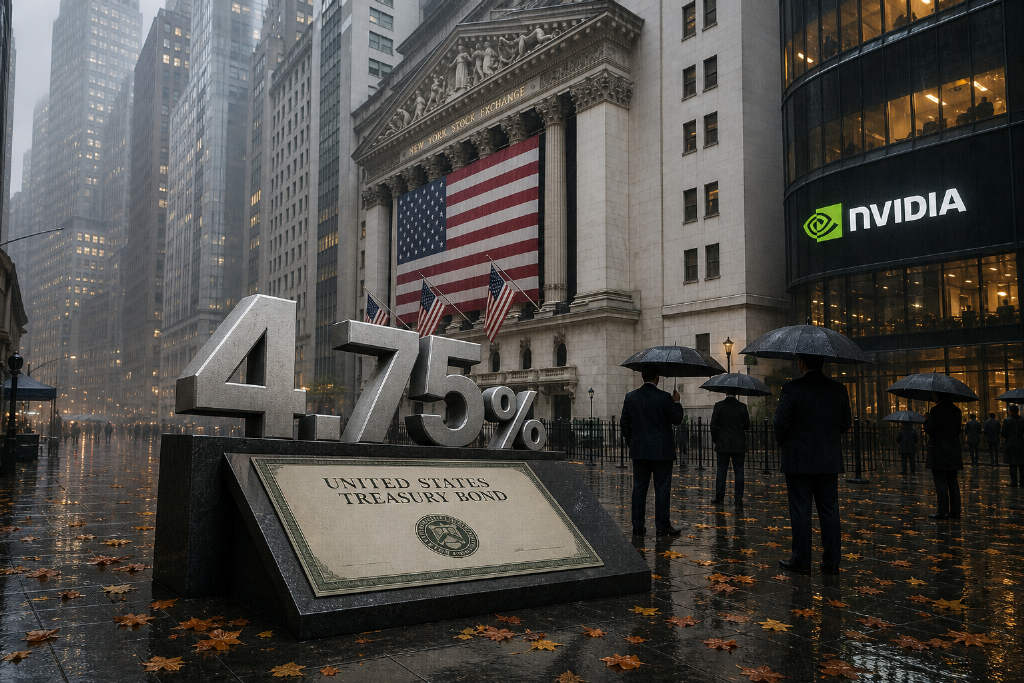
U.S. stocks ended lower Monday as geopolitical stress and monetary-policy pressure hit risk appetite at the same time, while oil and Treasury yields moved higher and investors began repricing around three themes: a historically weak September, the break above 4.75% in the 10-year Treasury yield, and a still-active AI infrastructure trade.
Major indexes fell, though August still finished in positive territory
The Dow Jones Industrial Average closed down 0.70%, the S&P 500 fell 0.33%, and the Nasdaq Composite slipped 0.12% on Monday. Even with that pullback, all three major indexes posted gains for August: the Dow rose 1.34% for the month, the S&P 500 added 2.62%, and the Nasdaq gained 3.93%.
The U.S. dollar index edged down about 0.2%. Bloomberg’s spot dollar index fell 0.9% in August, marking a second straight monthly decline. Wells Fargo strategists warned that if the Federal Reserve does not deliver the rate-hike expectations priced in by the market for September, dollar weakness could continue.
Spot gold was little changed. Gold gained about 10% in August, while silver at one point rose more than 22%. PANews said hawkish policy signals from Warsh had already limited room for further upside in precious metals.
Wall Street turns more guarded as weak September seasonality comes back into focus
Wall Street has started to take a more cautious tone on the near-term outlook. JPMorgan’s analyst team cut its U.S. equity rating from bullish to “tactically cautious/neutral,” saying the market will most likely move sideways over the next two to three weeks, with sharper swings in individual stocks and sub-sectors.
The team also flagged Friday’s nonfarm payrolls report as a potential trigger. A strong reading could push bond yields higher and weigh on equities. A weak reading could bring stagflation concerns back into view.
September seasonality is also drawing fresh attention. Over the past 30 years, September has been the weakest month for the S&P 500, with an average decline of 0.8%. Ameriprise said that when rates, geopolitical conditions and consumer signals all deteriorate at once, that seasonal weakness is often amplified.
Hormuz risk lifted oil prices and pushed Treasury yields through a key level
A renewed escalation in the U.S.-Iran military conflict, one month after the last flare-up, became Monday’s central macro driver. In a White House interview, Donald Trump said the U.S. “may strike Iran,” adding that large volumes of oil were still moving through the Strait of Hormuz. He also repeated that U.S. interest rates were too high and said he respected Federal Reserve Chair Warsh. Iran’s military responded that it would not tolerate aggression.
Crude prices jumped on the development. West Texas Intermediate rose about 3.2% to $85.8 a barrel, and Brent crude climbed about 2.7% to $91 a barrel.
Higher oil prices revived reflation worries and triggered selling in Treasuries. The 10-year U.S. Treasury yield moved above 4.75% intraday and reached about 4.78%, the highest level since January 2025. The 30-year yield rose to 5.276%, and the 5-year yield also climbed to its highest level since early last year.
The market logic was straightforward: the higher oil goes, the harder it becomes to bring inflation down; the stickier inflation is, the less reason Warsh has to move quickly on rate cuts.
Investors are watching 4.75% and 5% as the next bond-market lines
Dakota Wealth Management said 4.75% is a key psychological line for the bond market and high enough to make investors genuinely more alert. If the 10-year yield keeps moving toward 5%, the risk of a deeper correction in U.S. equities would rise sharply.
Franklin Templeton took a similar view, saying stocks can still absorb current rate levels, but 5% would be the real danger point.
Supply pressure is also building. Potomac River Capital said September is usually a peak month for credit issuance. It expects about $10 billion of new debt to hit the market this week alone, while total September issuance could reach a record $215 billion.
PANews described bond supply, fiscal deficits and inflation expectations as a “triple pressure” now weighing on the Treasury market.
Bessent plays down market anxiety while G20 officials stress growth
U.S. Treasury Secretary Bessent tried to calm concern around the bond selloff. He said the government “cannot change the equilibrium price of bonds” and had never tried to manipulate market direction. He added that he was working with budget director Vought on a fiscal consolidation plan built around solving the debt burden through growth rather than pushing down long-term yields through administrative means.
At the G20 summit, Warsh and Bessent sent a shared message on growth, calling for deregulation, more private investment and bigger investment in AI infrastructure. Warsh summed that view up by saying “growth is a choice.”
Even so, markets remain concerned that with oil prices, debt levels and interest rates all elevated, that growth narrative may come at the cost of higher long-term yields.
Another closely watched development came on the sidelines of the G20. Russian Finance Minister Anton Siluanov made an unexpected appearance and held a rare meeting with Bessent to discuss financial cooperation and a Ukraine peace plan. European countries were described as visibly uneasy and even resisted the traditional group photo.
AI infrastructure stayed in focus as storage and chip stocks outperformed
Energy, storage and crypto-related shares were among the market’s stronger groups Monday, while utilities slumped and mega-cap technology names diverged. Investors continued to chase parts of the AI trade, though higher rates are weighing on long-duration cash-flow valuations.
AI compute remained the main theme. Anthropic signed a $35 billion cloud computing deal with Nvidia-backed cloud provider Lambda. The data centers will be built by Hut 8, and the leases will be held by Nvidia. PANews said this was Anthropic’s second AI compute order worth more than $10 billion this year, bringing the total to about $80 billion. Nvidia, in that reading, is no longer just selling chips; it is helping AI companies secure compute, find capital and build an ecosystem.
Goldman Sachs also argued that the AI investment cycle is far from over. Eric Sheridan, the firm’s head of TMT research, said supply and demand in AI may not balance until the first half of 2028. Chip, memory, data-center land and facility costs are still rising, and capital spending by large technology companies is nowhere near finished. That supports Nvidia, Micron, data centers, power equipment and cloud infrastructure over the long term, while also putting long-term pressure on free cash flow and valuation.
Nvidia’s MediaTek deal added a second catalyst for semiconductors
Semiconductor stocks got a two-part boost. First, Anthropic’s large compute order reinforced expectations for continued demand. Second, Nvidia said it would invest $3.5 billion in MediaTek through a convertible bond, with the two companies set to build AI factories together. MediaTek plans to introduce technologies including NVLink Fusion as it pushes into the data-center market.
The Philadelphia Semiconductor Index rose 0.57%. Qualcomm gained more than 3%, Micron rose 2.77%, and Nvidia added 1.48%.
Storage names also found fresh buying interest. Sandisk rose late in the session and closed up 5.50% after being added to the MSCI All Country World Index. Micron gained nearly 3%, SK Hynix rose more than 2%, and Rambus added more than 1%. PANews said memory is no longer behaving simply like a traditional cyclical segment in this AI capex cycle; it has become part of the compute bottleneck.
Stock and sector moves across the tape
Sandisk and the memory complex
Sandisk climbed 5.50% after its formal inclusion in the MSCI All Country World Index, with passive inflow expectations driving a late-session rally. Related storage names mostly followed higher: Micron rose nearly 3%, Western Digital fell nearly 2%, SK Hynix gained more than 2%, and Rambus added more than 1%.
Nvidia and related chip names
Nvidia rose 1.48%. Lambda, which it backs, signed a $35 billion cloud-services agreement with Anthropic, and Nvidia separately announced the $3.5 billion convertible bond investment in MediaTek to deepen its AI infrastructure push. Related chip stocks mostly rose: Micron gained 2.77%, Qualcomm rose more than 3%, and Arm added more than 1%, while Marvell Technology fell more than 2% and Teradyne slipped more than 1%.
Tesla
Tesla advanced 5.51% after introducing a lower-priced Model 3 in Hong Kong and Macau. The starting price in Hong Kong was HK$205,000, 8.5% below the previous base version. The market read the move as supportive for demand, while rising expectations around Cybercab also revived the autonomous-driving narrative.
Amazon
Amazon fell 2.50% after the Federal Trade Commission and 22 states sued the company, accusing it of manipulating ad-auction mechanisms and generating more than $20 billion over seven years. The case could bring major fines and more transparency pressure on the advertising business. Amazon denied the allegations and said they misread how advertisers operate.
Apple
Apple slipped 0.89%. Tim Cook formally stepped down as chief executive officer, and John Ternus took over on Sept. 1. Investors are watching Apple’s Sept. 9 fall event, the next iPhone cycle, foldable devices and Siri AI progress. Phil Schiller also stepped down from overseeing the App Store and launch events, adding to a broader governance reshuffle in Apple’s services unit. PANews also noted that reports of OpenAI and Anthropic buying Macs for reinforcement learning have opened a new narrative around Apple’s local AI hardware.
Google and Microsoft
Google fell 2.09%. Its AI application Dreambeans scrapped paid subscriptions and opened free testing in the U.S., but investors remained focused on AI spending returns and capex pressure in a high-rate, higher-regulation setting.
Microsoft lost 1.22%. The company said the native Windows 11 UI framework WinUI had completed its open-source migration, with core development moving to GitHub. The announcement was not enough to offset the drag from higher rates on software valuations.
AMD and AI infrastructure
AMD gained 1.10%. A joint venture involving HUMAIN, AMD and Cisco will begin deploying up to 250 megawatts of AI infrastructure in Saudi Arabia from 2027 using AMD Instinct MI400 series GPUs, with plans to scale to as much as 1 gigawatt by 2030. Related AI infrastructure names benefited, and Cisco also got support from the compute-network narrative.
Crypto-related stocks
Crypto-linked names moved higher against the broader market trend. Strive rose more than 11%, Circle gained nearly 10%, Bitmine Immersion Technologies climbed more than 6%, Coinbase rose more than 5%, and Strategy and IREN both gained more than 4%.
Energy and utilities
Energy stocks broadly advanced as crude prices surged. Exxon Mobil rose nearly 3%, Chevron and Devon Energy gained more than 2%, ConocoPhillips, Occidental Petroleum and Ovintiv rose nearly 2%, and Schlumberger climbed nearly 5%. PANews said that as long as risk around the Strait of Hormuz remains in place, investors may continue using energy shares as a hedge.
Utilities were hit hard. Edison International dropped 23.07% and PG&E fell 20.06% after revisions to California wildfire legislation raised concern. Investors repriced possible liabilities and capital pressure facing power companies, and the sector’s defensive image gave way to policy risk.
Other large-cap names
Meta slipped 0.98%, though Mark Zuckerberg announced an AI coding tool called Muse Code and said it would be offered on a monthly subscription basis. Reddit and Roblox were placed under a stricter European Union regulatory framework and will face obligations tied to “very large online platforms.” SpaceX rose 1.55% after Elon Musk confirmed the company is building a gas-turbine casting plant in Texas, a move expected to shorten launch timing by as much as 18 months.
What markets are watching on Sept. 1 and Sept. 2
Sept. 1, Tuesday
- Apple leadership transition: Tim Cook formally steps down as Apple CEO and John Ternus takes over, with Cook becoming executive chairman. The market is watching whether Apple accelerates hardware innovation and AI device strategy under the new leadership, including foldable iPhones, on-device AI, a new Siri and smart display products.
- Electronics and materials price increases take effect: Qualcomm raised prices on some products, Maxscend adjusted RF product pricing, Taiyo Yuden increased MLCC prices, Mitsubishi cutting tools were repriced, and Nan Ya Plastics raised CCL and prepreg prices by 20%-25%. PANews said the moves reflect rising upstream material, capacity and supply-chain costs.
- G20 technology ministers’ meeting: Running through Sept. 2, the gathering includes Elon Musk, Jensen Huang and Sam Altman, with discussion centered on global AI governance, digital-economy rules and the light-touch AI regulatory “Carolina Principles” backed by the U.S.
- Japanese government bond auctions: Japan is set to sell 10-year and 30-year government bonds on Sept. 1 and Sept. 3. With the yen below 160 and long-dated U.S. yields elevated, markets are watching whether domestic demand in Japan diverts capital from overseas markets.
- NIO earnings before the U.S. open: Investors are focused on second-quarter deliveries, vehicle gross margin, narrowing losses, the contribution from Onvo and Firefly, and third-quarter delivery guidance. PANews said sentiment around Chinese EV shares could improve if vehicle gross margin stays around 17%-18% and guidance is strong.
- Baidu dual primary listing becomes effective: Its dual primary listing in Hong Kong and the U.S. is expected to improve liquidity and financing flexibility across both markets.
- SHEIN and Mech-Mind Robotics list in Hong Kong: Their first-day trading is being watched for implications on Hong Kong valuations in consumer technology, cross-border e-commerce, robotics and machine vision.
Sept. 2, Wednesday
- Earnings lineup: Dell, Credo Technology, MongoDB and Palo Alto Networks are due to report. Dell will test visibility on AI server orders and margin quality; Credo will offer a read on active-cable demand in AI data centers; MongoDB will give a signal on enterprise database cloud migration; and Palo Alto will show whether cybersecurity spending is holding up as AI-driven threats rise.
- SEMICON Taiwan: The semiconductor event runs through Sept. 4 and will focus on advanced packaging, HBM, semiconductor equipment and materials. Any signs of capacity expansion or technical breakthroughs could lift advanced packaging, memory, equipment, materials and suppliers tied to TSMC.