
The latest market swing has centered less on any single stock or industry group and more on U.S. Treasury yields moving back toward a critical threshold.
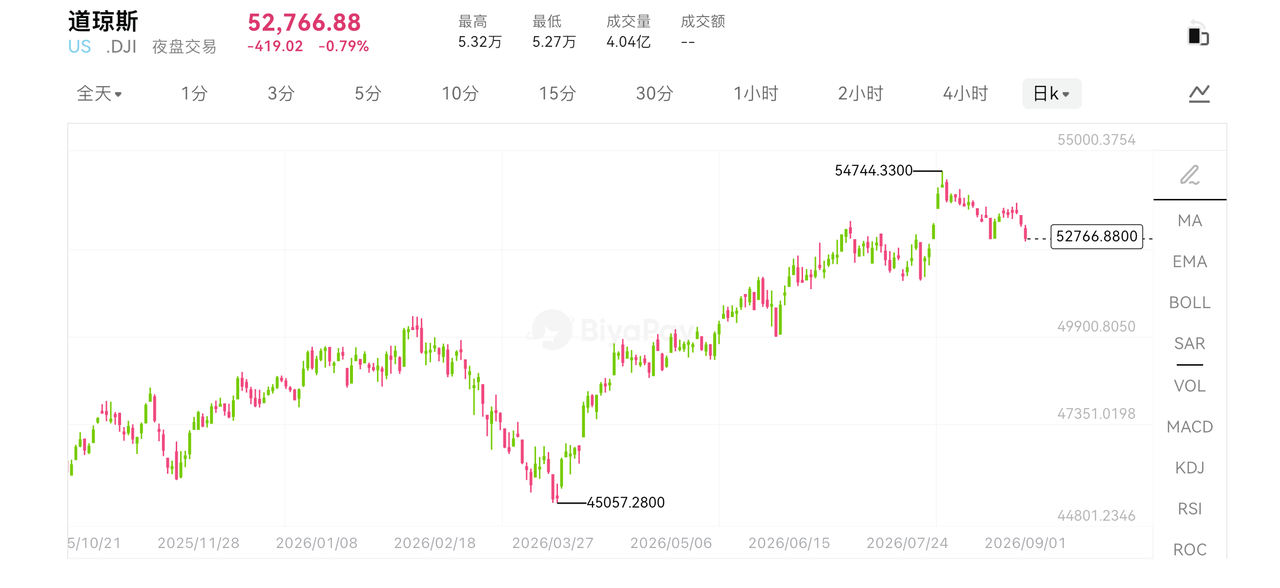
On Sept. 1, BiyaPay market data showed another weak session for the three major U.S. stock indexes. The Dow Jones Industrial Average fell 0.8%, the S&P 500 dropped 0.7%, and the Nasdaq lost 1%, extending the slide to a third straight trading day. At the same time, the 10-year Treasury yield rose to about 4.79%, while the 30-year yield moved close to 5.3%. The report said rising oil prices, inflation concerns, the approach of the Fed’s September meeting and U.S. fiscal pressure had combined to push investors into a fresh round of repricing.
Why Treasury yields matter far beyond the bond market
Treasury yields are one of the core reference points in global asset pricing. When rates move higher, equities, gold and digital assets are all forced back into the same valuation framework.
For U.S. equities, the question is whether valuations can still hold. For gold, the focus turns to real yields and the U.S. dollar. For digital assets such as Bitcoin and Ether, liquidity and risk appetite carry more weight in the short term. That is why the report argues that yields approaching 5% cannot be treated as a bond-market story in isolation.
It notes that Treasury volatility rattling stocks is not new. This time, though, the pressure is not coming only from the Federal Reserve. Oil, fiscal deficits, the policy cadence of the Trump administration and financing demand tied to AI capital spending are all part of the picture. What the market is really questioning is not one day’s move but whether the high-rate environment may last longer than previously expected.
As cross-asset linkages strengthen, watching only one market makes it easier to miss the signal. The report cites the BiyaPay app as a place where investors can track U.S. stocks, Hong Kong stocks, BTC and ETH at the same time. It describes BiyaPay as a global one-stop asset allocation platform covering digital assets, U.S. equities, Hong Kong equities and fiat exchange, making it useful for following price shifts and changes in risk appetite across markets.
In volatile conditions like these, the report says the key is not simply to fixate on one price level, but to watch which assets react first and which follow as Treasury yields, the dollar, tech stocks, gold and digital assets move against one another.
Near-5% yields reflect more than a simple rate-hike debate
With the 10-year yield near 4.8% and the 30-year yield near 5.3%, the report says the message goes beyond short-term expectations for Fed tightening. It points instead to a broader repricing of long-term funding costs.
Short-end rates are tied more directly to Fed policy. Long-end yields are shaped by a wider mix: inflation, fiscal deficits, Treasury supply, growth expectations and the willingness of long-term capital to absorb that supply. The article says U.S. debt has already exceeded $40 trillion and that interest-expense pressure is growing. As the Treasury continues to issue debt, investors are demanding higher yields as compensation for risk.
That is where the report frames Trump’s problem. Politically, he may want strong growth, steady equity markets and lower financing costs. The bond market, however, is paying closer attention to inflation data, the fiscal path and long-term credit conditions. If oil keeps rising, inflation pressure could return. If fiscal deficits do not ease, supply pressure in the long end may remain in place. As long as those factors persist, Treasury yields will not be easy to push lower.
In that sense, the core market issue is not just whether the Fed raises rates again. It is whether investors have begun to doubt that borrowing costs will fall back as soon as previously assumed.
For U.S. stocks, the first hit lands on valuations
Higher Treasury yields put direct pressure on equity valuations. That is especially true for tech names, AI-linked stocks and other high-growth sectors, where share prices often reflect aggressive expectations for future expansion. As the risk-free rate rises, the present value of future cash flows falls, and the market becomes less willing to tolerate elevated multiples.
The report uses that logic to explain why the Nasdaq has looked weaker during the pullback. It says the AI theme itself has not been disproved, and that cloud computing, chips, data centers and energy infrastructure are still key areas of focus. The problem is that the AI supply chain has already rallied quickly, and many stocks have priced in several years of future growth. With Treasury yields rising again, the market is asking whether orders can continue to materialize, whether margins can hold up and whether capital spending will weigh on cash flow.
Under low-rate conditions, investors are generally more willing to pay for long-dated growth stories. In a higher-rate environment, profit, cash flow and visibility start to matter more.
That, according to the report, will shape the next phase for U.S. stocks. Strong earnings alone may not guarantee gains, and weak results alone may not explain declines. What matters more is whether the quality of growth can offset the valuation pressure created by higher rates.
Gold is caught between rate pressure and lingering support
The effect of rising Treasury yields on gold is more nuanced. Gold does not generate interest income, so when yields rise and the dollar strengthens, the opportunity cost of holding it goes up. That usually weighs on prices.
The report says that logic has already shown up in the recent pullback from gold’s highs. Public market data cited in the article showed gold futures briefly falling below the area around $4,400 on Sept. 1, marking a clear retreat from late-August highs.
At the same time, gold is not only a rates trade. As long as investors remain concerned about fiscal deficits, geopolitical risks, recurring inflation pressure and monetary credibility, the metal can still attract hedging and safe-haven demand. That leaves gold pulled by two forces at once: higher yields and a stronger dollar on one side, and fiscal and geopolitical support on the other.
For that reason, the report says gold is not well understood through the single label of “safe haven” in the short run. Real yields are the more useful metric to watch. If nominal yields rise faster than inflation expectations, gold is more likely to stay under pressure. If inflation and fiscal worries heat up again, investor interest in gold could return.
Digital assets remain tied to liquidity and risk appetite
Bitcoin, Ether and other digital assets are also sensitive to Treasury yields. The report says the reason is straightforward: in short-term trading, liquidity conditions and appetite for risk play an outsized role.
When Treasury yields rise and the dollar strengthens, capital tends to lean back toward assets with more certain returns. Risk assets then come under pressure. The report said Bitcoin briefly fell to around $77,900 in premarket trading on Sept. 1 and was hit alongside U.S. technology stocks by the move higher in rates. In other words, crypto does not fully detach from the global liquidity backdrop when macro pressure intensifies.
Still, digital assets have a second narrative. Whenever markets turn to U.S. fiscal deficits, monetary credibility and long-term debt pressure, some investors start to view Bitcoin through the lens of a macro hedge. That means it can be restrained by high rates in the short term while also being repriced over a longer horizon because of fiscal and monetary concerns.
The report says that tension is what makes digital assets especially complex right now. They are neither pure risk assets nor stable safe havens. Their market role shifts with the environment: when rates rise, they trade more like risk assets; when fiscal credibility becomes the focus, they can regain attention under a different framework.
Before the September FOMC meeting, markets will keep watching the data
The next Federal Open Market Committee meeting is scheduled for Sept. 15-16. The report says Warsh, speaking at Jackson Hole, stressed that the 2% PCE inflation target is fixed and that short-term interest rates remain the main tool for achieving the Fed’s dual mandate. He also said 12-month PCE inflation stood at 3.7% and the six-month change was 4.1%, leaving inflation still above target.
The market takeaway is fairly direct. The Fed did not lay out a precise path, but it signaled that policy will not easily turn dovish unless inflation moves back toward target quickly enough.
From here, payrolls, CPI, PCE, oil prices and Treasury auction results are all set to influence expectations. If incoming data stays strong, or if inflation pressure does not cool clearly, Treasury yields may remain elevated and the valuation squeeze in U.S. stocks may persist. If economic data weakens sharply, market concerns could shift from inflation to growth.
The report says that is what makes the current environment difficult to call. Inflation has not been fully resolved, but growth cannot slow too abruptly either. Both the Fed and the market are waiting for more evidence.
Rising funding costs are now the main variable
The article’s final point is that once Treasury yields move back toward 5%, the effect on U.S. stocks, gold and digital assets is no longer theoretical. It is already visible, even if the direction is not identical across assets.
U.S. equities are most vulnerable to valuation compression, especially AI and high-growth technology shares. Gold is pressured in the short term by higher yields and a stronger dollar, yet still supported by fiscal, geopolitical and inflation risks. Digital assets sit between tighter liquidity and the idea of macro hedging, making short-term swings more pronounced.
For Trump, the report argues, stabilizing market sentiment will depend in the end on whether the bond market accepts the current inflation and fiscal setup. As long as long-dated Treasury yields stay elevated, global assets may face repeated repricing. Stocks will be judged on whether earnings can offset rate pressure, gold on real yields and defensive demand, and digital assets on liquidity and risk appetite.
The broader message is that the old trading environment, where growth stories alone could carry prices, is changing. As the cost of capital rises again, every asset class is being forced to answer the same question: can the expectations built into current prices withstand a high-rate test?