
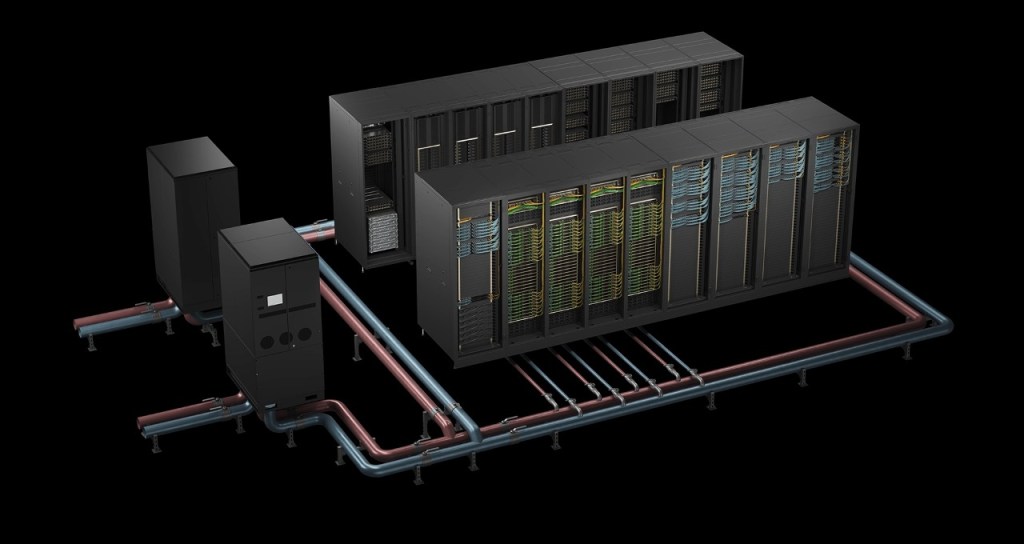
Liquid cooling is becoming a required part of high-end AI server infrastructure as AI chip power consumption keeps rising. TrendForce said in its latest research that liquid-cooling penetration for AI chips is set to reach 53% in 2026 and move closer to 60% in 2027. Taiwanese suppliers including AVC, Auras and Jentech have already secured positions in that supply chain.

Rack power demands are pushing air cooling aside
According to TrendForce, AI chips from NVIDIA, Advanced Micro Devices and Google are advancing quickly, and single-chip thermal design power has already crossed 1 kW. Complete rack-scale AI server solutions now draw several hundred kilowatts, a level where conventional air cooling is no longer sufficient to keep systems stable.
The firm said liquid cooling is turning into standard equipment for high-end AI data centers because it offers better heat dissipation and improves power usage effectiveness, or PUE. TrendForce expects liquid-cooling penetration for AI chips to jump from about 33% in 2025 to 53% in 2026, then approach 60% in 2027.
NVIDIA’s Vera Rubin platform expands liquid cooling across the rack
TrendForce described NVIDIA as the most important driver behind wider liquid-cooling adoption. It said data center operators are speeding up investment in AI infrastructure, while Chinese cloud service providers are also increasing overseas AI project deployments. That combination is expected to double NVIDIA GB/VR rack shipments in 2026.
The report added that overall GPU rack shipments are still projected to grow by more than 30% year over year even if the Kyber NVL144 platform faces delays.
On the system side, NVIDIA’s latest Vera Rubin platform uses a fanless, full-liquid-cooling design. The cooling footprint now reaches beyond GPUs and CPUs to cover CX9 network interface cards, busbars and power boards, as well as optical transceiver modules.
That marks a shift away from partial cooling aimed only at core compute components. In TrendForce’s view, liquid cooling is now being built into the full rack system, which also raises the liquid-cooling capacity required for each rack.
AMD and Google are adding to the momentum
Competition is also accelerating the transition. TrendForce said AMD is broadening its AI strategy from a standalone GPU lineup to a full AI platform ecosystem. Beginning in the second half of 2026, the company will put more emphasis on its Helios AI rack-scale solution, which integrates CPUs, GPUs and high-speed interconnect interfaces. Large-scale shipments are expected in 2027.
AMD is then expected to follow with the MI450 platform and the next-generation MI500 platform, with the latter positioned against NVIDIA Rubin Ultra.
Among major cloud service providers, TrendForce said Google has been the most aggressive in adopting liquid cooling. More than 80% of Google’s AI servers already use the technology, well ahead of peers. The firm said Google has built a highly customized liquid-cooling architecture on the back of its in-house TPU accelerator program and years of deep AI infrastructure integration, extending liquid-cooling design from individual servers to rack-scale systems.
As TPU power consumption and shipment volume continue to rise, TrendForce expects Google’s liquid-cooling deployment to keep expanding and remain a major force behind broader industry penetration.
Taiwanese cooling suppliers are positioned in cold plates and packaging
Liquid-cooling systems
TrendForce said liquid-cooling systems are built around cold plates, manifolds and cooling distribution units, or CDUs. It identified the cold-plate segment as the main battleground in the supply chain, naming Cooler Master, AVC and Auras as key suppliers.
AVC is expected to begin shipping Vera Rubin cold-plate modules in the third quarter of 2026. The company has also entered cold-plate supply chains for AI ASIC platforms used by hyperscale cloud operators including Amazon Web Services, Google, Meta and OpenAI.
TrendForce said AVC’s presence across both a leading GPU platform and multiple in-house AI chip programs at top-tier cloud providers points to meaningful technical and manufacturing strength in liquid-cooling cold plates. Its broader customer mix also gives it more room to absorb risk.
Chip packaging
In packaging, the heat spreader has become a critical part. Jentech is currently the sole supplier for NVIDIA’s Rubin platform, giving it an exclusive position in that segment.
TrendForce said NVIDIA had originally planned to use a two-piece heat spreader design for Rubin to improve cooling performance further. Manufacturing issues including substrate warpage led the company to switch to a one-piece design as a transitional solution. Even with that design change, Jentech’s exclusive supplier status was left intact.
Penetration nears 60% by 2027
TrendForce said liquid cooling has effectively become an industry standard in AI infrastructure. With AMD’s Helios platform expected to scale in 2027 and Google continuing to expand TPU deployments, the firm expects order visibility and pricing power for Taiwan’s liquid-cooling supply chain to strengthen at the same time.