
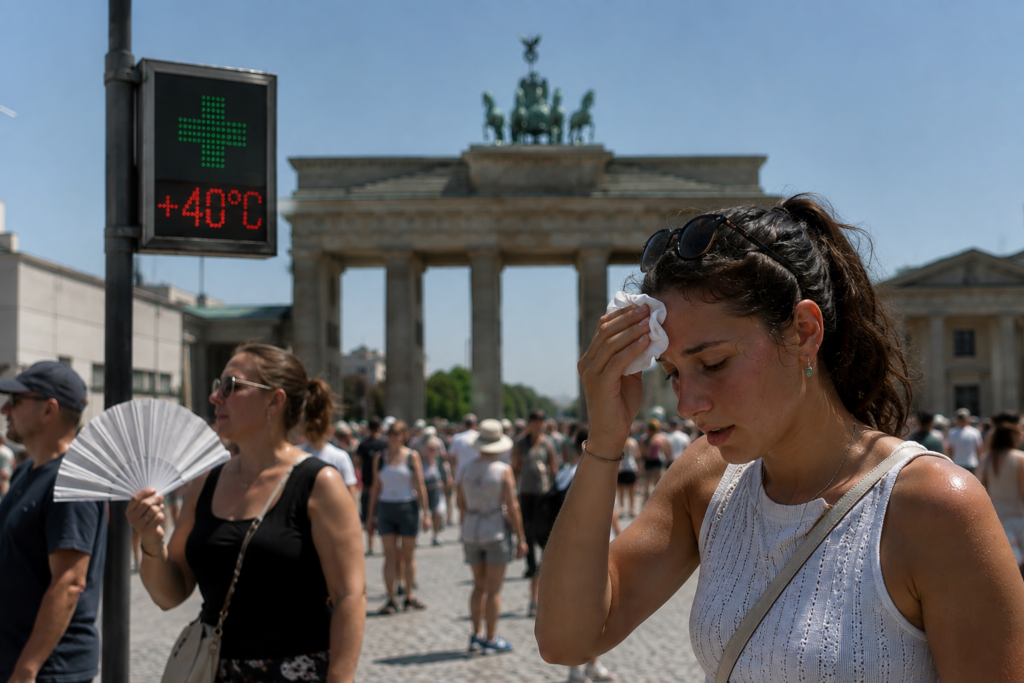
Dutch bank Triodos Bank estimates that this summer’s heatwave could cut about 1% from European Union GDP in 2026, wiping out roughly €180 billion in output and nearly canceling the bloc’s expected growth for the full year. The figure was also presented as about $208 billion.
France appears to be the most exposed major economy in the estimate. Triodos said French GDP could be reduced by 1.4%, enough to turn full-year growth into a 0.6% contraction.
Four channels behind the €180 billion estimate
Triodos breaks the damage into four parts, and the largest one is not wildfire or water shortages. It is weaker labor productivity.
Extreme heat is forcing shorter working hours and, in some cases, temporary shutdowns for outdoor construction and logistics. That channel alone accounts for about 0.6 percentage points of EU GDP, more than half of the total loss in the bank’s estimate.
The other three channels are smaller but still material:
- Tighter food supply and lower dairy output, adding about 0.15 percentage points of damage.
- Power-sector disruption and higher electricity prices, at about 0.12% to 0.15%.
- Land and water transport bottlenecks, subtracting another 0.15 percentage points.
Together, those four components produce the €180 billion estimate.
France could slip into contraction, while Dutch growth nearly stalls
At the country level, France stands out as the hardest hit. Under repeated heatwaves, Triodos estimates that the country’s annual growth rate could flip into negative territory.
The Netherlands follows, with growth reduced by 0.8 percentage points and activity nearly flat for the year. Italy, Spain and Belgium are also listed among the most affected economies, while Poland, which has seen fewer extreme-heat days, is described as the least damaged.
Over a longer horizon, Allianz gives a darker outlook. Its estimate suggests that by 2030, highly exposed economies including Spain, France and Italy could face a cumulative growth cost of 5% to 7%. A two-week heatwave in June alone already shaved about 0.3 percentage points off Europe’s overall growth rate this year.
Why this shock is harder to offset
The article argues that this is not a typical downturn driven by weak demand. Instead, it is a supply-side shock imposed by physical limits: factories may still have orders but cannot operate normally, power plants may have fuel but cannot cool efficiently, and farmland may still hold crops that fail to grow.
That distinction matters. If the constraint is production capacity rather than demand, lower interest rates or fiscal support do not solve the core problem. The report says this is what makes the GDP hit from extreme heat especially difficult for Europe.
Rivers, electricity and transport are all under strain
The transmission starts with pressure on water resources and the power system at the same time. With rainfall low and soil unusually dry, water levels in the Seine, Rhine and Danube have fallen sharply. Barges and cargo vessels face draft limits, forcing lighter loads or complete suspensions on inland routes.
The electricity system is under pressure as well. More than six nuclear power plants have had to cut output or stop operating because river water was too warm to provide enough cooling. That has tightened power supply for households and industry and pushed electricity prices higher.
Germany offers one example. ING said disruption to Rhine cargo traffic alone could reduce the country’s growth rate by 0.3 percentage points this year. In Hungary, a model from MBH Bank showed that if the nuclear power plant responsible for most domestic electricity supply stayed offline for one additional week, GDP growth would lose another 0.1 percentage points.
Transport disruption is also starting to create price differences across regions. Agriculture is weakening at the same time. The article says July output for late-harvest crops such as corn and sunflower was already down 6% to 7%, and full-year agricultural output is expected to shrink by 3% to 7%.
Food inflation leaves the ECB with a harder problem
Lower crop output can feed directly into higher food prices. That is already showing up in the food chain and complicating the European Central Bank’s effort to control inflation.
The article points to a precedent from 2022. Extreme heat that year lifted euro-area inflation by 0.34 percentage points through food prices alone. In other words, hotter summers can cut growth and at the same time reduce room for future ECB rate cuts.
That is the classic difficulty of a supply shock. Output falls while prices rise. Rate hikes do little to restrain food and electricity costs, but rate cuts risk making inflation stickier. The piece adds that this challenge may return every summer.
Wildfires, excess deaths and a tourism shift
Wildfires are another part of the bill. The Copernicus Atmosphere Monitoring Service said hot and dry conditions are making large, intense fires more likely in southern Europe, with the fire season gradually spreading north. This year’s total wildfire scale in Europe could set a record, according to the article, forcing governments to absorb forest and infrastructure losses along with firefighting and reconstruction costs.
The human toll is also rising. The six European countries hit hardest this year have already recorded more than 14,000 heat-related excess deaths, and Germany alone has reported more than 10,000.
Tourism patterns may also change. ING economist Berteschi said that when temperatures in southern Europe regularly move above 40 degrees Celsius, travelers’ tolerance will show up in where they choose to go. Summer demand could gradually shift away from traditional hotspots such as Italy and Spain and toward milder northern European destinations.
Triodos warns of a climate-driven vicious circle
University of Mannheim economist Usman said the damage from extreme weather does not stop when summer ends. Pressure on corporate profits, investment appetite, tax revenue and public finances may continue to emerge over the following years.
Allianz economist Krischen also said the overall economic cost this year will likely be clearly higher than in previous years. He added that existing estimates still do not include wildfires, drought, floods or the El Niño event that markets expect, which means €180 billion may only be the lower bound.
Triodos chief economist Hans Stegeman gave the article’s bluntest warning: 「This summer proves that climate change is not a distant economic risk. The most effective way to lower these costs is to slow climate change itself.」
Stegeman said Europe is being pushed into a vicious circle in which climate disasters weaken economic growth, fiscal pressure then encourages governments to loosen climate policy, and the next heatwave causes even deeper damage.
Low growth, tighter fiscal room
Set against the euro area’s growth forecast of only about 1% this year, the scale of a single summer’s climate shock looks substantial.
European governments are also dealing with several spending demands at once. The article says they need more investment in power grids, transport and water infrastructure to reduce losses from the next heatwave, while also funding defense spending and the green energy transition. That leaves less fiscal room.
For markets, the report points to a transmission path that is becoming harder to ignore: stickier food and energy prices may leave the ECB with less room to cut rates later on.