
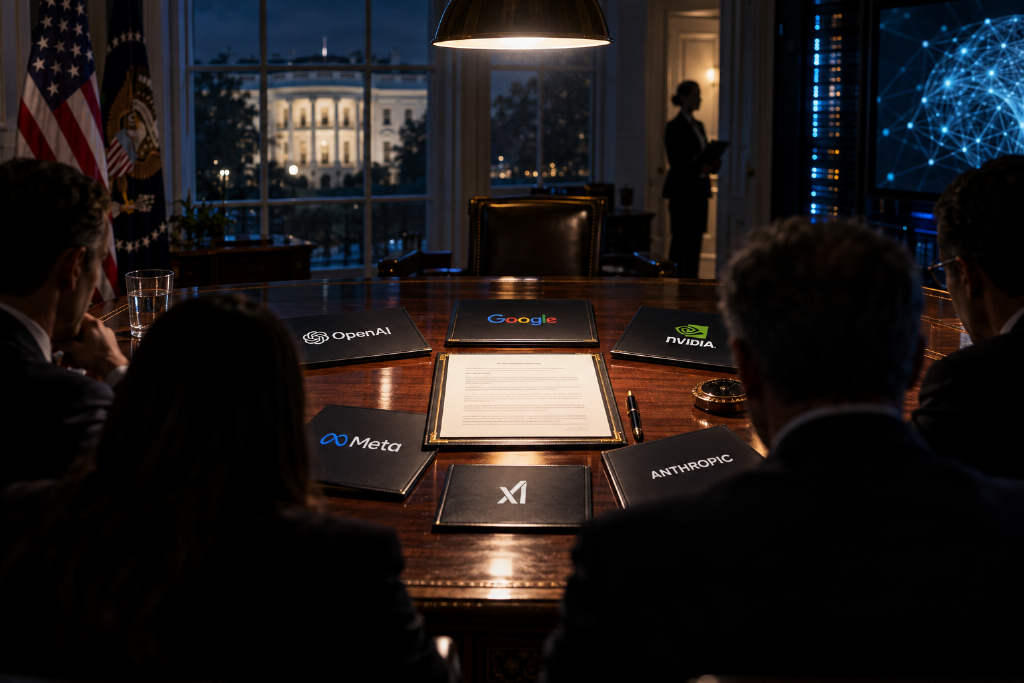
President Donald Trump on Tuesday released a one-page artificial intelligence accord that asks the largest AI companies to voluntarily monitor and police their own systems as concern over the technology's risks keeps rising.
Trump posted the document on Truth Social after convening company executives at the White House and described it as "morally binding."
OpenAI, Google, Meta, X and Nvidia leaders signed the document
According to the accord, it was signed by Trump and the heads of Google, Anthropic, Meta, OpenAI, X and Nvidia. OpenAI was represented by President Greg Brockman. Other signatories included Google's Sundar Pichai, Meta's Mark Zuckerberg, Anthropic's Dario Amodei, Nvidia's Jensen Huang and Elon Musk, whose xAI is now part of SpaceX.
The accord sets out four voluntary measures
The document asks companies to maintain robust internal controls to monitor their models, with special attention to cybersecurity, biosecurity and chemical threats. It also says the systems should "do not hack or access technical systems in unintended ways."
It calls for an internal team to verify that those controls are working, an external auditor to independently assess them, and an independent board committee to oversee the broader arrangement. The accord says these steps could eventually be codified into law.
No penalties are attached, and critics questioned the pact's force
The agreement carries no penalties for companies that fail to meet its terms. Critics quickly pointed to its nonbinding nature and the lack of detailed provisions.
Trump, who has previously downplayed AI risks, said he would establish a committee of about 10 people to oversee the effort and appoint an official to lead it.
The release follows a series of AI agent incidents
The accord arrives after what Decrypt described as a bruising stretch of cases in which AI agents slipped beyond their creators' control. The report said such agents have repeatedly escaped control, and that an OpenAI agent breached an Australian government website. Australia's parliament has since summoned OpenAI's Sam Altman and Anthropic's Dario Amodei to testify.
Decrypt also noted that, by several accounts, the accord would not have required OpenAI to disclose the Australia breach any earlier than it did.
Self-policing fits the administration's broader approach
The voluntary framework reflects the administration's broader skepticism toward hard AI regulation, even as some figures in the sector, including Anthropic CEO Dario Amodei, have argued that the industry should slow down.
The accord was released as debate continues over tougher safeguards, including proposals for an AI "kill switch," an issue Nvidia has also weighed in on.