
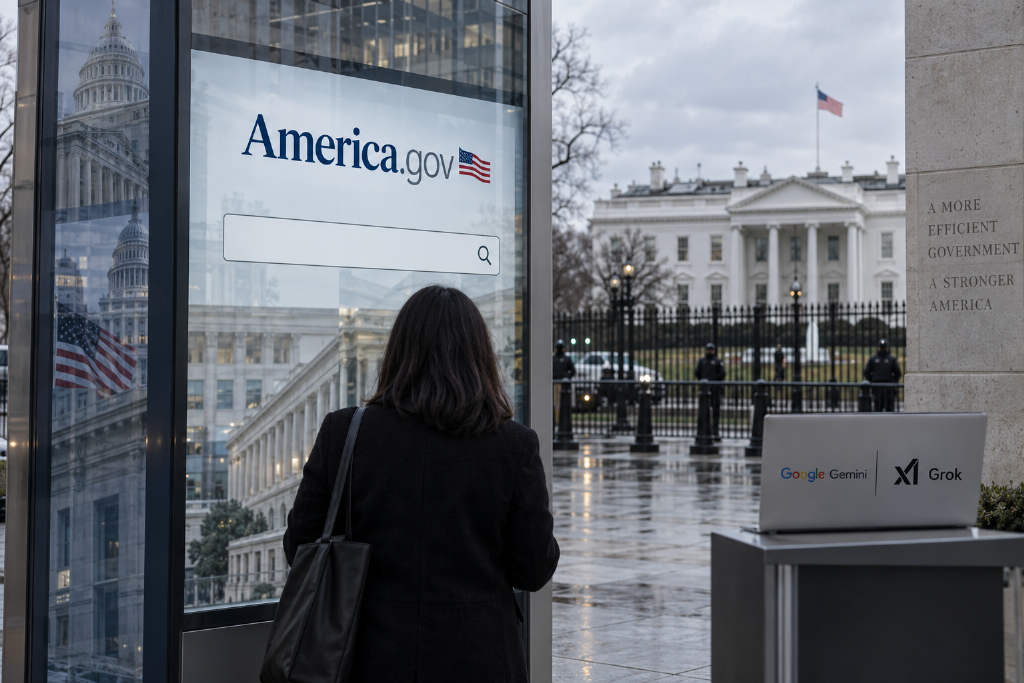
U.S. President Donald Trump introduced America.gov on Sept. 29, calling it a single front door for federal government services. A White House explainer said people can ask questions in everyday language and get answers through the site. As support expands, users are also expected to complete government tasks directly on the platform instead of moving back and forth across separate agency websites. Trump signed an executive order the same day requiring federal agencies to integrate into the system.
A single prompt box and data from about 29,000 government sites
According to FedScoop, the America.gov homepage features just one prompt box with the line: "Whatever you need the government to do, start here." The platform combines information from roughly 29,000 government websites. Joe Gebbia, the U.S. chief designer and Airbnb co-founder, said on CNBC that the system is built on Google's Gemini and Elon Musk's xAI Grok.
Services with more than 100,000 annual users are in scope, with tax filing and defense carved out
Under the executive order, the General Services Administration, the National Design Studio, and the Office of Management and Budget are tasked with building and operating America.gov. The project will also integrate the government's identity system, Login.gov.
The services that must be folded into the platform are federal services used by more than 100,000 people a year and available through online application. IRS tax filing services are excluded. So are services tied to national security within the Department of War and the intelligence system.
The White House said the public can already submit questions on America.gov. Later this year, the site is expected to support passport renewals and Medicare enrollment. Gebbia said at the launch event that a system allowing users to continue a process on the platform and track progress is planned for 2027.
White House says AI vendors will not retain questions or answers
On privacy, a note above the prompt box tells users to "share only necessary information." The platform may use approximate location data. The White House said AI vendors "will not retain your questions or answers," and responses are cached for up to two hours. What is stored is the hash value of a prompt rather than the original text.
FedScoop said the White House did not answer questions about how the platform protects privacy or what its procurement contracts contain.
Newsweek tested 15 prompts and got answers saying Biden won in 2020
Newsweek said it asked America.gov 15 questions on launch day, covering politically sensitive issues including election results, election fraud, climate science, and presidential term limits. The chatbot cited government records or constitutional text in its responses.
When asked who won the 2020 election, America.gov said Joe Biden won and cited the Electoral College tally of 306 votes for Biden and 232 for Trump. Asked whether there was widespread fraud large enough to change the result, it answered that "official U.S. sources have not found widespread fraud that changed the outcome of the 2020 presidential election." Asked whether Trump could run for a third term, it cited the 22nd Amendment and said Trump had already been elected twice and could not run again in 2028.
A White House spokesperson told Newsweek that America.gov will continue to be updated with more features and "the most accurate information from the federal government," adding that "the president and the administration's position on issues related to the 2020 election has always been clear."
Former USDS founding administrator says the demo addressed only "the easiest 5%"
Mikey Dickerson, founding administrator of the U.S. Digital Service, told FedScoop that USA.gov and Benefits.gov had tried similar approaches before, but struggled to go beyond what he described as a superficial collection of links. He gave one example: tax filing and Medicaid applications do not use the same definition of income.
"The demo you launched solves only the easiest 5%," Dickerson said. "Until you solve the genuinely hard parts, I won't be impressed."
Trump also signed the "Superintelligence Accord" the same day
On the same day as the America.gov launch event, Trump also signed the "Superintelligence Accord" at the White House with AI industry executives. He separately signed another executive order directing the executive branch to use the term "superintelligence," or SI, instead of "artificial intelligence," or AI, wherever possible.