


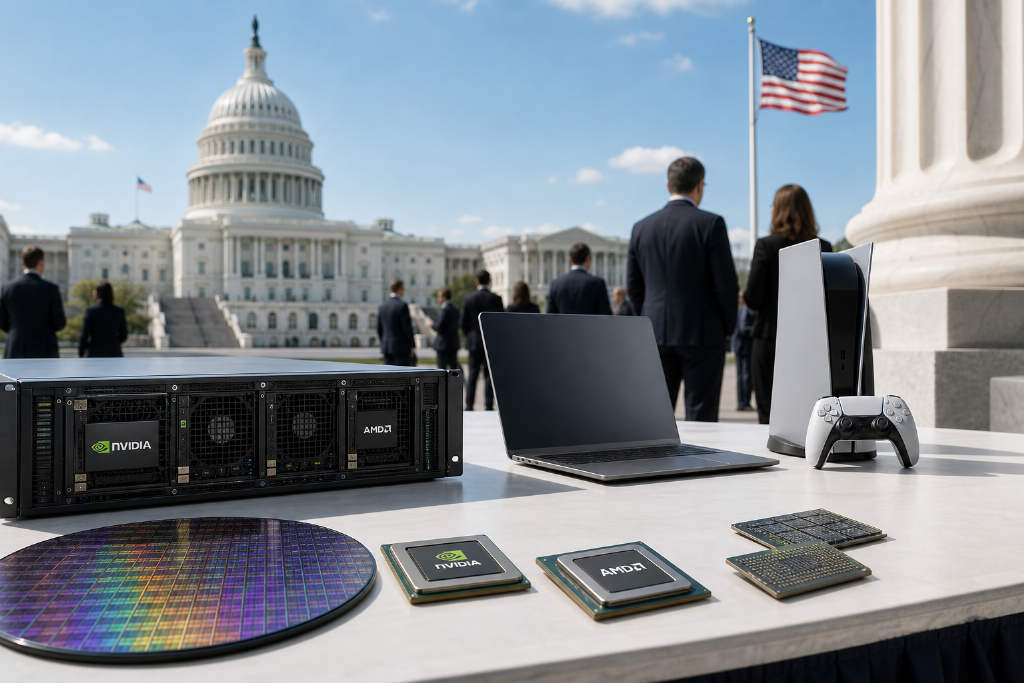
The Trump administration is considering a new semiconductor tariff plan that could reach far beyond chip suppliers and hit finished products that use chips, including servers, laptops and game consoles, according to Politico, which cited people familiar with the matter.
While the details have not been finalized, the potential effect on semiconductor supply chains, data center construction and related technology stocks is already drawing investor attention.
Tariff scope may expand from chips to end products
The report says the most important shift under discussion is a broader target base for the tariffs. A version released by the Trump administration in January had included exemptions for data centers, research, startups and consumer uses. Internal discussions now suggest Commerce Department officials are weighing the removal of those carveouts.
If that change goes through, end products that contain chips, such as servers, laptops and game consoles, could also be subject to the tariffs.
Commerce Secretary Howard Lutnick is described as backing a framework that would permit a certain volume of chips to enter the United States at zero tariff, with the size of that duty-free allotment linked to a company’s investment commitment inside the U.S.
The proposal is also said to include differentiated tariff rates and exemption quotas by country, with separate rules under consideration for major semiconductor exporters such as South Korea and Taiwan in an effort to balance supply.
Domestic capacity timeline clashes with current demand
The sharp industry backlash centers on a timing mismatch. The report says Taiwan alone produces more than 90% of the world’s advanced-process chips, while advanced fabs require investments of billions of dollars and take years to build.
People familiar with the matter estimate that meaningful U.S. chip manufacturing capacity is still at least five years away, a timeline that exceeds any transition period attached to past Trump tariff measures.
Even the largest foreign direct investment projects are unlikely to close that gap quickly. Taiwan Semiconductor Manufacturing Co. (TSMC) has committed $265 billion in Arizona, but even after all planned facilities are completed, they are expected to account for only about 30% of its advanced-process capacity, with most of that output still years away from mass production.
Sujai Shivakumar, an economist at the Center for Strategic and International Studies (CSIS), said: 「Raising import costs changes relative prices, but it does not create more skilled workers out of thin air, it does not shorten fab construction timelines, and it does not expand electricity and water infrastructure.」
Tech companies step up lobbying as talks turn against the industry
Amazon, Google and Meta are reportedly part of a lobbying push aimed at officials including the commerce secretary, the deputy commerce secretary and the head of the occupational safety agency.
The industry’s main argument is that AI data center buildout is on a scale comparable to the U.S. transcontinental railroad in the 19th century, and that any policy that raises costs and reduces predictability would directly weaken the country’s AI competitiveness.
Still, three people familiar with the discussions told Politico that the direction of the talks has recently turned against the sector. One official who served in Trump’s first administration and now works for a technology trade association described the proposal this way: 「This is probably the dumbest way imaginable to pursue U.S. AI dominance. It amounts to making life harder for yourself right at the starting line.」
Investors focus on chip costs and cloud spending plans
For investors, the possible knock-on effects run across several layers of the market. U.S. chip designers such as Nvidia and AMD rely on offshore foundries, so broader tariffs could directly lift their supply chain costs.
At the same time, capital expenditure plans at hyperscalers could come under pressure if the cost of securing chips rises sharply.
One industry representative put the issue in numerical terms: 「The duty-free quota they want to offer would not even be enough for a few hyperscalers, let alone the whole industry. And we cannot buy those chips inside the United States because the capacity simply does not exist yet.」
The White House said in a statement that bringing semiconductor manufacturing back to the United States is a core Trump priority and that related policies have already attracted hundreds of billions of dollars in investment, but it did not directly address the timing gap raised by the industry.
The proposal remains under revision, and investors are watching for the final wording on country-by-country exemptions and any remaining carveouts.