
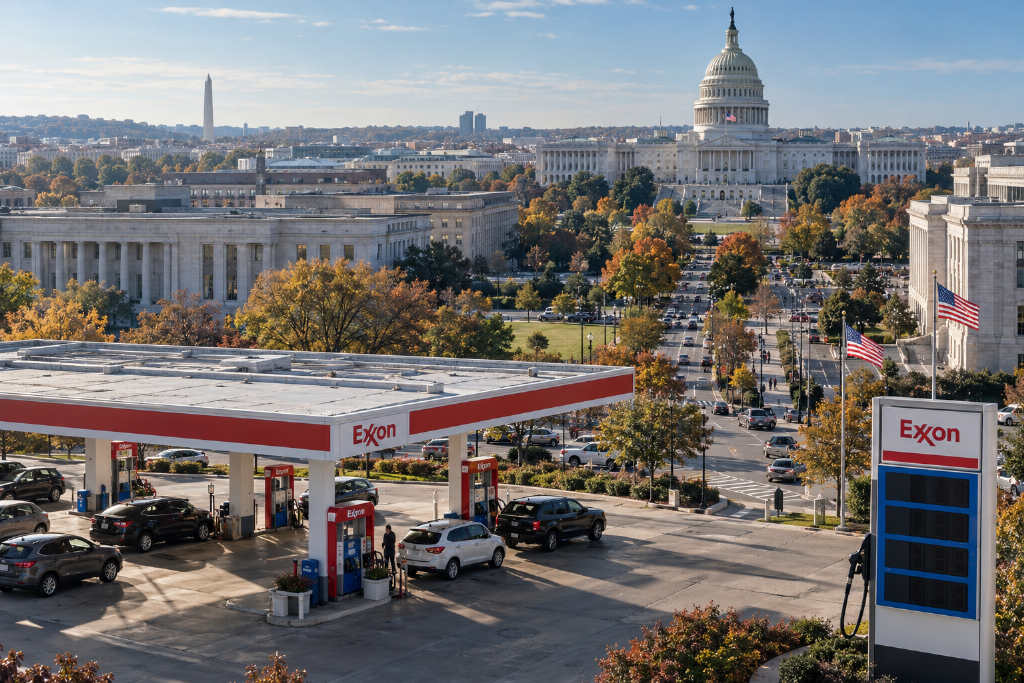
President Donald Trump said he is considering suspending the 18.4-cent-per-gallon federal gasoline tax, but the proposal would still need congressional approval because the president cannot halt the tax unilaterally.
Trump made the comment on Tuesday when asked whether the federal gas tax should be paused. 「We are considering it.」 The remark came 28 days before the midterm elections and marked his latest response to voter anger over fuel prices. Even so, the political path is narrow. Lawmakers would have to pass legislation, and Trump’s own party shelved a similar bill three weeks earlier. The House is not set to return until November, leaving no voting window before the election.
Estimated savings would be smaller than the headline tax rate
AAA data showed the U.S. national average for regular unleaded gasoline stood at $4.3685 per gallon on Tuesday, up $1.2352 from $3.1333 a year earlier, an increase of about 39%. Diesel was at $6.3151 per gallon after reaching a record $6.5276 on Sept. 22.
The federal tax is 18.4 cents per gallon for gasoline and 24.4 cents for diesel. At current gasoline prices, the 18.4-cent levy is equal to about 4.2% of the pump price.
Still, consumers would not necessarily receive the full benefit. According to estimates released by the Penn Wharton Budget Model on May 11, assuming a suspension runs from June 1 through Oct. 1 for 122 days, with pass-through rates of 0.72 for gasoline and 0.60 for diesel, pump prices would fall by about 13.2 cents per gallon for gasoline and 14.6 cents for diesel. The rest would remain with suppliers as profit. The 13.2-cent reduction is roughly 3% of current gasoline prices.
For a household filling a 15-gallon tank once a week, that works out to savings of about $1.98 per fill-up, or roughly $35 over 122 days. The direct effect on household budgets would be modest.
Both parties floated bills, but none advanced
The idea of a federal gas tax holiday is not new. It has repeatedly run into resistance in Congress.
- May 11: Trump first said he wanted to suspend the tax. On the same day, Republican Senator Josh Hawley introduced S. 4485, which proposed a 90-day suspension with an option for the president to extend it by another 90 days. Democratic Senator Mark Kelly introduced S. 4032, which called for a suspension through Oct. 1. Neither bill moved forward.
- Sept. 9: Trump said gasoline prices would not fall until after the midterm elections.
- Sept. 15-16: House Republicans debated the issue internally, and the bill was shelved.
- Oct. 5: Trump signed an executive order on diesel, temporarily allowing dyed diesel to be used on roads and delaying the related federal excise tax payment until year-end.
- Oct. 6: Trump said the administration was considering a gas tax suspension.
Executive authority stops short of canceling the gas tax
In its explanation of the Oct. 5 executive order, the White House said Trump temporarily allowed dyed diesel, which is normally tax-exempt and restricted to off-road use, to be used on roads. It also directed the Treasury Department to let users pay the related federal excise tax at the end of the year without interest or penalties. The White House said truck drivers could save more than $100 per fill-up.
That order also showed the limit of executive power in this case. The administration can delay diesel tax payments and loosen fuel-use rules, but eliminating the gasoline tax itself would still require Congress to act.
Highway Trust Fund revenue would take the hit
The cost of a suspension would fall first on the Highway Trust Fund.
The Committee for a Responsible Federal Budget estimated in March that a one-month suspension would reduce revenue by about $3.5 billion, while a six-month suspension would cut about $21 billion. Under that six-month scenario, the fund could run out around September 2027 instead of July 2028.
The Penn Wharton Budget Model’s four-month scenario put the revenue loss at about $11.5 billion, equal to roughly 19% of the fund’s projected fiscal 2025 spending of about $62 billion. The report also noted that the federal fuel tax rate has not been adjusted since 1993, leaving the fund under pressure even before any holiday.
CRFB also warned that suppliers could raise pre-tax prices, and that the stimulus from a tax cut could add upward pressure on inflation or interest rates, offsetting part of the savings.