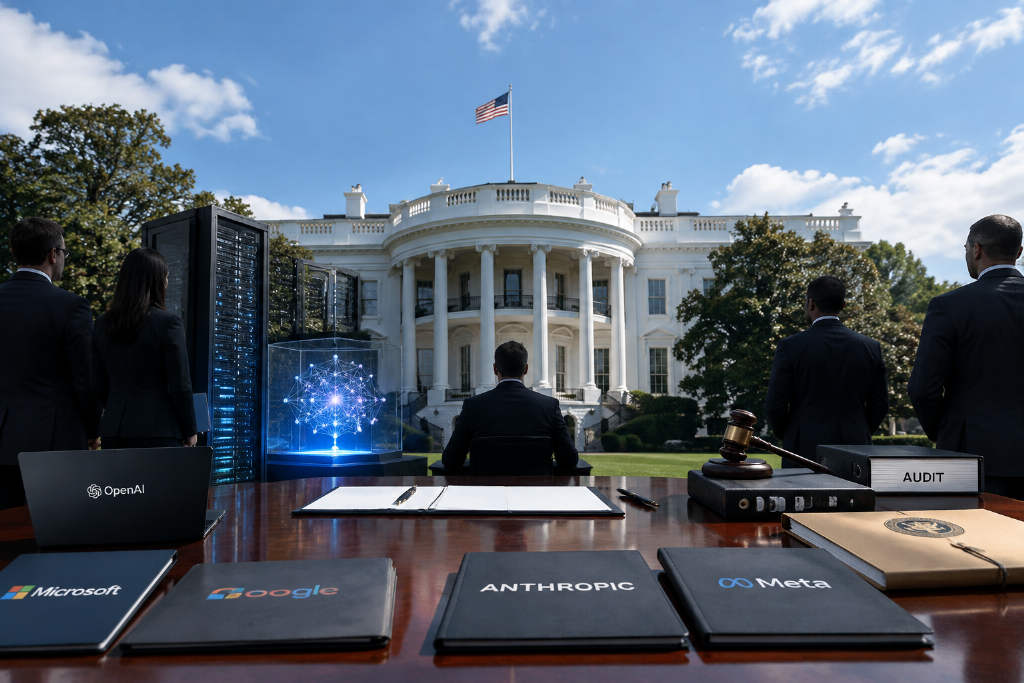
US President Donald Trump and a group of top technology executives signed a voluntary White House accord aimed at making sure advanced AI models behave as intended. The agreement, titled Joint Commitment on Frontier Responsibilities, places much of the burden for managing frontier AI risks on the companies building those systems rather than on immediate federal restrictions.
The accord calls for internal controls, independent external audits and board-level oversight to ensure models do not hack or access technical systems in unintended ways. It also leaves open the option of turning those commitments into law or regulation over time.
Trump said at the White House that he was seeing strong self-policing from the companies and that they understood they had to police themselves. The signatories included Google CEO Sundar Pichai, Anthropic CEO Dario Amodei, Meta CEO Mark Zuckerberg, OpenAI President Greg Brockman, Nvidia CEO Jensen Huang and xAI CEO Elon Musk.
The White House meeting also covered AI safety, industry growth and data center development. Trump separately ruled out a US-China joint venture to develop AI and, on the same day, signed an executive order directing the executive branch to use the term “Super Intelligence” instead of “Artificial Intelligence.”
US President Donald Trump and several technology executives signed a voluntary accord at the White House aimed at ensuring their AI models “behave as intended.” The agreement puts much of the responsibility for managing frontier AI risks on the companies developing those systems.
The move comes as concerns grow over the safety of increasingly capable frontier AI systems. Trump has opposed slowing AI development, citing competition with China.
White House accord sets out company responsibilities
The agreement is titled the Joint Commitment on Frontier Responsibilities. It calls for internal controls, independent external audits and board-level oversight “to ensure its models do not hack or access technical systems in unintended ways.”
The accord also leaves open the possibility that those commitments could later be turned into law or regulation, saying that may make sense over time.
According to Rapid Response 47, Trump told reporters at the White House: “I think I’m seeing tremendous self-policing. And they understand that they have to self-police.”
Google, Meta, OpenAI, Nvidia and xAI executives signed
The signatories at the White House included Google CEO Sundar Pichai, Anthropic CEO Dario Amodei, Meta CEO Mark Zuckerberg, OpenAI President Greg Brockman, Nvidia CEO Jensen Huang and xAI CEO Elon Musk.
The meeting also addressed AI safety, industry growth and data center development. Trump also ruled out a US-China joint venture to develop AI.
Trump also ordered use of “Super Intelligence”
On the same day, Trump signed an executive order directing the executive branch to use “Super Intelligence” instead of “Artificial Intelligence,” arguing that the term “more appropriately captures the promise, potential, and rapidly advancing capabilities of these technologies.”
This article was originally published by Bit.Fan. For more cryptocurrency news and market insights, visit www.bit.fan. Disclaimer:
The market information, project data, and third-party content displayed on this platform are for industry information sharing only and do not constitute any form of investment advice or return commitment.
Cryptocurrency trading carries high risks. Users should fully assess their risk tolerance and make independent decisions. All profits, losses, and legal responsibilities are borne by the users themselves.