
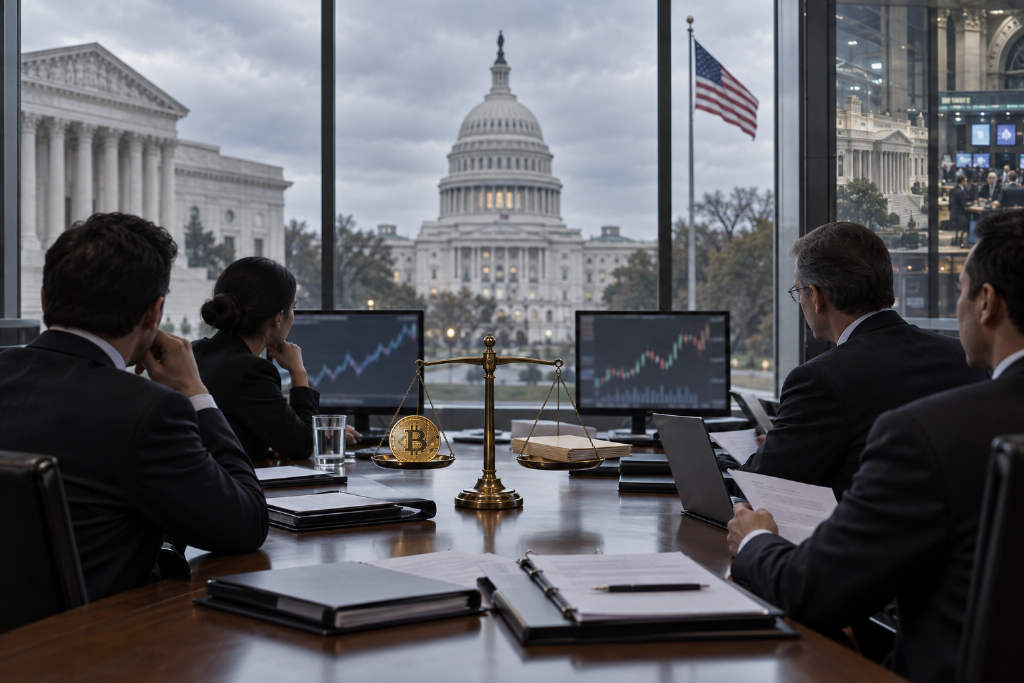
The U.S. Senate’s failure to move the Clarity Act forward has raised fresh questions about whether regulatory uncertainty will slow crypto mergers and acquisitions. Bankers and investors who spoke to CoinDesk said they do not expect the bill’s setback to bring dealmaking to a sudden stop. They expect a more uneven outcome instead: areas with clearer regulatory treatment may keep attracting buyers, while businesses tied to unresolved token rules could remain tougher to acquire.
This article is based on an excerpt from the upcoming CoinDesk Insider newsletter.
Senate setback narrows the path for legislation this year
The crypto industry had spent years waiting for Congress to produce a durable U.S. framework for digital assets, one that would clarify which assets fall under the Securities and Exchange Commission and which belong under the Commodity Futures Trading Commission. That kind of legislation would have given companies and investors more certainty than relying mainly on regulators whose policies can shift from one administration to the next.
Those hopes took a hit on Sept. 15. The Clarity Act failed a procedural vote in the Senate, drawing 49 votes in favor and 50 against, short of the 60 required to advance. Negotiations broke down over ethics restrictions on senior officials’ crypto business interests, including those involving President Donald Trump, along with concerns tied to investor protection and illicit finance.
With the November midterms approaching and little legislative time left, the vote sharply reduced the odds that the bill will pass this year. That leaves regulators to keep filling the gap.
Bankers say M&A is still moving, but buyers are selective
At first glance, the Clarity Act’s failure might look like a reason for crypto dealmaking to cool. Regulatory uncertainty can make acquisitions harder to price and harder to approve, especially for traditional financial firms looking at U.S. targets whose business models depend on tokens or activities that could be treated differently under future rules.
But Paul McCaffery, head of digital assets at investment bank KBW, told CoinDesk that the setback does not alter the broader direction of travel. 「The Clarity Act’s setback doesn’t change the trajectory,」 he said.
His view is that Congress is not the only source of regulatory progress. 「The SEC and CFTC are already moving proactively to provide the regulatory certainty markets need, and that’s unlocking a wave of M&A across digital assets, traditional financial services, and fintech alike,」 McCaffery said.
He pointed to several recent steps. Two days after the Senate vote, the SEC approved a temporary Innovation Exemption that allows limited trading of tokenized U.S. stocks on certain onchain venues. Then on Oct. 1, the agency proposed a new rule meant to clarify how investment firms can handle and custody customer crypto assets. The CFTC has also been removing some barriers, including relief for certain software providers and updated guidance on tokenized investments and blockchain-based recordkeeping.
McCaffery said the market is still early in what he described as a tokenization and digital-payments supercycle that is building internationally first and will eventually return to the U.S. He added that firms waiting for Congress risk missing the opportunity, and that buying rather than building can be the more efficient path.
Todd White, a partner at advisory firm Architect Partners, gave a similar assessment. He said regulatory action outside Congress should keep activity moving, especially in tokenization. In his words, the SEC’s response after the legislative failure could catalyze both commercial momentum and strategic transactions around tokenization. He also said the new Innovation Exemption should reinforce a shift already underway toward more liquid assets and institutional finance.
Record disclosed value, but activity is concentrated in a few large deals
The numbers show that digital-asset dealmaking has not stalled. According to CryptoRank Research, disclosed deal value in the sector reached a record $9.7 billion in the first half of 2026, up 44% from a year earlier.
That headline figure comes with an important qualifier. The number of announced acquisitions fell 8% year over year to 87. The four largest deals accounted for 76% of disclosed value, a sign that the market is being driven by a small number of large transactions rather than a broad-based rise in activity.
Payward, the parent company of Kraken, is one example of what is driving those deals. The company agreed to acquire payments firm Reap for $600 million and derivatives platform Bitnomial for up to $550 million. Nasdaq also agreed to invest $100 million in Payward alongside an expanded commercial partnership.
Those transactions point to continued demand for licenses, technology and distribution, even while comprehensive U.S. crypto legislation remains stuck.
Investors say legal clarity would still unlock more transactions
Not everyone believes SEC and CFTC action can fully replace legislation.
Dmitriy Berenzon, a partner at venture firm Archetype, said a clearer legal framework would lead to more deals and more partnerships across financial services and beyond, with broader economic benefits in the U.S. and overseas. He added that the GENIUS Act has already shown how clearer rulemaking can support stablecoin adoption.
Jake Brukhman, founder and CEO of venture capital firm CoinFund, framed the Clarity Act setback in a different way. He said it does not necessarily make the regulatory environment worse. What it does is leave in place the uncertainty that buyers were hoping would ease.
「Failure of Clarity does not create a new drag so much as preserve the regulatory uncertainty already weighing on the sector,」 Brukhman said. He added that the effect will not be uniform. In his view, the failed bill blocks a meaningful regulatory de-risking that could have accelerated dealmaking, especially for token-centric companies and pre-token financings. Equity-based infrastructure, payments, and businesses operating under clearer existing rules should be less affected.
Will Nuelle, general partner at Galaxy Ventures, described a similar divide. He said a clearer legal framework for digital assets would produce more deals, though not evenly across every category. He noted that deal activity has already concentrated in segments that the SEC and CFTC have de-risked through Project Crypto and joint guidance, including exchange infrastructure, spot trading, and tokenized collateral.
Washington’s delay leaves buyers weighing how much uncertainty they can absorb
The question now is whether buyers will keep pursuing those strategic opportunities while Washington continues working toward a lasting rulebook, or whether prolonged uncertainty will make them hesitate.
Nuelle said regulatory frameworks are generally helpful, especially for institutional adoption. That kind of adoption can support entrepreneurs building in the sector and also supports M&A activity.