
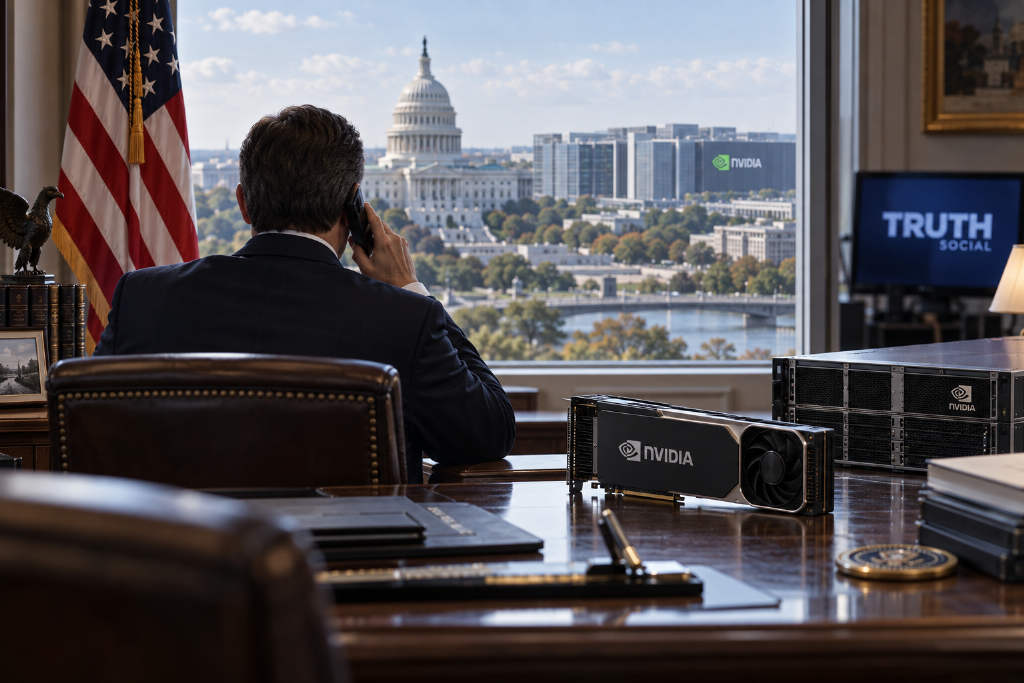
Donald Trump used a public phone call with Nvidia CEO Jensen Huang and a string of Truth Social posts to press a clear argument on artificial intelligence: claims that AI will destroy humanity or that machines will take over the world are a scam, while the bigger risk to the US is regulation, political panic, and resistance to data center construction.
Call with Jensen Huang at the ALL-In Summit
According to ABMedia, Trump recently called Huang while the Nvidia chief was on stage at the ALL-In Summit. Huang was appearing with All-In Podcast members Jason Calacanis, Chamath Palihapitiya, and David Sacks, and he briefly tried to put the call on speaker so the thousands in attendance could hear it.
During the exchange, Trump laid out his core view of AI. He said, "I understand AI, and I also have common sense about AI. Robots are not going to take over the world. AI is going to take over the rest of the world. The whole thing is a scam."
He added, "Whoever wins AI, wins. That’s how important it is. It’s bigger than the internet." In that framing, AI is not just another technology industry. Trump cast it as the next layer of infrastructure that could reshape the US economy.
Trump also defended data centers on the call, saying some American communities that had been in decline became prosperous again after data center investment arrived.
Truth Social posts target AI doomsday narratives
After the call, Trump posted repeatedly on Truth Social and made the same point even more directly. "The idea that AI will take over the world is a scam," he wrote.
He placed AI doomsday claims alongside political issues he has long criticized, including climate change, Russiagate, and impeachment, recasting disaster narratives around AI as a form of political fear. In his telling, people who say AI will destroy the world or that data centers will damage communities belong to the same camp as those who warned of global catastrophe from climate change.
Those comments came as Dario recently called for the AI industry to slow the frontier race and Anthropic said it would allow third-party evaluators to examine system safety on an ongoing basis with access close to employee level. Trump answered publicly by saying the US does not need to build an additional AI regulatory framework.
Direct criticism of Dario and Anthropic
Trump wrote, "The only control or ‘guardrails’ that AI needs is a strong and smart President." He also named Dario and Anthropic directly, saying the Trump administration had already stopped people in the AI industry from doing "bad, or possibly bad things," and saying Dario was now acting like a "perfect little angel."
He followed that with another claim: "We already have enormous criminal and regulatory power over these companies."
That marks a basic split between Trump and part of the AI safety camp. As summarized in the source article, AI safety advocates generally argue that existing legal systems may not be enough to handle future AI systems with high autonomy and capabilities beyond humans, which is why they support model evaluations, compute governance, third-party review, and even international agreements in advance.
Trump’s position is different. He argues that the government already has criminal, administrative, and regulatory tools in hand, and if companies actually engage in unlawful or dangerous conduct, authorities can intervene directly. On that basis, he says there is no reason to create a heavy regulatory structure in advance for AI doomsday scenarios that have not happened.
He also questioned the logic of AI companies asking for regulation in the first place, writing: "When in the history of business have you ever seen the leaders of an industry ask for regulation, when that regulation, if strictly enforced, would drive them into extinction and bankruptcy?"
Data centers as economic infrastructure
Trump’s posts did not focus only on AI models. He repeatedly linked AI with data centers. "The only reason there is suddenly opposition to AI/data centers is because the United States is so far ahead of the rest of the world," he wrote, before adding: "Don’t kill the goose that lays the golden eggs."
He described data centers as tools for wealth creation, not as burdens on local communities. That matched what he said on the call with Huang: places that had been declining became prosperous again after data center investment.
In the policy logic outlined by ABMedia, Trump is treating data centers more like steel mills, auto plants, oil fields, or railroads than ordinary server rooms. They stand for capital spending, land development, energy demand, jobs, tax revenue, and the broader AI supply chain.
He pushed the point further by writing that "AI and data centers will be the greatest economic development engine ever, bigger than oil, gold, diamonds, and even the internet."
Google and the Finland example
Trump also singled out Google. He said Google recently indicated that it wanted to build a large facility in Finland, with one reason being that US permitting is too difficult. Trump said he was "very unhappy" about that and wanted Google to change the decision.
In his view, if an American AI or technology company chooses to build computing capacity overseas because of electricity, land, environmental review, or administrative procedures, that reflects a policy failure in the United States itself.
China remains the central frame
The final point running through Trump’s remarks was China. He repeatedly wrote, "WHOEVER WINS AI, WINS!"
Trump said the US still leads China and other countries, which is why opposition to AI and data centers is especially dangerous right now. In his framing, this is not a routine contest among companies. It is a national-level technology race.
If the US slows itself because of model safety concerns, local opposition to data centers, energy constraints, or permitting delays while China keeps pushing ahead, then "safety" itself could turn into a national security risk, according to that argument.