
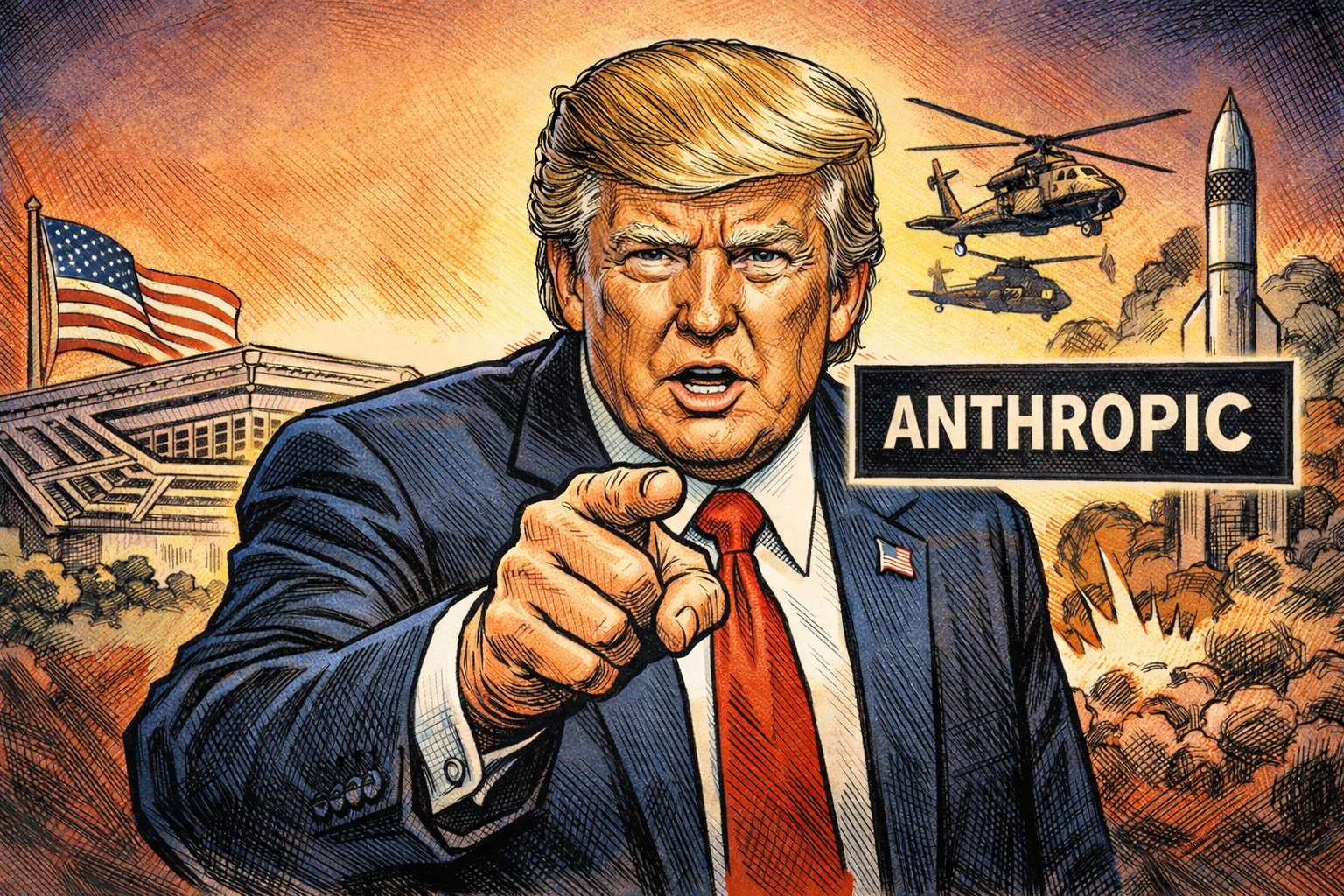
President Donald Trump ordered U.S. federal agencies to “immediately stop using” all Anthropic technology, turning a dispute over AI safety rules into a federal crackdown. The trigger was Anthropic’s refusal to remove two built-in Claude restrictions: a ban on use in fully autonomous weapons and a ban on mass domestic surveillance. In a February 28 Truth Social post, Trump said the government would no longer do business with the company, while giving the defense establishment a six-month phaseout period where Anthropic tools were already deeply embedded.
The Pentagon had demanded access for “all lawful purposes” and tied that demand to a $200 million military contract. Defense Secretary Pete Hegseth then labeled Anthropic a “supply chain risk,” a designation that would block defense contractors and suppliers working with the U.S. military from maintaining commercial ties with the company. That moved the conflict well beyond a single procurement dispute.
Anthropic says the red lines will stay
Anthropic co-founder and CEO Dario Amodei said pressure from Washington would not change the company’s position and that he could not agree to the request in good conscience. In a formal statement, Anthropic gave two reasons. First, current frontier AI models are not reliable enough for fully autonomous weapons, and premature deployment could endanger U.S. service members and civilians. Second, mass domestic surveillance would violate basic human rights.
The company said it had supported U.S. military personnel since June 2024 and wanted that work to continue, but would challenge any supply chain risk determination through legal channels. According to NBC News, Anthropic did offer a narrower compromise by allowing Claude to be used for defensive cases such as missile defense, while holding firm on autonomous weapons and large-scale domestic surveillance. A Pentagon counterproposal included legal language that could bypass the safety guardrails at any time, and Anthropic rejected it.
OpenAI publicly sides with a rival
The sharpest surprise came from OpenAI. CEO Sam Altman said on CNBC that the Pentagon should not make threats of this kind, adding that while he has many disagreements with Anthropic, he trusts the company on safety. The comment stood out because only on February 19, Altman and Amodei drew attention at an AI summit in India after refusing to shake hands during a public photo opportunity.
Support spread beyond executive comments. A total of 70 OpenAI employees signed an open letter titled “We Will Not Be Divided,” and Google engineers joined the effort. By the time of the report, the number of signatories had passed 450. The letter called on AI companies to reject demands that would allow their models to be used for mass domestic surveillance or for lethal autonomous actions without human oversight.
OpenAI kept its own restrictions in Pentagon talks
Fortune reported that OpenAI was also discussing a possible Pentagon agreement at the time, though no contract had been signed. In an internal all-hands meeting, Altman said OpenAI would retain control over technical safeguards, deployment targets, and deployment regions. Use of its models would be limited to cloud environments, excluding aircraft, drones, and other edge systems.
OpenAI’s stated red lines were also explicit: no use in autonomous weapons systems, no use in mass domestic surveillance, and no use in critical decision-making domains. The U.S. government agreed to include those limits in contract language. Anthropic faced a federal halt order and a supply chain risk label for defending similar boundaries, while OpenAI saw its own restrictions written into a negotiating framework. The gap between those outcomes quickly became one of the central questions raised by the dispute.