
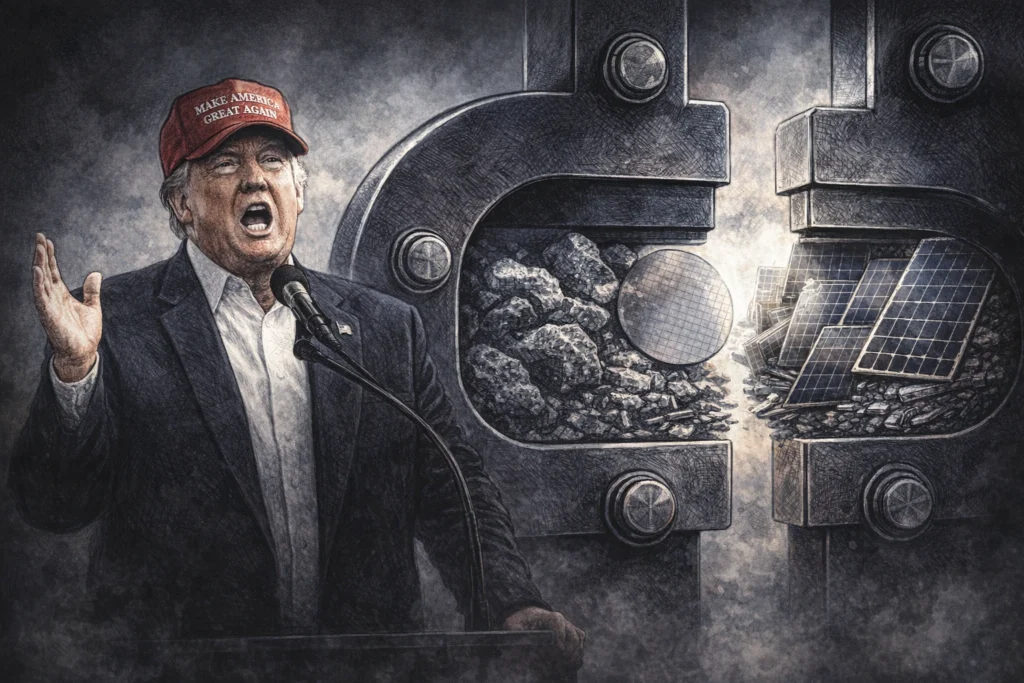
The Trump administration could formally announce new trade restrictions on polysilicon as soon as Aug. 6 Eastern Time, according to Reuters, which cited four people familiar with the matter. The reported package includes a tariff of at least 15% on polysilicon derivative products and minimum import prices for polysilicon, wafers, solar cells, and solar modules.
The move targets a raw material that sits high up in both the semiconductor and solar supply chains. Based on the policy details that have emerged so far, the plan has two parts: a 15% tariff on polysilicon derivative products, and a price floor for imports of polysilicon, wafers, solar cells, and solar modules. Imports priced below that floor would not comply with the new rules.
Bloomberg reported separately that officials are also preparing a temporary offset mechanism. Under that arrangement, importers that invest in US wafer and solar cell production capacity could receive credits to offset the extra costs created by the tariff and the minimum price requirement.
Polysilicon sits at the base of chip and solar manufacturing
Polysilicon is refined silicon material, and its end use depends on purity. Electronic-grade polysilicon can be processed into chips, while solar-grade material has slightly lower purity and is widely used in silicon-based solar panels.
The legal basis for the proposed tariff and price floor traces back to July 14, 2025, when the US Commerce Department’s Bureau of Industry and Security, or BIS, opened a national security investigation under Section 232 of the Trade Expansion Act. The probe covers polysilicon and its derivative products, silicon wafers, solar cells, and solar modules. According to the report, the goal is to reduce US dependence on foreign polysilicon supplies while checking China’s continued expansion across the chip supply chain.
The report said China still dominates the solar industry supply chain, which helps explain why the White House is focusing on upstream materials.
Reported tariff rate is lower than some forecasts
The 15% figure is milder than some market expectations. Analysts at Roth Capital Partners had previously estimated that the tariff could come in between 25% and 35%, making the reported version notably lower.
Roth also estimated that the minimum import price could raise the cost of imported solar cells by $0.10 per watt. On a full module basis, that would translate into an added cost of about $600 to $800, with the burden likely ending up on businesses and households installing solar systems.
The report named two companies that could benefit from stronger protection for domestic production capacity in the United States: Michigan-based Hemlock Semiconductor, a joint venture between Corning and Japan’s Shin-Etsu Handotai, and Munich-headquartered Wacker Chemie, which has operations in Tennessee. After the news emerged, Corning shares rose more than 9% at one point.
The US Commerce Department and the White House had not responded to requests for comment at the time of the report. The final text of any official announcement could still change.