
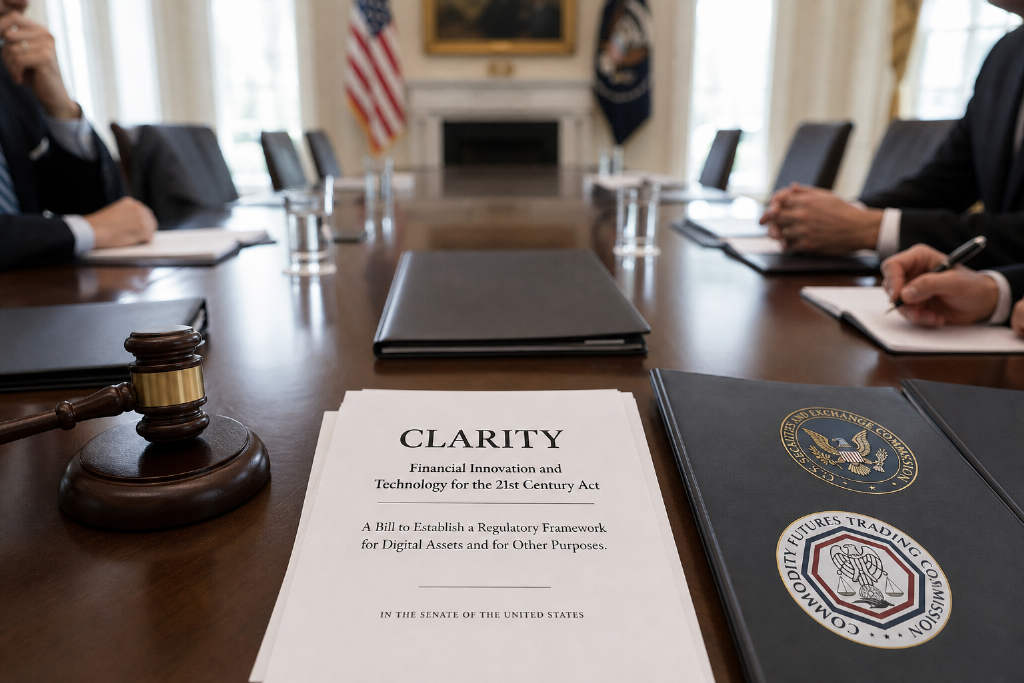
U.S. crypto regulation moved quickly this week as the Trump administration pushed the CLARITY Act forward, the SEC proposed its first crypto-asset rule framework, and the CFTC said it would move ahead with its own market rules if Congress fails to act.
Trump met at the White House with executives from Coinbase, a16z, Ripple and Kraken, and publicly urged lawmakers to pass what he called a "fair version" of the CLARITY Act. The discussions focused on the bill’s possible effects on U.S. jobs, innovation and the return of crypto companies to the country.
One of the main sticking points remains certain ethics provisions. Trump said the language may target individuals, while industry figures are working to find a compromise that could win bipartisan support.
CFTC Chair Mike Selig said the CLARITY Act is key to reducing regulatory uncertainty. If Congress keeps delaying action, he said the CFTC will use its existing authority to set rules for the crypto-asset market.
The SEC, meanwhile, formally introduced its Regulation Crypto Assets framework. The proposal would allow some crypto fundraising to avoid full securities registration if certain conditions are met, including a cap of $5 million over four years or $75 million annually. It would also create a conditional safe harbor for some token projects. The SEC is also considering limits on some state-level securities registration requirements.
Market participants see the recent moves as a sign that Washington is shifting away from enforcement-led oversight and toward a more structured crypto regulatory system.
Outside the policy arena, former Signature Bank chairman Scott Shay launched N3XT Digital Dollar (NDD), a digital-dollar deposit project aimed at the stablecoin market. NDD runs on a public blockchain, enables around-the-clock dollar transfers, and is backed one-for-one by cash and short-term U.S. Treasuries. Shay said banks can use blockchain to build a stablecoin-like payment system while preserving the trust associated with the traditional dollar system.
Crypto investment activity is also showing signs of a new cycle. Dragonfly partner Rob Hadick said that although AI is attracting large amounts of capital, crypto startup activity is recovering. He pointed to prediction markets, institutional applications and improved U.S. regulation as possible drivers of the next phase of growth.