
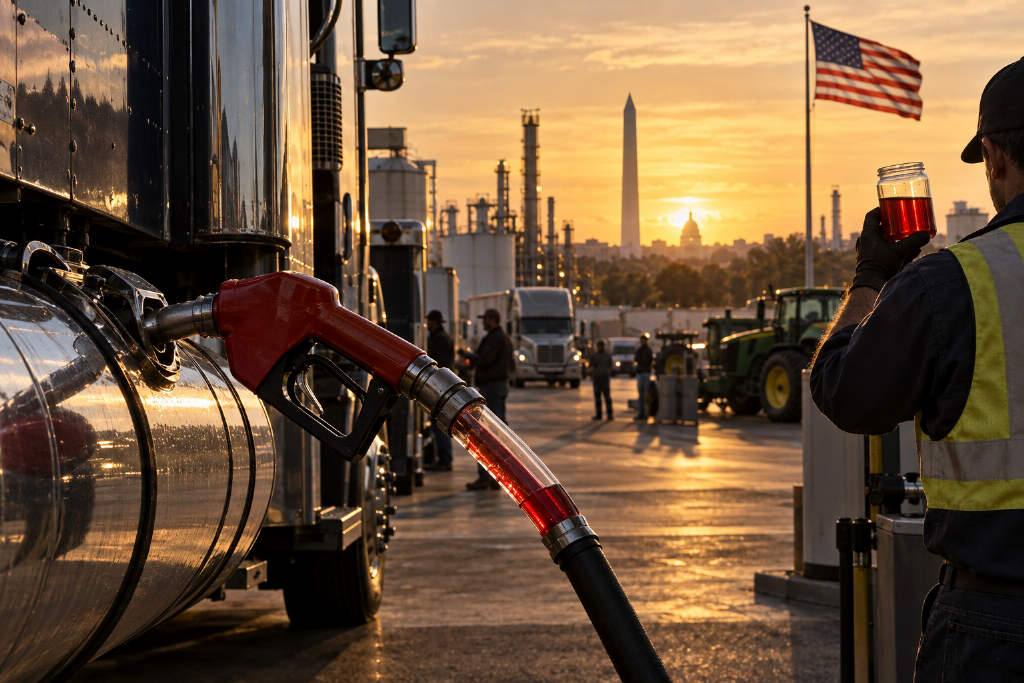
BlockBeats reported on Oct. 7 that U.S. President Donald Trump signed an executive order on Monday temporarily allowing tax-exempt red diesel, normally used in agriculture, mining, and other off-road sectors, to be sold into the highway transportation market.
The policy is meant to reduce the fuel tax burden for truck transport and ease pressure on logistics costs. Regular on-road diesel in the U.S. is currently subject to a federal excise tax of 24.3 cents per gallon, while red diesel is generally tax-exempt. On that basis, if the measure is fully passed through to end users, diesel costs could fall by as much as about 24.4 cents per gallon.
That said, the move does not increase diesel production. It changes the tax and usage rules tied to the fuel, but leaves underlying supply unchanged.
Diesel supply pressures remain in place
U.S. diesel supply is still facing several sources of strain. According to the report, refinery utilization is already running at high levels, Russia has restricted exports of refined products, and refined fuel supply from the Middle East has been disrupted. Those factors have kept diesel prices elevated.
Data from the American Automobile Association showed the national retail average for on-road diesel climbed to a record $6.528 per gallon on Sept. 22. It was still around $6.315 per gallon on Tuesday.
Distribution and infrastructure are still a constraint
Red diesel is mainly distributed through dedicated agricultural and industrial or mining channels. Highway truck stops broadly lack the storage and dispensing facilities needed for it. Even with the rule change, that leaves a practical limit on how quickly red diesel can move into road transport at scale.
Industry groups also warned that if large numbers of truck operators start buying red diesel through rural channels, fuel available for farm machinery could be squeezed during North America’s peak fall harvest period.
Analysts say the core issue is still inadequate supply
Energy analysts said expanding the permitted use of tax-exempt diesel would not change wholesale diesel prices or refinery capacity. At most, it can lower the tax burden for part of the end-user market. The real bottleneck in the U.S. diesel market, they said, remains a shortage of supply.