
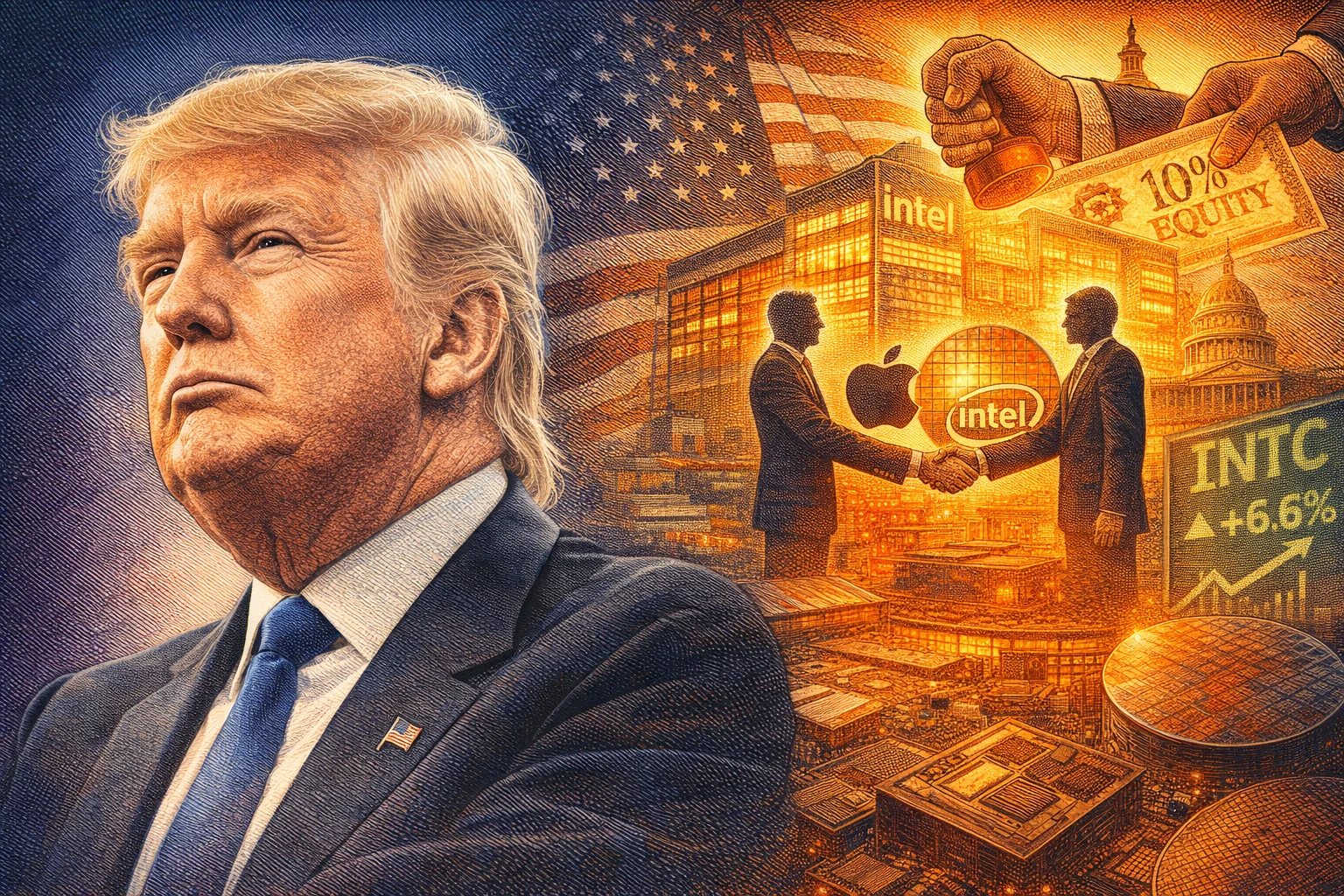
US President Donald Trump said early on June 18 on Truth Social that Apple had agreed to work with Intel to design and manufacture chips in the United States. The post quickly moved the market. Intel shares rose as much as 6.6% in premarket trading and were up about 5.7% overnight, while Apple gained only 0.6%.
Trump post puts Intel back in focus
Trump wrote that Apple had agreed to partner with Intel on chip design and production in the US. That statement pushed Intel back into the spotlight and triggered a sharp reaction in early trading. Apple, despite being named in the post, saw only a limited move in its stock.
He also pointed to the US government’s investment in Intel. According to Trump, the government acquired a 10% stake when Intel’s market value was about $100 billion. He said Intel’s market capitalization has now passed $600 billion, implying that the paper value of that holding has increased about sixfold.
Agreement described as preliminary
Public details remain sparse. Several media reports said the arrangement is still in a preliminary stage. The Wall Street Journal reported in May that Apple and Intel had spent more than a year in talks before reaching an initial agreement under which Intel would manufacture some chips for Apple.
Bloomberg also reported last month that Apple was evaluating whether to shift some main processor production to Intel and Samsung, reducing reliance on TSMC. As of publication, neither Apple nor Intel had formally commented, and no product lineup, production schedule, or financial terms had been disclosed.
Supply chain diversification remains the key issue
Based on the available information, the discussion centers on domestic manufacturing in the US and broader supply chain diversification. The source material does not specify which chip families are involved, and it does not confirm whether Apple’s A-series or M-series chips are part of the plan. What is clear is that Apple has been reviewing options beyond its current manufacturing setup.
The market reacted to Trump’s claim first. The actual scope of any agreement, the products covered, and the timing of mass production have yet to be made public.