
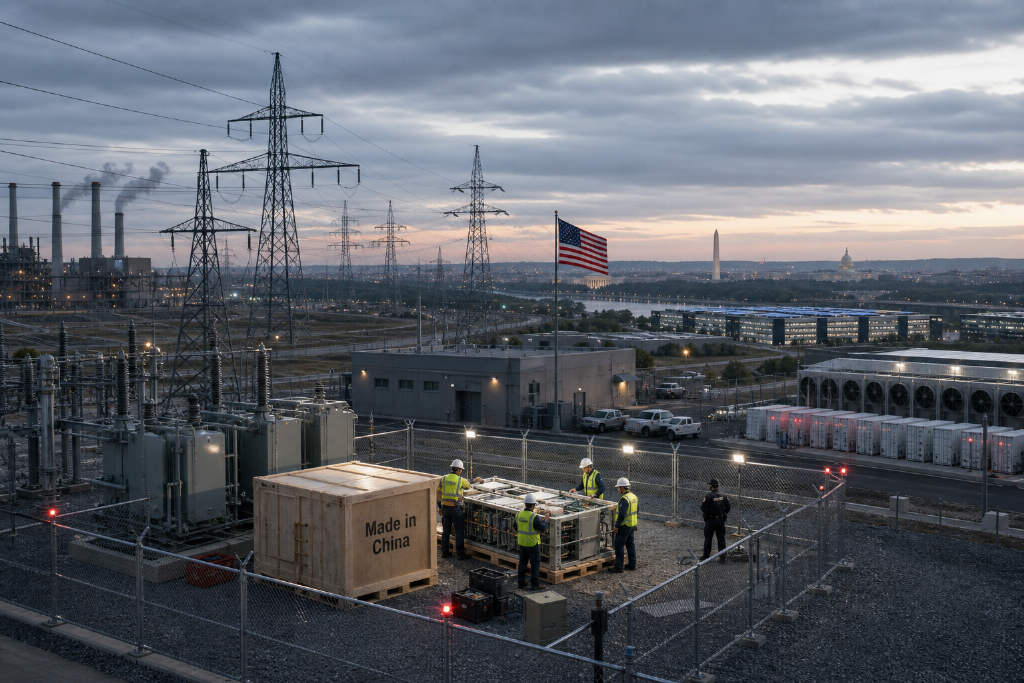
President Donald Trump signed an executive order on Aug. 26 declaring a national emergency over the U.S. bulk power system, saying chips or digital backdoors hidden inside grid equipment could expose critical infrastructure to remote interference by hostile foreign actors.
The order bars companies from purchasing, importing, or installing certain foreign-made bulk power system equipment in the United States. It does not explicitly name China, but a White House fact sheet released alongside it pointed to Chinese-made grid components imported in large volumes.
Backdoor concerns moved to the national security level
The administration treated the possibility of undisclosed chips or digital backdoors in power equipment as a national security risk. The order says weaknesses in grid equipment amount to an "unusual and extraordinary" foreign threat, with legal authority drawn from the International Emergency Economic Powers Act, or IEEPA, and the National Emergencies Act, or NEA.
At the core is a simple concern: equipment embedded deep inside the power network could contain functions that allow unauthorized remote access or shutdowns.
Reuters findings and EU action were cited as context
The report says those fears were not raised in a vacuum. Reuters last year examined equipment already integrated into grid operations and, after reviewing its cybersecurity posture, found undocumented communication modules inside several Chinese-made solar inverters. In practical terms, that meant the devices had external communication channels users did not know about.
The European Commission had also already moved on the issue. According to the report, energy tenders backed by public funding in the European Union are barred from purchasing Chinese-made inverters. Europe had already used policy to keep that concern outside the door; this U.S. order pushes the same line of thinking into the federal national security framework.
What the order covers
The definition of a bulk power system in the order is specific. It covers high-voltage transmission lines, substations, and power plants, the backbone that moves electricity across the United States. Local distribution lines serving homes are outside the scope.
The restrictions work on two levels. On the hardware side, companies cannot buy or install certain foreign-made bulk power system equipment in the country. On the software side, critical programs and digital functions that could create cybersecurity or operational risks are also subject to review and control.
Existing equipment does not have to be ripped out at once. The energy secretary is authorized to establish the conditions under which it may continue operating.
Two categories of countries are targeted
The order says certain foreign actors have continued to implant and exploit cybersecurity vulnerabilities in the U.S. bulk power system, pointing to the risk of digital backdoors embedded in software that could allow overseas actors to bypass authorization and remotely operate or shut down equipment.
According to the report, the restrictions are aimed at two categories of countries: those under U.S. arms embargoes or sanctions, and those the Trump administration considers to have governments acting against U.S. interests.
The piece also places the move in a broader pattern. Washington previously pushed allies to exclude Huawei Technologies and ZTE from next-generation mobile networks on cybersecurity grounds, and both companies were later placed on trade blacklists. This time, the focus has shifted from telecom gear to power grid hardware.
AI and Bitcoin mining are intensifying the power race
The order also highlights timing. Artificial intelligence data centers and other advanced technology projects are expanding quickly, increasing U.S. dependence on stable electricity supply. If the backbone grid fails, the fallout would be greater than in the past.
The report says U.S. data center power demand is expected to jump from about 4 GW in 2024 to 84 GW in 2030, making electricity a decisive resource in the AI race.
Cryptocurrency miners are part of that scramble as well. U.S. Bitcoin miners currently control more than 5 GW of power capacity, with another 6 GW under development, according to the report. A number of mining companies have also shifted into AI compute hosting in recent years, putting them in direct competition with data centers for electricity and grid interconnection capacity.
New compliance pressure for miners and data center operators
For Bitcoin miners and AI infrastructure operators, the message is clear: supply chain security for grid equipment is now part of national security screening, not just a matter of procurement cost.
In the near term, operators using inverters or control systems sourced from restricted countries may need to plan replacements or alternative suppliers earlier, or face compliance thresholds set by the Department of Energy.
Over a longer horizon, grid capacity was already one of the biggest bottlenecks for both AI expansion and crypto mining. Added geopolitical scrutiny means one more security checkpoint in front of an already crowded interconnection queue.