
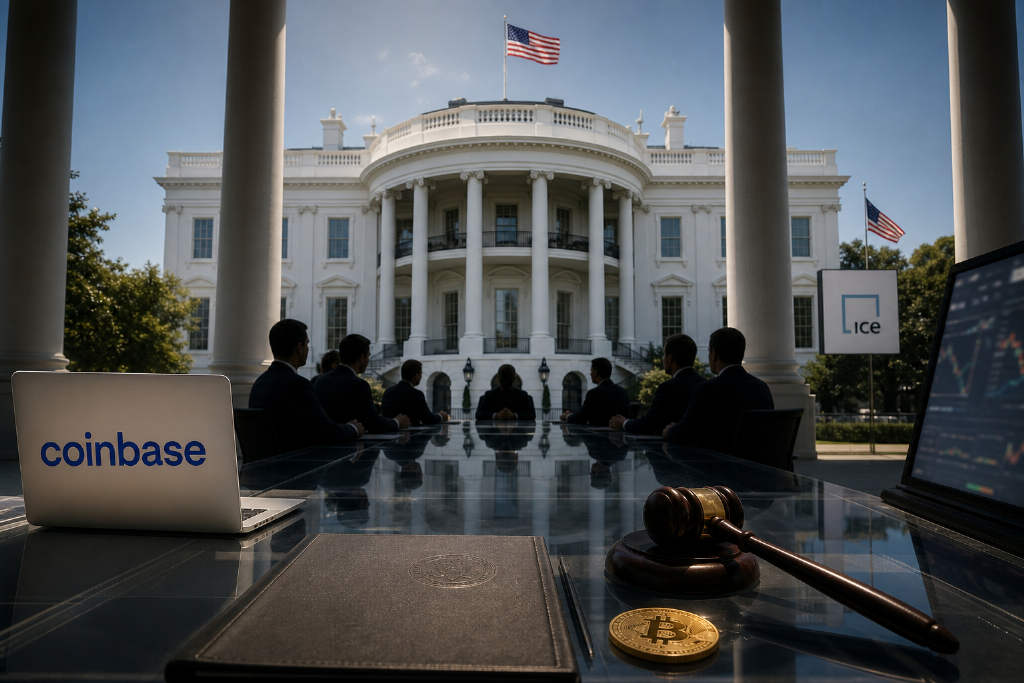
President Donald Trump convened a White House roundtable in Washington on July 20 with senior officials from U.S. financial regulators and executives from crypto, finance and technology companies, using the meeting to spell out a more supportive line on digital assets.
The market reaction described in the source was immediate. Bitcoin briefly jumped from $65,000 to $70,000 overnight, Ether rose nearly 20%, and HYPE moved close to an all-time high.
Regulators and industry leaders gathered at the White House
Attendees included Commodity Futures Trading Commission Chair Mike Selig, Securities and Exchange Commission Chair Paul Atkins, and Patrick Witt, executive director of the President’s Council of Advisers for Digital Assets.
Industry participants included Coinbase CEO Brian Armstrong, Intercontinental Exchange and New York Stock Exchange CEO Jeff Sprecher, Nasdaq CEO Adena Friedman, Robinhood CEO Vlad Tenev, Kraken CEO Arjun Sethi, Ripple CEO Brad Garlinghouse, Chainlink co-founder Sergey Nazarov, and the Winklevoss twins.
Trump said the United States is competing with other countries for leadership in financial markets and AI, and pledged to make sure the future of global financial technology is built and developed in the U.S. The participant list made clear that crypto was one of the central themes of the event.
Trump highlighted the GENIUS Act and pushed for the Clarity Act
Trump discussed two crypto-related bills during the meeting: the GENIUS Act and the Clarity Act.
- The GENIUS Act: Trump said he signed the measure a year earlier and described it as a landmark law. As presented at the meeting, the act is meant to support large-scale adoption of compliant dollar-pegged stablecoins. Trump also framed it as a measure that reinforces the dollar’s global standing and drives overseas capital into U.S. Treasuries.
- The Clarity Act: Trump said the bill is at a critical stage in Congress. It is intended to create a legal distinction between crypto securities and crypto commodities.
Trump urged Congress to pass the Clarity Act quickly and establish a clear legal framework for digital assets. During his remarks, Armstrong said Congress plans to vote on the bill on Sept. 15. If approved, he said, the regulatory tailwinds seen over the past year would be locked in through legislation.
CFTC points to Bitcoin perpetual futures and Hyperliquid
Mike Selig used the event to outline several CFTC initiatives.
- First compliant Bitcoin perpetual futures contract: Selig said the first true Bitcoin perpetual futures contract in the U.S. was launched in May 2026 on a CFTC-registered exchange.
- Framework for Hyperliquid: He said the CFTC is working to build a compliance framework that would allow decentralized trading protocol Hyperliquid to enter the U.S. market in a fully lawful way.
- Protection for prediction markets: Selig also said federal regulators are stepping in to prevent state officials from interfering beyond their authority in compliant prediction markets. The source specifically mentioned New York Attorney General Letitia James.
The source tied the sharp move in HYPE to the public mention of Hyperliquid during the meeting.
SEC outlines a new crypto asset rule and cites public market data
Atkins said the SEC has just proposed a new crypto asset rule aimed at resolving legal uncertainty for crypto startups seeking to raise equity and capital through digital assets in the United States.
He also cited public market figures since the new administration took office: 583 companies have gone public, up 75% year over year, raising a combined $28 billion. Atkins linked that activity to what he described as a rationalization of IPO thresholds.
The meeting also included discussion of what was referred to as the “Trump Account,” which was presented as a way to help a younger generation of investors participate more fully in capital market gains.
The financing rule was one of the key items watched by the market because it addressed the compliance path for using digital assets in equity and capital formation.
Trump says he is open to a bigger Bitcoin reserve
During the press Q&A, Trump was asked whether the U.S. government would consider expanding its Bitcoin reserve. He said he is open to the idea and would listen to recommendations from his regulatory team.
AI power policy was also mentioned
The event also touched on AI, though the source said few concrete details were offered. In response to the sector’s heavy electricity demand, Trump proposed a fast-track approval process that would allow technology companies to build dedicated power plants with approvals completed in two to three weeks. He said the arrangement would avoid crowding the public grid and would allow excess electricity to be fed back into the traditional grid.