
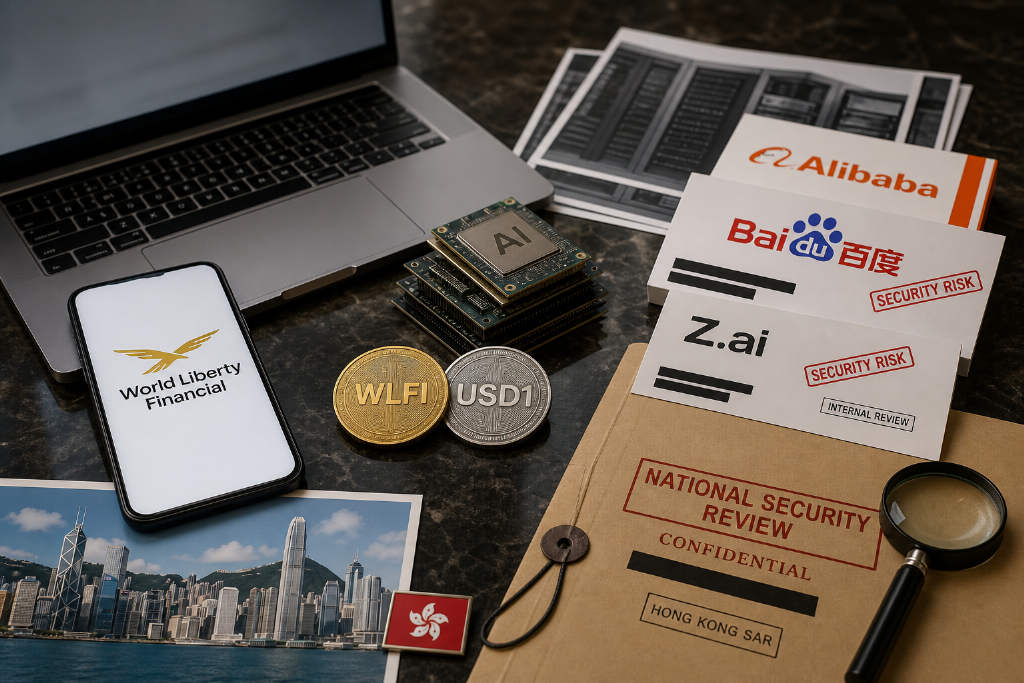
World Liberty Financial, the crypto venture backed by President Donald Trump, is collaborating with a Hong Kong-based company that resells artificial intelligence models from Chinese firms the U.S. administration has flagged over national security and intellectual property concerns, according to a Reuters report cited by Unchained.
WorldClaw offers Chinese models flagged by U.S. agencies
The company, WorldClaw, was founded earlier this year and accepts World Liberty’s crypto tokens as payment.
Reuters said its review of WorldClaw’s website found that 43 of the 90 available models came from Alibaba, Baidu, Z.ai and other Chinese technology companies the administration says pose risks to national security and intellectual property. That is close to half of the models listed on the platform.
The Defense Department has designated Alibaba and Baidu as Chinese military-aligned companies, a status that bars the Pentagon from doing business with them. Z.ai, formerly known as Zhipu AI, is on the Commerce Department’s entity list, where U.S. firms seeking export licenses to sell to it face a presumption of denial.
WorldClaw also offers models from DeepSeek and Moonshot. Reuters said administration officials have accused both companies of stealing U.S. intellectual property. At the same time, the platform carries dozens of American models, including offerings from OpenAI and Anthropic.
Payment flow draws attention to Trump family crypto income
Reuters said the financial connection is the key issue for people tracking the family’s crypto revenue.
The Trump family owns 38% of World Liberty and earns from the sale and use of the project’s $WLFI governance token and USD1 stablecoin. Reuters said USD1 is backed by assets including Treasury securities that generate interest, and the family is entitled to a share of that income.
When WorldClaw customers pay in USD1, World Liberty makes money. Reuters said it could not establish the terms of the arrangement or determine how much the family has earned through the collaboration.
Not illegal, but questioned against the administration’s public stance
Reuters said there is nothing illegal about the collaboration. It also noted that lower-cost Chinese AI models are gaining traction globally, including among U.S. technology companies.
Still, seven experts on Chinese technology, trade and government ethics told Reuters that the arrangement cuts against the administration’s stated position.
Sam Bresnick of Georgetown’s Center for Security and Emerging Technology said it was hypocritical to profit from Chinese AI tools while the government works to counter them. Peter Jeydel, who leads sanctions and trade controls at Troutman Pepper Locke, said the arrangement could be seen either as a tension inside a China-hawk administration or as consistent with a business-first approach.
Daniel Remler of the Center for a New American Security pointed to user risks that could include Chinese government monitoring, censored outputs and malicious code capable of hijacking AI agents.
World Liberty has faced earlier scrutiny
Reuters also noted that World Liberty’s due diligence has come under scrutiny before. Senator Elizabeth Warren has pushed to block the Trump family from profiting from crypto activities.
In June, Reuters reported that the family’s earnings from World Liberty tokens had topped $1.4 billion, the biggest share of its total crypto revenue of $2.3 billion.