
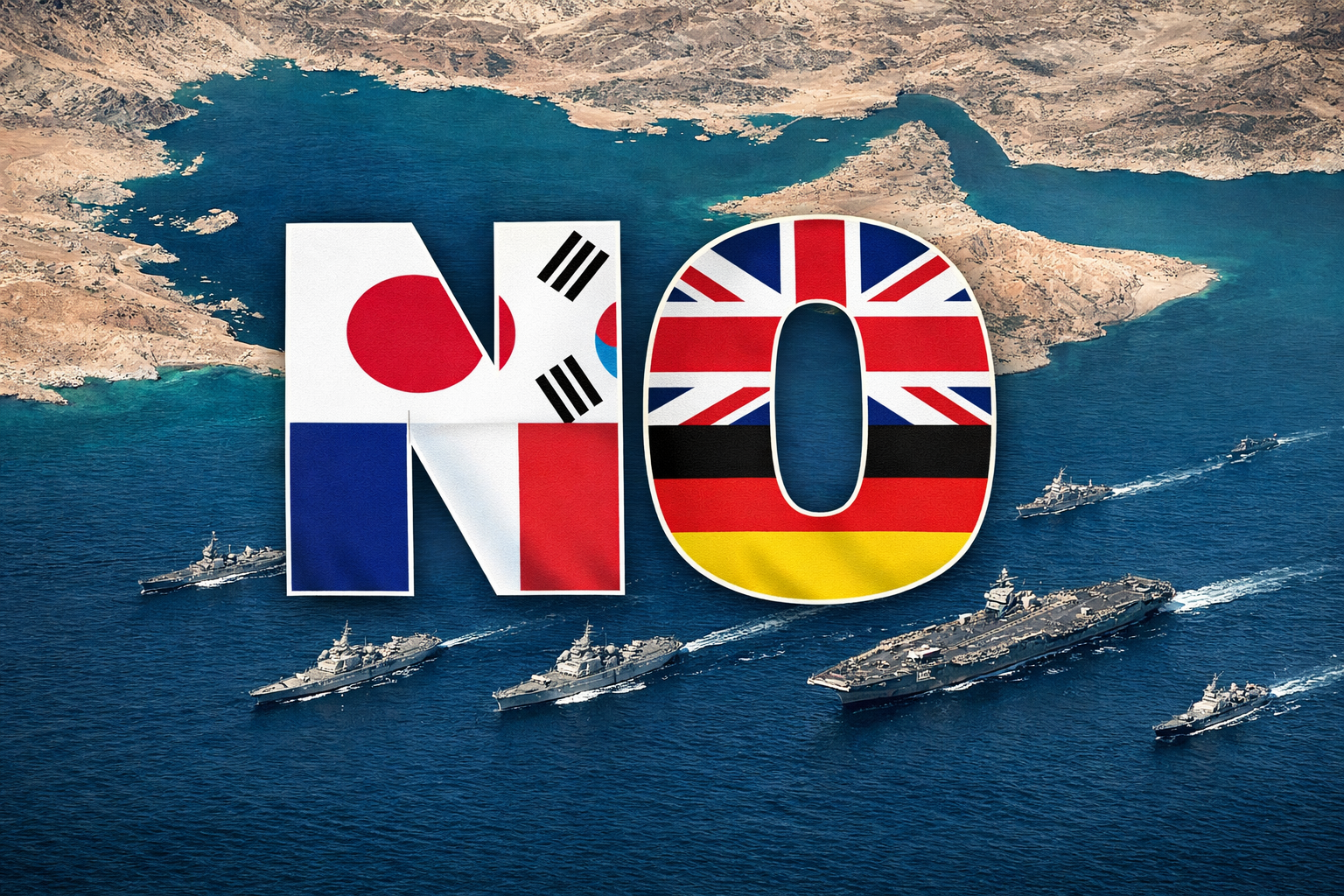
Trump’s appeal for foreign naval escorts in the Strait of Hormuz drew little support, with governments across Europe and Asia declining to join. According to the source material, Trump said on March 14 aboard Air Force One that he had asked China, the UK, France, Japan, South Korea and others to send warships to protect shipping through the strait, arguing that many of those economies rely heavily on the route for crude imports. In an interview with the Financial Times, he also warned that if countries refused to cooperate, “this will be very bad for the future of NATO.”
European and Asian partners kept their distance
The response from Europe was blunt. German Defense Minister Boris Pistorius questioned what Trump expected a few European frigates to do that the US Navy could not. A German government spokesperson said the war had nothing to do with NATO. French President Emmanuel Macron said France was not a party to the conflict and would not take part, under current conditions, in any operation to open or free the Strait of Hormuz. UK Prime Minister Keir Starmer said allies were discussing ways to reopen the waterway, but stressed that it would not be a NATO mission and that Britain would not be pulled into a wider war.
Asian allies were no more willing to commit. Japan’s Prime Minister’s Office denied that Washington had made a specific request for dispatching warships. South Korea’s foreign ministry said it had taken note of Trump’s call and would coordinate closely while making a cautious assessment. Australia, Poland, Sweden and Spain also said they would not send naval vessels.
The source contrasts 1987 with the current crisis
The article sets this episode against the Reagan administration’s 1987 convoy operation in the Persian Gulf. It says that during the Iran-Iraq “Tanker War,” Kuwait sought US help, leading Washington to reflag Kuwaiti tankers and launch what the source describes as the largest naval escort mission since World War II. That operation reportedly carried out 127 escort missions, protected 270 ships, and ended with zero losses. Britain, France, Italy, Belgium and the Netherlands all sent ships in support.
In the source’s telling, the real difference between 1987 and 2026 is not the military challenge but the state of alliance trust. Reagan was responding to an existing crisis and consulted allies along the way. By contrast, the 2026 conflict is described as a war launched unilaterally by the US and Israel. The source says no NATO member was consulted before the February 28 airstrikes, and some European diplomats learned about them from the news.
Tariffs, defense pressure and unilateral action are presented as the backdrop
The source links the refusal to a longer pattern of pressure on allies. It says Trump demanded in early 2025 that NATO members raise defense spending to 5% of GDP, up from the previous 2% goal, and threatened to leave the alliance when many European states said that target was unrealistic. It also says that in January 2026, over Greenland-related tensions, Trump imposed punitive tariffs of 10% to 25% on eight NATO allies: Denmark, Norway, Sweden, France, Germany, the UK, the Netherlands and Finland.
The article also cites Kiel Institute data saying 96% of the tariff burden was borne by US importers and consumers, while politically the measures were still seen in Europe as punishment and humiliation. Combined with the lack of consultation before the strikes on Iran, the source presents the silence that followed Trump’s March 14 requests as the accumulated result of tariff threats, alliance pressure and one-sided decisions.
Trump’s own messaging shifted within days
The source says that on March 17, after allies had turned him down, Trump told reporters at the White House during a meeting with Irish Prime Minister Martin: “We don’t really need help. We don’t need any help.” That stood in direct contrast to his earlier demand for support and his warning that countries refusing to join would be remembered. On the same day, the source says, he posted on Truth Social attacking NATO allies as well as Japan, South Korea and Australia for rejecting the request, while also hinting that leaving NATO was worth considering.
The article ends by comparing alliances to a credit line. Respecting allies, consulting partners and sharing risks build credit; tariff threats, public humiliation and unilateral moves spend it down. In that framing, Reagan in 1987 was drawing on trust accumulated over decades. Trump, facing silence over the Strait of Hormuz, was trying to draw on an account the source argues had already been heavily overdrawn.