
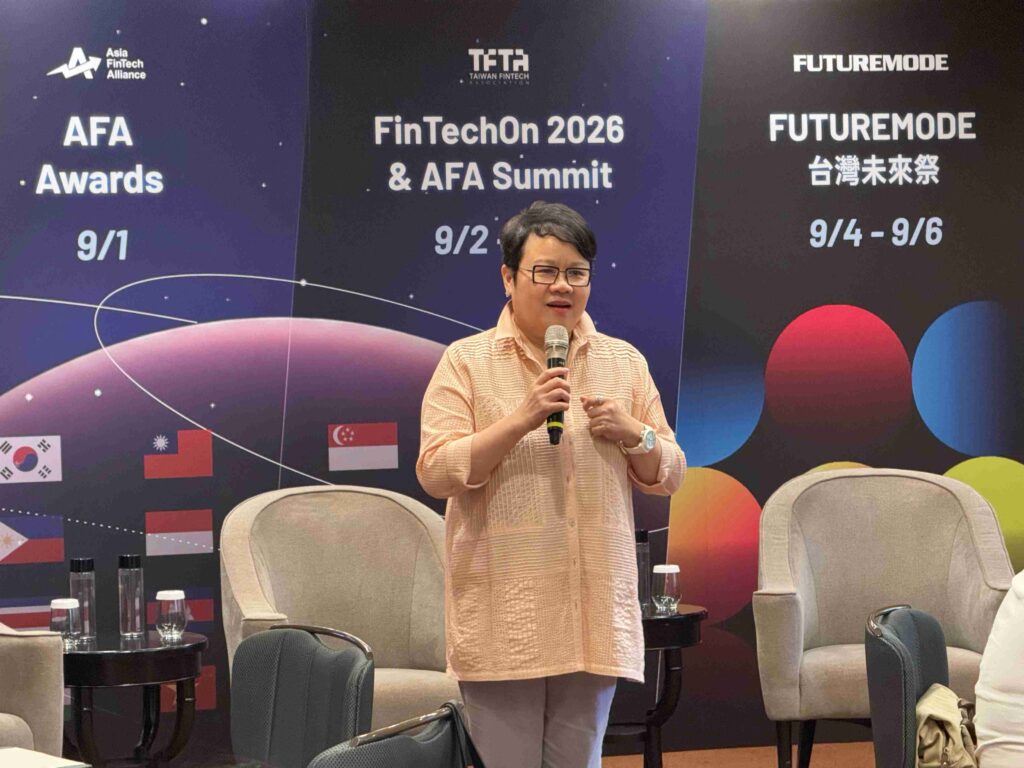
Taipei’s "Trendy Taipei 2026" tech event held a media briefing on Aug. 4, where Asian FinTech Alliance (AFA) chair and honorary chair of the Taiwan FinTech Association Tsai Yu-ling said she had directly checked with Taiwan’s Financial Supervisory Commission about the legal status of virtual asset service providers under the new licensing framework.
The answer, she said, was clear: VASP operators will be treated as "financial institutions," not "quasi-financial institutions." Tsai also said that while crypto assets were not legally defined as assets last year, the passage of Taiwan’s dedicated law means they are now legal and compliant assets, and can be regarded as financial assets with FSC approval.
Tsai says registered VASPs move into the financial institution category
Tsai said VASP operators that had previously completed registration would directly become financial institutions under the special law’s licensing regime. She quoted the regulator’s position this way: "I specifically asked the FSC whether they are quasi-financial institutions or financial institutions. The bureau responded very clearly: financial institutions."
She drew a distinction between the two labels. In her description, "quasi-financial institution" has long been an industry term used loosely for crypto firms, while "financial institution" carries a defined legal status and specific supervisory obligations. Her conclusion was that the crypto sector has now entered the mainstream financial system.
Tsai added that the next issue to watch is how financial institutions will cooperate with VASP operators once the law allows financial institutions to engage in such business lines concurrently. She said that relationship will directly shape how the broader ecosystem develops.
AFA expands to 16 economies, with Pakistan applying
Tsai also gave an update on AFA’s membership. She said the alliance had 15 member economies last year and has added Uzbekistan this year, bringing the total to 16. Pakistan is now applying to join, which could make it the 17th member this year. Tsai said Uzbekistan’s entry had also led her to see how active Central Asia is in fintech.
First AFA Awards receives 88 nominations
AFA secretariat official Yu Chih-wei laid out the selection process for the first AFA Awards. The awards are jointly organized by fintech associations from 16 economies. She said the format is the first of its kind in Asia, and companies cannot apply on their own; they must be nominated by the association in their home market.
In Taiwan’s case, the association received 11 applications and worked with China Development and IBF Securities to help screen them, eventually nominating seven companies. Across all 16 economies, the final tally reached 88 nominations.
The judging process has two stages. The first is a document review, with Amazon Web Services (AWS) and Ernst & Young (EY) screening entries from technical and financial angles to produce a Top 30. In the second stage, experts, investors, international venture capital firms, and sovereign wealth fund judges select a Top 10.
On Sept. 1, the 10 finalists will present in person in Taipei. Judges will ask questions on site and decide the final winners for each award that same day.
Nine international judges confirmed for the Sept. 1 final
The judging panel was disclosed for the first time at the briefing. AFA said all nine judges have confirmed attendance in Taipei. They include representatives from China Development Industrial Bank Capital in Taiwan, United Overseas Bank from Singapore and ASEAN, Carlyle’s Asia regional lead, SBI Investment from Japan, Gobi Partners, SGV & Co. from EY Philippines, Uzbekistan-based venture capital firm TMT Global, Sri Lanka’s Fintech Digital, and Korea’s KB Investment.
Yu said the awards are designed to recognize companies that already have proven cross-border success rather than early-stage startups. She said the shortlisted field includes a number of large listed companies from the 16 participating economies. The five major awards cover annual honors, excellence in financial infrastructure, market expansion and high growth, and compliance excellence.
Tsai said the draw of the program is not prize money but access to 16 markets. In her words, winning means being recognized by investment institutions as the most valuable investment target and being seen across 16 countries.
FinTechOn 2026 and the second AFA Summit follow on Sept. 2-3
After the awards, FinTechOn 2026 and the second AFA Summit will run on Sept. 2 and Sept. 3. Yu reviewed the event’s expansion over time: the first FinTechOn in 2020 was only a half-day forum, it expanded to a one-day event in 2022, turned into a two-day gathering in 2025 after joining with AFA’s resources, and this year became a three-day international program with the addition of the AFA Awards.
She said the first AFA Summit last year drew heads or deputy heads of state from four countries, while 13 AFA members attended. This year, she expects a larger turnout and delegations traveling as groups. On the regulatory side, officials or former officials from the United States, the European Union, Abu Dhabi, Hong Kong, Japan, and Taiwan have attended. Participants from traditional finance and crypto have included Cathay Financial Holdings, China Development, Taipei Fubon, The Shanghai Commercial & Savings Bank, Visa, Mastercard, Tether, and Ripple.
The first group of speakers announced at the briefing includes Global Blockchain Business Council CEO Sandra Ro, Peter Kerstens, who was described as the "father" of the EU’s MiCA framework, a representative from an Abu Dhabi regulatory authority, and a JPMorgan managing director who heads Asia-Pacific product for securities services.
Supply chains and regulatory harmonization remain central themes
This year’s theme continues last year’s focus on fintech and the global supply chain. Tsai said AFA has stayed with the topic for three straight years because supply chains are Taiwan’s strongest field, and the question is whether fintech can be used to improve Taiwan’s supply chain capabilities.
She also said the theme is not unique to Taiwan. A recently concluded annual meeting in Manila involving 11 ASEAN countries discussed "One Asia, One Economy, One Digital Economy," and cross-border payments and cross-border KYC were shared assignments across markets.
Tsai stressed that the AFA Summit is intentionally not being built as a large trade show. "We are not in Singapore, and we are not in Hong Kong. We are right here on this third floor, with more than 300 people sitting down and 16 countries sitting down together," she said. In Yu’s presentation, the platform’s long-term target was described as "Regulatory Harmonization."
Chen Chun-an, director of Taipei’s Department of Economic Development, also spoke on behalf of the city government and said these events used to operate separately before beginning to be integrated last year.