
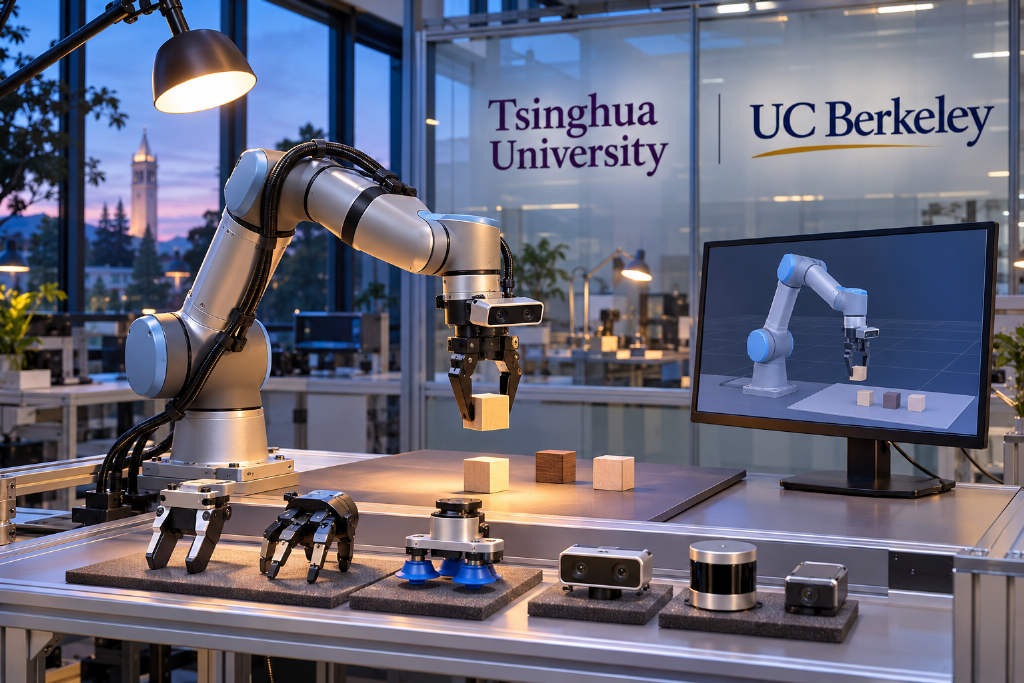
Robots may be approaching their own version of a Computer Use moment.
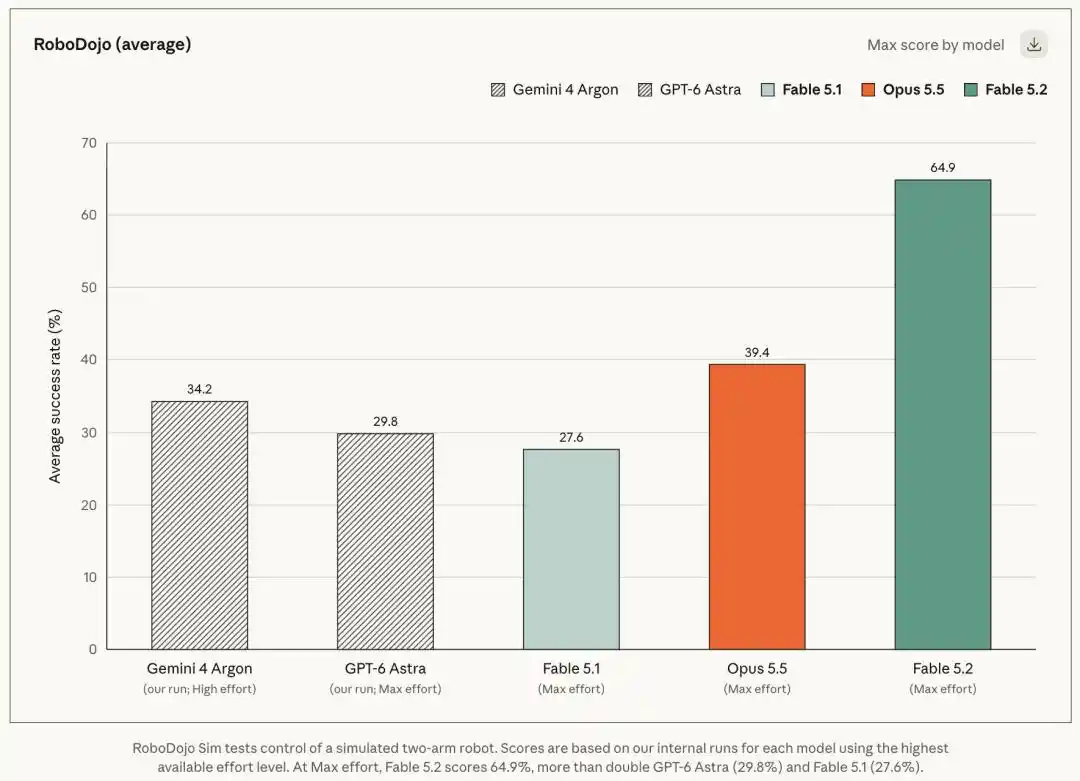
On the 10th, Anthropic’s Fable 5.2 showed a marked improvement in physical robot control over its predecessor. The model completed tasks for which it had not received dedicated training. In the RoboDojo Sim evaluation, Fable 5.2 scored 64.9%, well above GPT-6 Astra’s 29.8% in Anthropic’s internal test under the same configuration.
In September, MIT researcher Phillip Isola argued in Robot-Use Agents that robots connected to the internet and exposing sensor and actuator interfaces could become tools available to general-purpose agents.
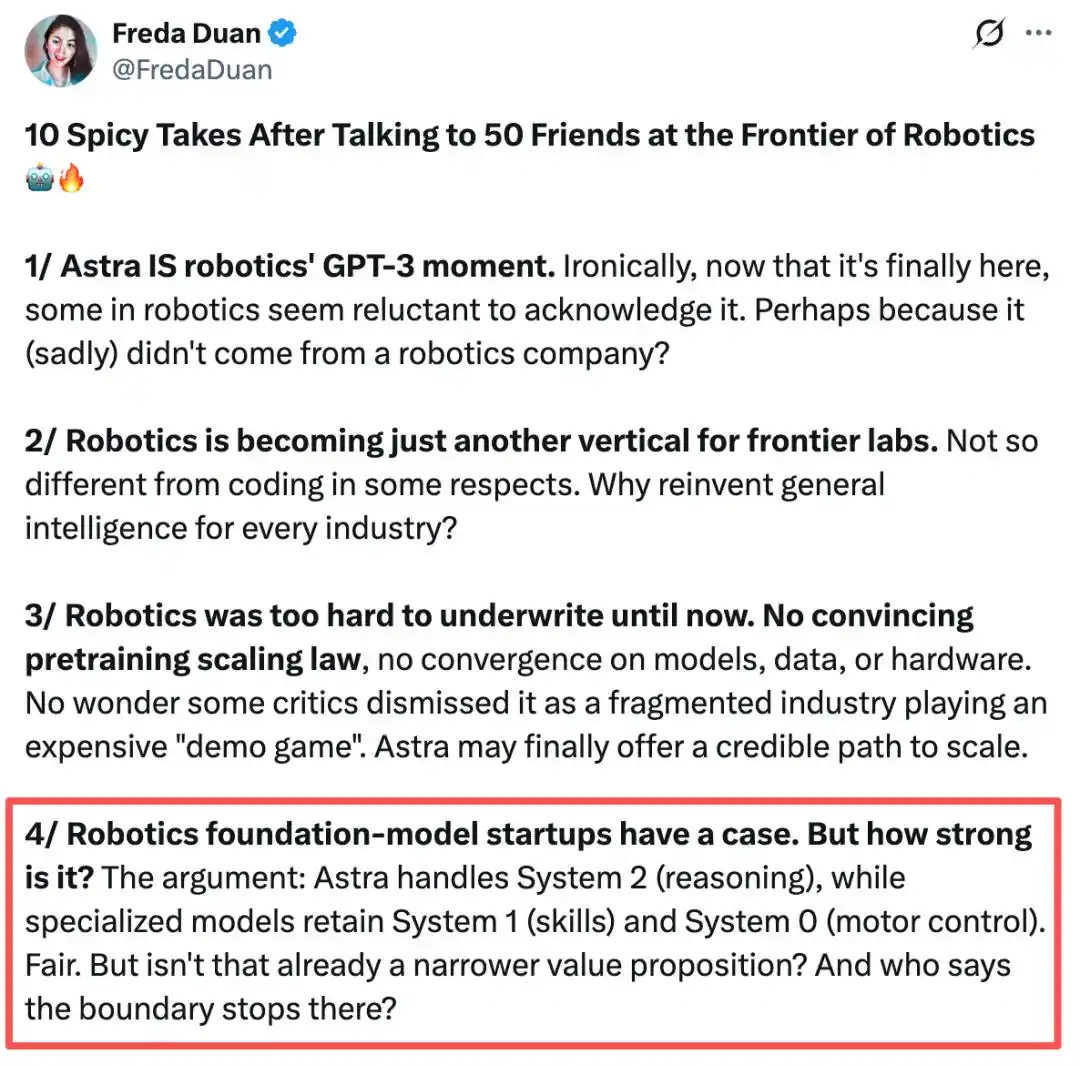
The idea follows a System 1 and System 2 division often discussed in embodied intelligence. A general model handles high-level reasoning and task planning, while a lower-level policy executes specific actions. GPT-6 Astra and Fable 5.2 have offered early evidence that this route can work.
Two barriers for Robot-Use Agents
Two problems still stand between that concept and a practical Robot-Use Agent, or RUA.
The first is the model itself. Closed frontier models have shown promising robot manipulation skills, but researchers cannot directly access their weights. They also cannot easily keep training those models with interaction data collected from robots.
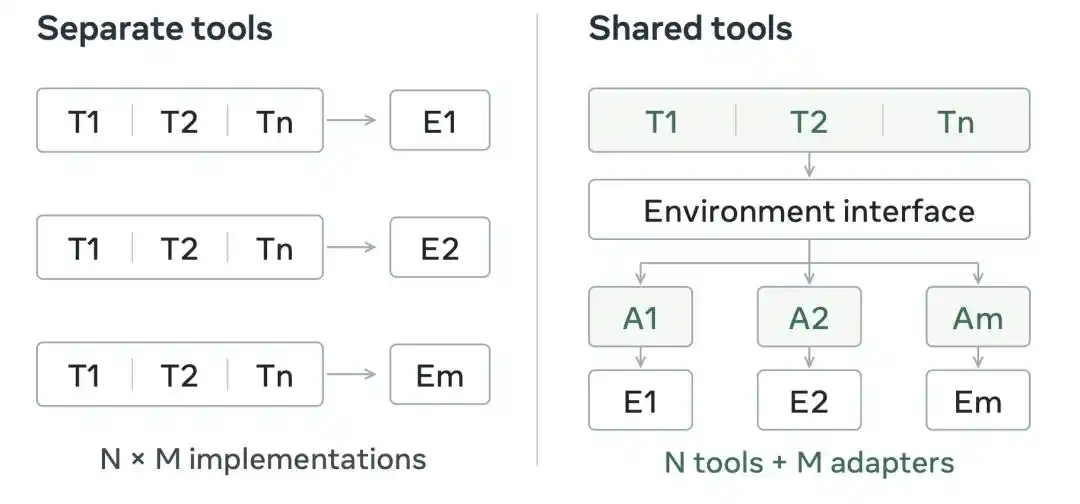
The second is the system layer. Robots differ substantially in hardware structure, sensors and control interfaces. Simulation environments differ from physical environments as well. If every new robot requires a separate tool system, cross-environment transfer and large-scale experimentation become expensive.
A RUA system therefore needs a common interaction interface that hides low-level differences in hardware and environments. The model should be able to obtain observations, call control tools and receive execution feedback through consistent methods.
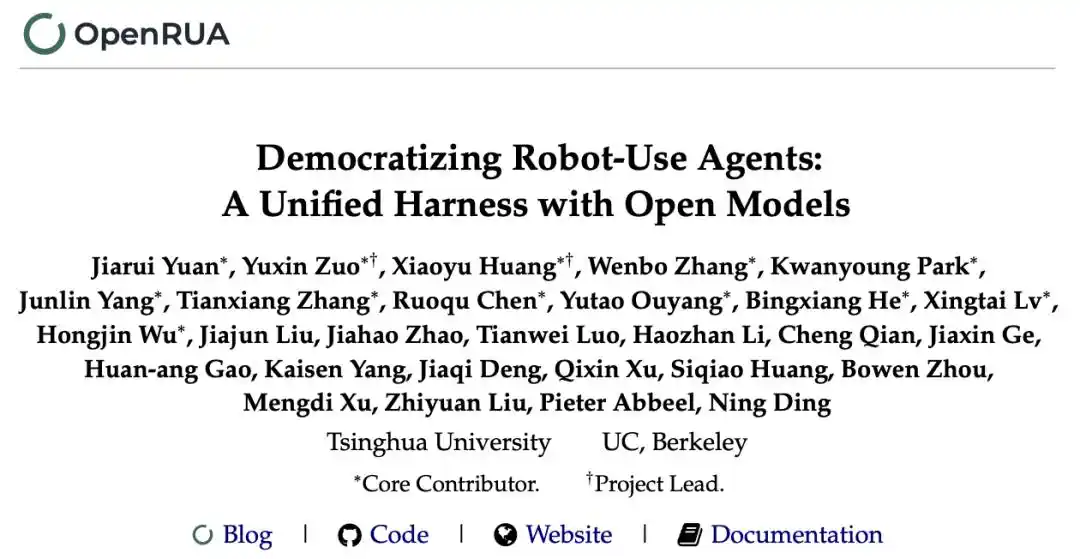
Researchers led by Ding Ning, Liu Zhiyuan, Xu Mengdi and Zhou Bowen at Tsinghua University joined Pieter Abbeel, a professor at the University of California, Berkeley and co-director of the Berkeley Artificial Intelligence Research laboratory, to release uni-robot-agent. The open-source project is designed as a unified and modular harness for RUA, allowing language models to control different robots and simulators through standardized tool interfaces.
The paper, project blog and code are available online:
- Paper: https://arxiv.org/pdf/2611.01560
- Blog: https://openrua.ai/uni-robot-agent
- Code: https://github.com/Open-RUA/uni-robot-agent
Results in simulation and on physical robots
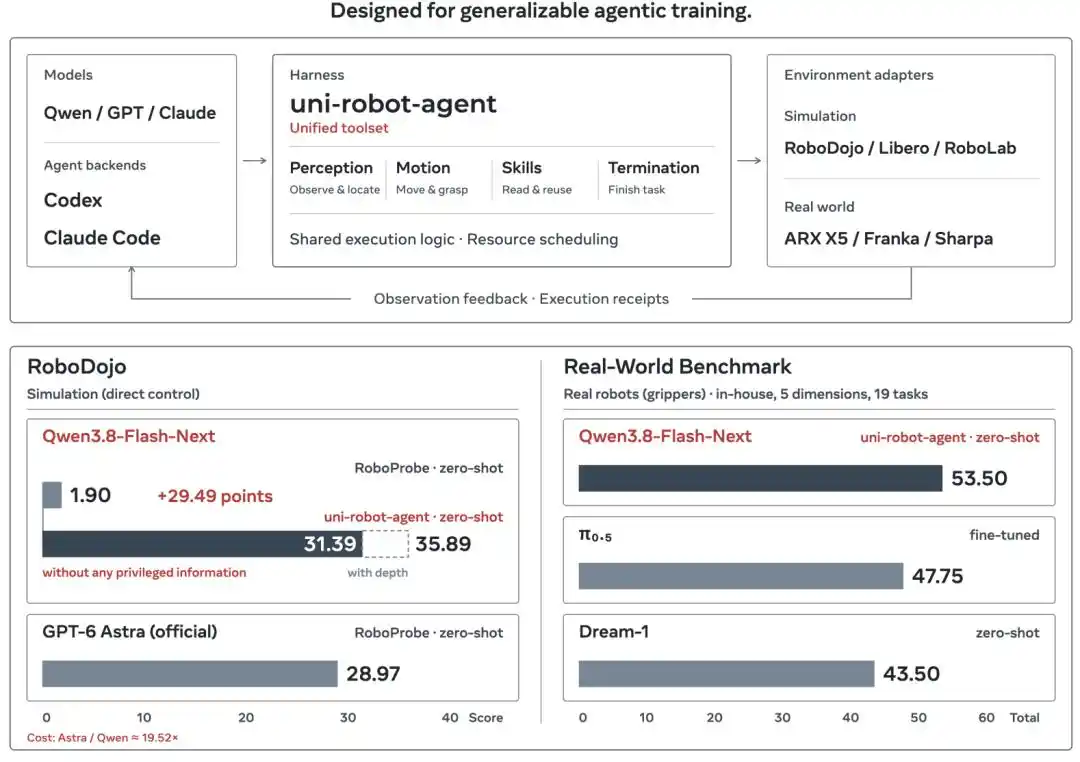
On the RoboDojo benchmark, the open-weight Qwen3.8-Flash-Next model paired with uni-robot-agent scored 31.39. That was above the 28.97 score previously published by RoboDojo for GPT-6 Astra with RoboProbe. GPT-6 Astra scored 51.90 when paired with the same framework.
The physical evaluation covered 19 tasks. Qwen, without task-specific fine-tuning, scored 53.50. It led fine-tuned π₀.₅ by 5.75 points and zero-shot Dream-1 by 10 points. GPT-6 Astra with the framework scored 80.50.
The researchers went beyond leaderboard numbers. They examined how far the models could operate robots, where failures came from, which capabilities were missing and how much the systems cost to run. Their broader goal is an open foundation that can connect models to different robots and support later training and local deployment.
Why a common interface matters
In the Coding Agent field, the same tools can support different programming tasks. Models read files, run code and inspect results through similar interfaces, allowing tool-use experience to transfer between environments.
Robot manipulation involves more hardware variation. A single-arm robot and a dual-arm robot may expose different action interfaces even when both are asked to pick up an object. The model has to learn new parameters, coordinate systems and control rules, so previous tool-use experience may not transfer directly.
uni-robot-agent is intended to bridge those differences. A Franka single-arm robot may need to locate, grasp and stack blocks. An ALOHA dual-arm robot may need to coordinate both arms while handing an object from one to the other. A physical YuMi dual-arm robot may need to align and insert a peg into a hole. Their hardware, action spaces and task goals differ, but the model can call common perception, motion, skill and task-control interfaces. Low-level adapters handle the control details for each platform.
The model can keep using the same tool-calling rules. When a new environment is added, developers mainly implement the corresponding adapter rather than rewriting the upper-level agent logic.
A common interface also changes how interaction data can be organized. If environments share tool semantics, parameter units and feedback formats, trajectories collected during robot operation can be combined more easily. Experience from single-arm stacking, dual-arm handoffs and physical insertion tasks can enter one data system.
That creates conditions for cross-environment agent training. Researchers can use interaction data from different robots to train one model to learn tool-use and manipulation skills that transfer across platforms.
A five-layer architecture
uni-robot-agent has two design goals: to provide a common base for cross-environment agent training and to evaluate the existing robot skills of general-purpose models as objectively as possible.
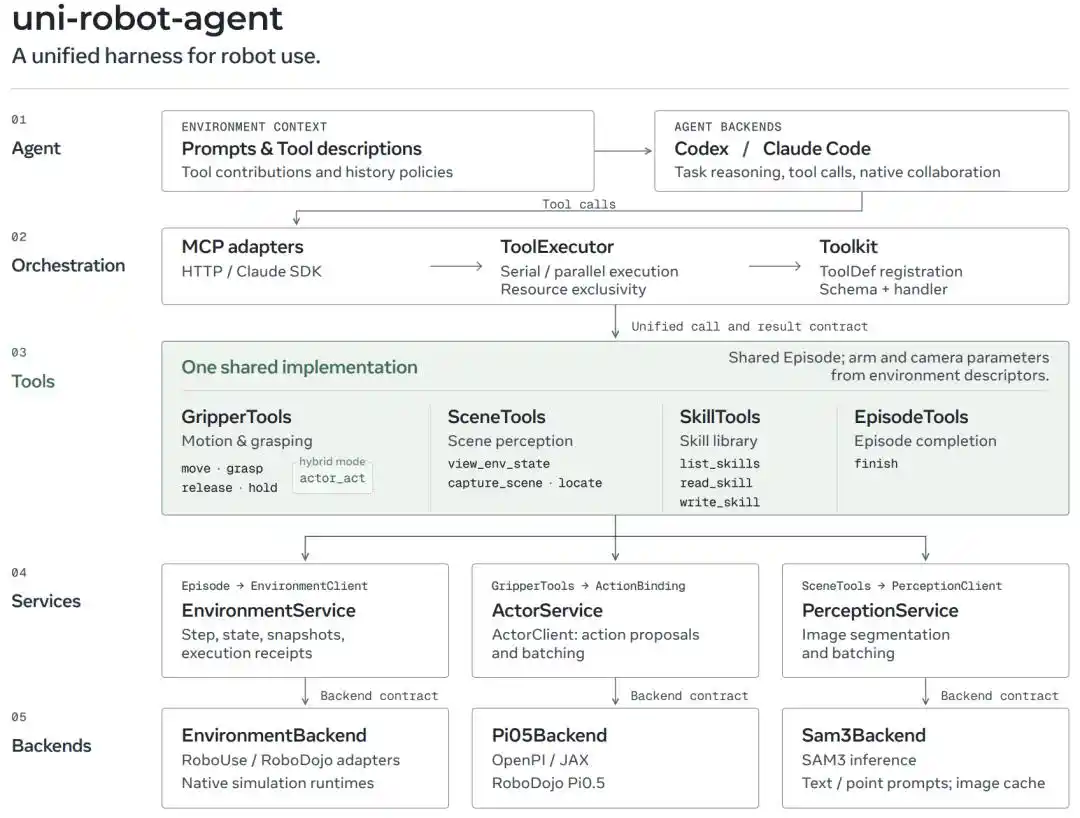
The system is divided into five layers: Agent, Orchestration, Tools, Services and Backends.
- The Agent layer interacts with the model and manages context and task decisions.
- The Orchestration layer schedules tool requests.
- The Tools layer exposes standardized operations to the model.
- The Services layer manages runtime resources.
- The Backends layer connects concrete robots, simulators and model implementations.
This modular structure allows models, tools and robot backends to be replaced independently. Researchers can compare models without rebuilding the full system and can collect interaction data in a consistent structure.
Objective evaluation also requires conditions close to deployment. A simulator can directly expose an object’s exact 3D position, CAD model, hidden scene state and even a task-success judgment. A physical robot normally cannot access those signals directly. If a model uses privileged information, it becomes difficult to measure its actual visual understanding, spatial reasoning and manipulation ability.
For its main simulation experiments, uni-robot-agent gives the model only RGB images, camera calibration, robot proprioception and task instructions. It withholds ground-truth depth, object CAD assets, hidden scene annotations and task-verifier feedback. External network access is also disabled. The researchers restrict shortcuts tailored to evaluation tasks so that a model cannot obtain high scores by using prewritten task answers.
Synchronized observations and reliable execution
Without those extra signals, a general model’s ability to complete complex robot tasks depends on how information is organized and whether tools execute reliably.
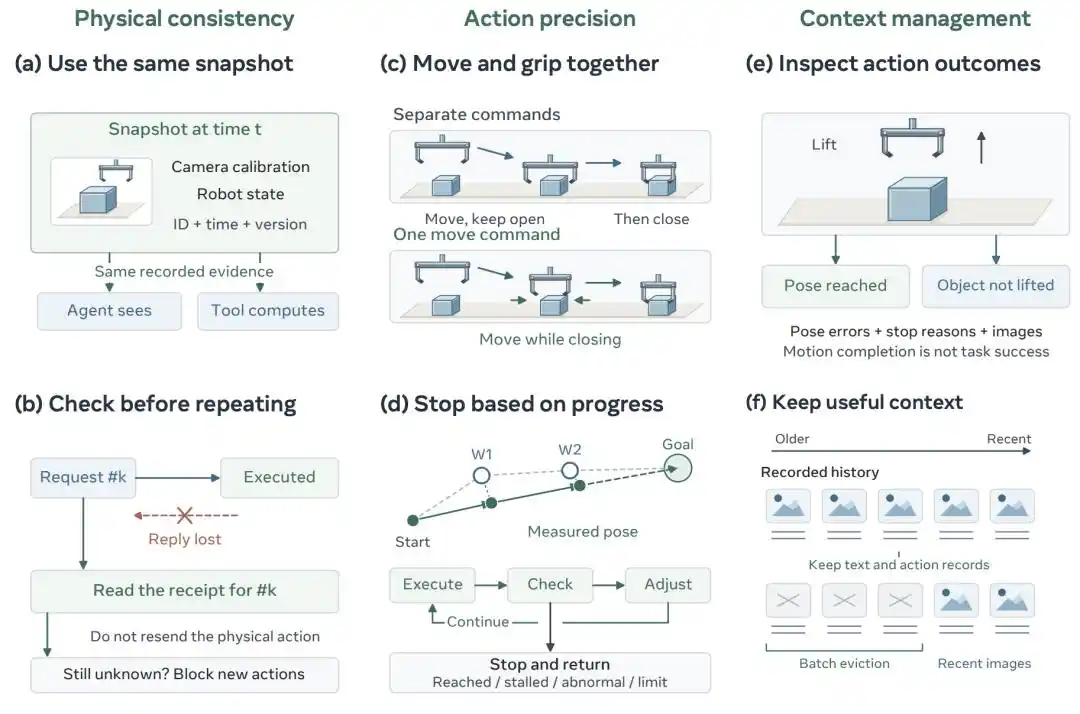
When a robot grasps an object, the model must calculate a grasp position from an image and the arm’s position. If the image comes from an earlier moment while the arm state has already changed, the calculation can be wrong. uni-robot-agent binds camera images, calibration data and robot state to the same time point, reducing errors caused by stale or mismatched state.
During execution, the system deduplicates requests to prevent repeated actions and monitors arm motion to identify stalled or abnormal execution. After an action finishes, it sends the result and a new observation back to the model. The model can then decide whether the task succeeded or whether the next action needs to change.
Robot actions can take time. The framework therefore supports asynchronous execution. The model can continue other work while some tools are running, while motion requests for the same arm are queued in order to prevent conflicts.
These choices bring practical robotics engineering into the harness. They reduce the effects of state mismatch, repeated actions and missing feedback. Under these conditions, the study found that general language models could show competitive robot manipulation performance without privileged simulation information or task-specific shortcuts.
RoboDojo and its 42 tasks
The researchers first tested the unified harness in simulation on RoboDojo. The benchmark contains 42 robot manipulation tasks across five dimensions: generalization, fine manipulation, long-horizon execution, memory and open-vocabulary instructions. The main experiments ran 252 evaluations per group.
With the same Qwen3.8-Flash-Next model, RoboProbe scored 1.90 and RPent scored 7.75. GAP Hybrid, which combines the approach with π₀.₅, reached 21.01. With uni-robot-agent, Qwen reached 31.39 and a 25% success rate. Its combined score was 29.49 points higher than RoboProbe.
The comparison shows that tool-system design can materially affect robot performance even when model weights remain unchanged.
The framework also supported other models. DeepSeek-V4.1-Flash scored 27.11, while GPT-6 Astra reached 51.90 with a 46.67% success rate. Their strengths were not identical. Qwen and DeepSeek performed relatively better on memory and open-vocabulary tasks than on fine manipulation and long-horizon execution. Some specialized VLA and WAM models had an advantage on long-horizon tasks.
Physical tests and input differences
The physical evaluation used dual-arm robots for 19 manipulation tasks spanning spatial understanding, object generalization, instruction following, compositional generalization and unseen tasks. The tasks included placing test tubes in a rack, passing a bottle between two arms, stacking blocks in color order, wiping a whiteboard and solving the Tower of Hanoi.
GPT-6 Astra scored 80.50 and received a perfect 20 out of 20 on compositional generalization. Qwen scored 53.50, ahead of fine-tuned π₀.₅ and zero-shot Dream-1.
The researchers noted that the inputs were not identical. Qwen and Astra used RGB images plus depth from a RealSense D405 sensor. π₀.₅ and Dream-1 used RGB only. The score gap therefore cannot be attributed entirely to the models themselves.
The team tested which external signals the models relied on. With depth and camera calibration available, Qwen scored 35.89. Removing depth while keeping calibration produced 31.39. Removing calibration as well, leaving only RGB images and robot proprioception, reduced the score to 9.13.
Under the corresponding settings, Astra scored 55.83, 55.04 and 31.29.
The results indicate that a model can use camera calibration, multiple views and geometric calculations to perform some spatial localization without direct depth measurement. Performance fell sharply after calibration was removed. Recovering reliable spatial relationships from RGB images alone remained difficult.
Skills, cost and execution time
The researchers also examined whether a predefined skill library changed the evaluation. After disabling the skill library and skill-writing functions, Qwen’s overall score fell from 31.39 to 30.31, leaving 96.6% of its original result. Its success rate moved from 25% to 24.58%.
The finding suggests that Qwen’s performance did not depend mainly on prepackaged task skills. Standardized perception and motion tools, combined with the model’s own reasoning, supported a substantial portion of the manipulation work.
Average API cost per task was about $1.09 for Qwen, $0.94 for DeepSeek and $21.29 for Astra.
Execution speed also affected the efficiency of a robot agent. The first time the systems reached a combined score of 25, Astra had used about 7.4 million tokens over 42.6 minutes. Qwen had used 23.5 million tokens over 95.5 minutes, while DeepSeek had used 49.9 million tokens over 99.2 minutes.
To reduce waiting, the team tested an asynchronous pipeline. Across five selected tasks, pipeline execution was faster than serial execution, with reductions ranging from 4.8% to 73.7%. In a conveyor-belt picking task, execution time fell from about 59.7 minutes to 15.7 minutes.
Robot skills do not map simply to model size
The common harness made it possible to test different models under similar interaction conditions. It also allowed the researchers to ask a basic question: what abilities does a general model need before it can operate a robot?
The team compared 13 models from different families, generations and parameter scales. Robot manipulation ability did not show a simple relationship with model size or release generation.
Within the Qwen family, the tested Qwen3.5, Qwen3.6 and Qwen3.7 models recorded no complete task successes. With Qwen3.8, the 27B model reached an 8.06% success rate, while Flash-Next reached 25%. The 27B model was smaller in parameter count but completed some tasks that older, larger models could not.
The GPT family also showed generational change. GPT-5.6 Sol achieved a 19.17% success rate, GPT-6.1 Sol reached 37.50% and GPT-6 Astra reached 46.67%.
The results suggest that robot manipulation skills may already appear inside general-purpose models. Improvements may be connected to training-data distributions, combinations of capabilities and training methods.
Four capability groups behind failures
By studying failure trajectories, the team identified four capability groups: visual understanding, spatial localization, geometric calculation and embodied reasoning. Lower error rates across these dimensions generally corresponded to stronger robot-task performance.
Visual understanding requires a model to identify objects, determine orientation and verify the state after an action. Some earlier Qwen models read the digit 0 as 9 or classified an upside-down cup as upright, causing later actions to rely on incorrect observations. In the inspected trajectories, the rate of such errors in some older models ranged from 12.2% to 23.8%. The corresponding checked samples for Qwen3.8-Flash-Next contained no such errors.
Spatial localization requires the model to infer a target’s 3D position from images. Without depth, it can use multiple views for triangulation, but matching the same physical point across views remains difficult. The paper found that about 31.5% of related triangulation calls by GPT-6.1 Sol failed geometric-consistency checks.
Geometric calculation involves converting positions and poses between camera, world and robot-arm coordinate systems. Some older Qwen models had error rates of 47.3% to 81.8% on related calculations. Qwen3.8-Flash-Next reduced the figure to 8.2%, while DeepSeek-V4.1-Flash reduced it further to 1.5%.
Embodied reasoning requires the model to judge whether a grasp pose is suitable, whether the arm can reach a target and whether an action risks a collision. Some models found the target position but repeatedly failed to grasp because the wrist orientation was wrong.
The researchers also correlated robot scores with general benchmarks including ERQA, MMMU-Pro, ScreenSpot-Pro and LiveCodeBench v6. Visual understanding, embodied reasoning, spatial localization and coding ability showed different levels of correlation with robot performance. Robot operation may reflect the generalization of a combination of foundational skills from several domains.
Robot operation consists of continuous visual judgments, spatial localization, geometric calculation and physical decisions. An error at any stage can cause the task to fail. Improving RUA systems will require attention to these connected capabilities together.
Code as Policy, Hybrid and Clean Mode
uni-robot-agent supports more than direct tool calls. It also supports Code as Policy, a Hybrid mode and Clean Mode, allowing different approaches to be evaluated inside one framework.
Under Code as Policy, the model controls the robot by writing code. It can perform calculations, call actions in a program and use execution feedback to decide whether to continue. Using Qwen, the researchers compared code control with direct tool calls across RoboDojo’s five capability dimensions. In 252 RoboDojo evaluations, Qwen scored 25.60. Code control reached 17.40 on fine manipulation, higher than its direct-tool result in that dimension, but its overall result remained lower.
Hybrid mode lets a vision-language model work with a vision-language-action or WAM model. The VLM interprets instructions, analyzes the scene and organizes the task. The VLA generates action segments from observations, and execution feedback informs later decisions.
The team demonstrated this setup in simulations involving a Panda arm with an Allegro dexterous hand, the Unitree Go2 quadruped, the Unitree G1 humanoid and the R1Pro wheeled robot. It connected π₀.₅, GR00T and NaVILA action models, covering dexterous manipulation, humanoid operation and mobile navigation.
As model capabilities improve, some calculations and action logic currently packaged inside tools may be handed to the model. The harness could become thinner. uni-robot-agent offers Clean Mode to explore that direction. It retains only four basic tools: move, hold, finish and capture_scene. The model must complete tasks through observation, calculation and action composition.
With camera calibration available, Qwen and Astra in Clean Mode retained 90.4% and 90.5% of their scores under the full tool configuration. Average token use fell by 35.7% and 78.8%, respectively. Comparisons with the historical full configuration indicate that the models maintained most of their task performance after tools and context were reduced. The result provides early evidence that a thinner harness can improve token efficiency without removing most of the capability.
More physical platforms are being added
The framework is also being extended to additional physical robots. The team has connected ARX One and the AgileX Piper-X. Low-level adapters handle hardware-specific control differences while the model observes the environment, acts and adjusts the next step through the same interface. Intelligence Dynamics G2 and Unitree G1 are also being integrated.
Integration code and deployment instructions have been released. Developers can run uni-robot-agent on supported hardware, replace the model and test their own tasks.
uni-robot-agent is the first open-source release from the OpenRUA project. OpenRUA was started by researchers from universities and frontier laboratories with backgrounds in embodied intelligence and language models. Its stated goal is to build open infrastructure for agents that can act in the physical world. The team’s homepage is https://openrua.ai/.
The project is more than a robot manipulation framework. Its experiments show that open-weight models can achieve competitive results in simulation and on physical robots when information is organized carefully and tools provide reliable feedback. The researchers identify continued model updates using interaction data as a next direction.
The source article was published by the WeChat account “机器之心” (ID: almosthuman2014) and written by Yang Wen.



