
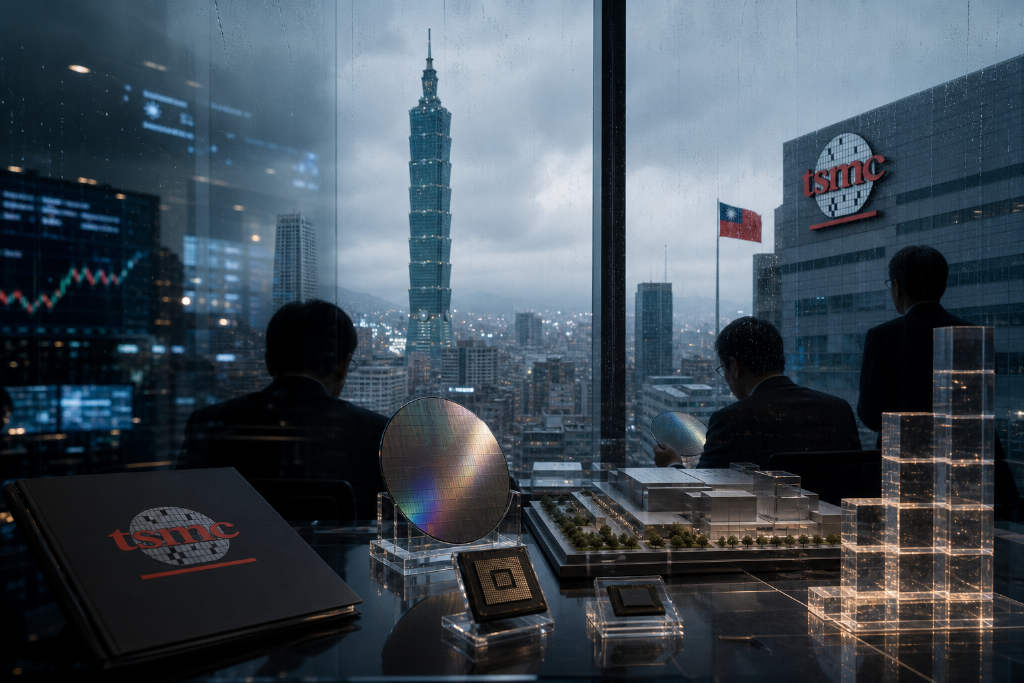
A column published by U.S. financial media outlet The Motley Fool says Taiwan Semiconductor Manufacturing Co. (TSMC, 2330; ADR ticker TSM) could reach a $3 trillion market capitalization by the end of 2028. From its current level of about $2.2 trillion, that would mean about 35% more growth over the next two years and four months, which the article translates into an ADR price of roughly $580.
The piece says that 35% gain works out to about 14% a year on an annualized basis. Its calculation does not assume investors will pay a higher price-to-earnings multiple than they do now. The premise is simpler: if valuation stays flat, the stock should broadly track earnings growth over time. Under that framework, earnings compounding at about 14% a year would be enough to lift the company to a $3 trillion valuation.
Quarterly results and guidance revisions are central to the argument
TSMC reported second-quarter consolidated revenue of about NT$1.27038 trillion, up 12% from the prior quarter and 36% from a year earlier. In U.S. dollar terms, revenue was $40.2 billion, up 33.7% year over year. Net profit after tax reached NT$706.56 billion, up 77.4%, while earnings per share came in at NT$27.25.
The column also highlighted the company’s profitability. Gross margin was 67.7% and operating margin was 60.3% in the second quarter, both above the high end of the company’s own forecast and both record highs. Gross margin was up 9.1 percentage points from 58.6% a year earlier.
Chief Financial Officer Huang Jen-chao said in the earnings report that third-quarter results would benefit from continued strong demand for advanced process technologies, with 2-nanometer production in a ramp-up phase. The company also raised its full-year outlook for a second time at its July earnings call, saying 2026 revenue in U.S. dollar terms is expected to grow by slightly more than 40%, up from a previous forecast of more than 30%.
Capex increases and U.S. expansion remain part of the setup
The report says TSMC has lifted its 2026 capital expenditure plan to $60 billion to $64 billion, above its previous budget. It also announced another $100 billion of investment in the United States for additional advanced wafer fabs and advanced packaging facilities, bringing its total planned U.S. investment to $265 billion.
The column identifies revenue concentration as the main risk. High-performance computing accounted for 66% of TSMC’s second-quarter revenue, tying the company’s growth closely to spending on AI infrastructure. If the biggest AI buyers pull back, the growth rate could slow quickly.
Margins are another pressure point. TSMC guided for third-quarter gross margin of 65% to 67%, below the 67.7% delivered in the second quarter. If profitability keeps easing, earnings growth would lag revenue growth, and the $3 trillion case depends on earnings expanding at about 14% a year.
The article says valuation is harder to forecast than earnings
Even so, the columnist argues that the target is not out of reach. The article models revenue growth slowing to 20% in 2027 and then to 10% in 2028. As long as margins stay near current guidance, two-year compounded growth would still be about 15%, above the required threshold. The piece adds that this does not include the second half of 2026, when growth is running at about three times that level.
What is less predictable, the column says, is the market’s willingness to pay for those earnings. If investors turn more cautious on AI infrastructure spending, they may assign a lower price to each dollar of profit even if earnings keep growing. Any compression in the price-to-earnings ratio would raise the growth required from the core business, potentially by well more than 14%.
Still, the article concludes that a company guiding for slightly more than 40% full-year revenue growth has meaningful room above that hurdle, and says TSMC could top a $3 trillion valuation by the end of 2028.