
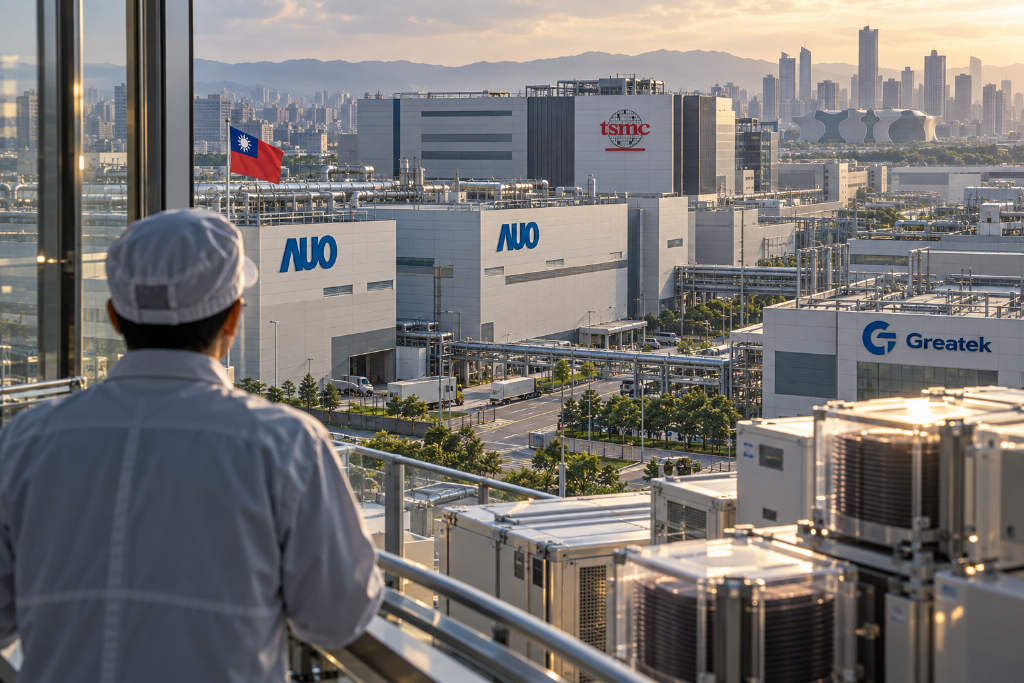
TSMC and ChipMOS Technologies are reportedly planning to acquire AUO’s L7A and L5C panel plants in Taiwan’s Central Taiwan Science Park, with the combined deal value said to top NT$20 billion, according to a Commercial Times report cited by ABMedia.
If completed, the transaction would set a new record for a single disposal of older-generation panel plant assets and give TSMC additional room near its existing operations to expand advanced packaging capacity while CoWoS supply remains under pressure. The report said the division of roles between the buyers, the exact scope of the sale, and the final transaction value have not been disclosed or confirmed.
Plants next to Fab 15 are said to be near the signing stage
Industry sources cited in the report said TSMC visited AUO’s high-generation panel fabs in the science park in June and showed interest in L7A and L5C. It later sent personnel multiple times for due diligence to assess plant systems and the conditions required for future conversion work. Market observers cited in the report believe the process has moved close to the contract-signing stage, pending AUO board approval.
The two plants are located next to TSMC’s Fab 15 in Central Taiwan, a point seen as an operational advantage. L7A is a Gen 7.5 fab that started production in 2006, with a newer facility and a larger floor area. If the final price does exceed NT$20 billion as rumored, it would surpass Innolux’s NT$17.1 billion sale of its G5.5 site and become the largest single transaction involving the disposal of older-generation panel plant assets.
For the buyers, taking over an existing facility and retrofitting it with equipment could shorten the time needed to build capacity compared with starting from scratch.
AUO is still operating both sites while pursuing asset activation
Central Taiwan Science Park is AUO’s main panel manufacturing base, housing its G5, G6, G7.5, and G8.5 production lines. L5C mainly produces notebook panels, while L7A focuses on TV panels and also makes some monitor panels.
The report said rising memory prices this year have increased total device costs and weakened notebook panel pull-in demand. It also pointed to competition from Chinese brands and OLED panels, with long-term demand expected to slow. In TV panels, Chinese manufacturers account for about 70% of capacity, leaving Taiwanese producers with limited pricing power. Against that backdrop, selling the two plants is seen as a way for AUO to recover capital, improve asset efficiency, and redirect resources toward newer businesses.
Both plants are still operating normally. If a transaction is completed, AUO would recertify products at other sites to maintain supply. Together with relocation work and staff transfers, formal closing is expected around the end of 2027, according to the report.
Advanced packaging expansion in Central Taiwan is in focus
Supply chain sources cited in the report said AUO’s asset activation plan in Central Taiwan would proceed in stages. The current talks involve two plants, while another two may be sold later. TSMC Group is said to hold a right of first refusal on those later assets, though any such move would also require AUO board approval.
Within TSMC’s Central Taiwan footprint, Fab 15 currently focuses on 28 nm and 7 nm production and is gradually introducing 5 nm. Fab 25 is expected to target the A14 process, while the packaging side includes the AP5 plant for CoWoS-L. Industry analysis cited in the report said acquiring AUO’s facilities could help TSMC place advanced process manufacturing and advanced packaging in the same area and, with nearby optical component suppliers, build out a co-packaged optics, or CPO, ecosystem.
The report added that long-running undersupply in CoWoS capacity is one reason TSMC is expanding AP7 and AP8 at the same time. OSAT providers have also benefited from spillover orders.
ChipMOS capacity is full, with IVR validation expected by late Q4
ChipMOS is also expected to become more important in this expansion cycle. Institutional investors cited in the report said TSMC holds about a 41% stake in ChipMOS and is its largest customer, contributing more than 70% of revenue. ChipMOS’s new P2 plant has a cleanroom area of about 23,000 square meters and is already fully loaded. The company is also expected to take on system-level testing, or SLT, demand from strategic partners, increasing the urgency of finding additional land for expansion.
Beyond testing, ChipMOS is working with TSMC on a 12-inch integrated voltage regulator, or IVR, backside copper process aimed at high-performance computing chips. The report said institutional investors expect process validation and pilot production to be completed by the end of the fourth quarter this year, with mass production starting in the second half of 2027.
The report framed TSMC’s approach as using existing facilities to save time. With advanced packaging demand still elevated, market attention is now on AUO’s board stance and the pace of any formal acquisition process.



