
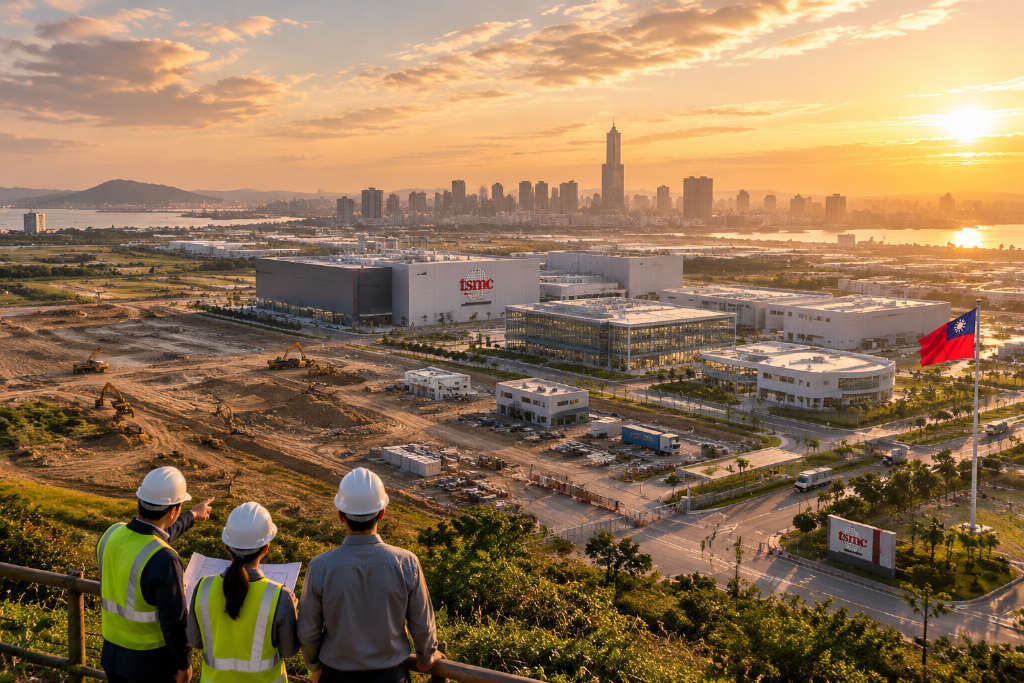
Kaohsiung is set to host Taiwan’s first advanced packaging industrial cluster at Baipu, adding a new segment to the city’s semiconductor buildout after the Nanzih advanced process site. TSMC and its supply chain have taken 25 hectares in the project, the first phase of leasing has been fully booked, and construction is expected to start in September this year.
Baipu park earmarks about 53 hectares for industrial use
According to Wealth Magazine, the Baipu park is located on Taiwan Sugar’s Baipu Farm and spans 88.73 hectares in total. About 53 hectares are planned as a dedicated industrial zone, and 25 hectares will be used by TSMC and key suppliers. Two centers are expected to be established by TSMC on the southern side of the park, while the Kaohsiung city government plans to hold an investment briefing in mid-September for the northern section to bring in international companies.
Taiwan’s Ministry of Economic Affairs has submitted a proposal to the Executive Yuan to reclassify Baipu from a general industrial park to a technology industrial park, a move aimed at shortening plant construction procedures.
Plan links R&D, verification and mass production
The Baipu project is not designed as a simple factory site. Under the current plan, TSMC will take charge of talent training and build a materials research laboratory, following the model used in the Pingtung supply chain zone. The park will also introduce a wafer-level advanced packaging equipment and materials ecosystem area, a TSMC equipment and materials verification and talent training center, and a third-party testing center run by the Industrial Technology Research Institute.
Together, those facilities are intended to form a complete chain covering R&D, verification and mass production.
Ho Chun, TSMC’s vice president of advanced packaging technology and service, said CoWoS capacity is expected to post a compound annual growth rate of more than 80% through 2027. He said TSMC’s presence in Baipu will include part of its process R&D work and support the buildout of supply chain and verification platforms, helping connect overseas and domestic suppliers.
Kaohsiung’s semiconductor roles are becoming more defined
With Baipu added to the map, Kaohsiung’s semiconductor division of labor is becoming clearer. Nanzih centers on TSMC’s advanced processes and its 2 nm base. Renwu is focused on advanced packaging testing and related industries. The Qiaotou Science Park is developing semiconductor materials and key components. Baipu will cover advanced packaging equipment, materials, R&D and verification.
Traditional manufacturers are expected to connect to the equipment chain
Kaohsiung has long built up strengths in fasteners, metal processing, precision machinery and equipment manufacturing. Those capabilities are seen as a base for entering the semiconductor equipment supply chain. Kaohsiung Mayor Chen Chi-mai said the city hopes the practical demand raised by TSMC and international companies will help local firms upgrade their technology and move into higher value-added semiconductor equipment and materials supply chains.
The city government and central authorities also plan to integrate technical resources from public institutes and establish local advanced packaging testing and R&D verification capacity, so equipment and materials suppliers can complete technical validation before entering mass production systems.
Government incentives include financing support
To lower the initial burden on companies, the government is offering subsidies. Kaohsiung’s industrial development incentive program provides financing interest subsidies of up to five years and NT$30 million. Additional support will cover land and building rent, property tax and labor-related subsidies. Combined with the “Taiwan 3.0” incentive package in the Qiaotou New Town special district, the measures also include corporate income tax reductions, investment and R&D subsidies, and policy tools tied to equipment and materials verification.
Advanced packaging is becoming a core AI chip battleground
The report said competition in AI chips is no longer defined only by how far wafer processes can shrink. Advanced packaging, the ability to integrate different chips at high speed, and the speed at which equipment and materials can be verified and introduced into mass production are now part of semiconductor competitiveness.
From advanced wafer processing in Nanzih to advanced packaging equipment and materials verification in Baipu, Kaohsiung is filling in a supply chain link that has drawn less outside attention in the past but directly affects AI chip production capacity.