TSMC Q2 Earnings Preview: AI Orders Remain Strong, Gross Margin Under Test
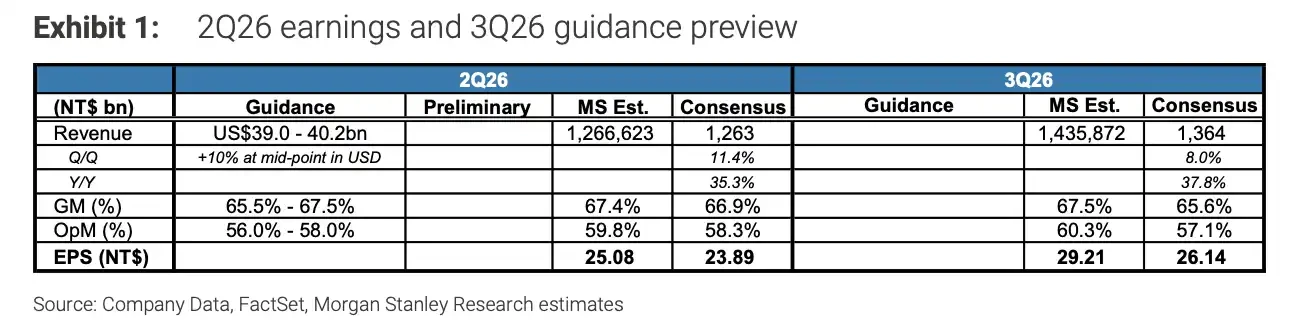
TSMC will hold its Q2 2026 earnings conference on July 16 at 14:00 Taiwan time, entering a quiet period from July 6 to 15. Market focus has shifted beyond simple revenue growth to three core questions: Are AI orders continuing their strong trajectory? Is the 2nm ramp proceeding smoothly? Can a gross margin near 66% be maintained? Q1 delivered a robust scorecard: USD revenue of $35.9 billion, gross margin of 66.2%, and operating margin of 58.1%. In NT dollar terms, revenue reached NT$1.134103 trillion, net profit NT$572.48 billion with EPS of NT$22.08; year-over-year revenue growth was 35.1% and net profit growth 58.3%. Q2 guidance remains at high levels: USD revenue of $39.0-$40.2 billion and gross margin of 65.5%-67.5%. Morgan Stanley estimates Q2 gross margin at 67.4%, the upper end of management's guidance range.
AI/HPC Drives Revenue Structure Shift, but Profit Pressure Persists
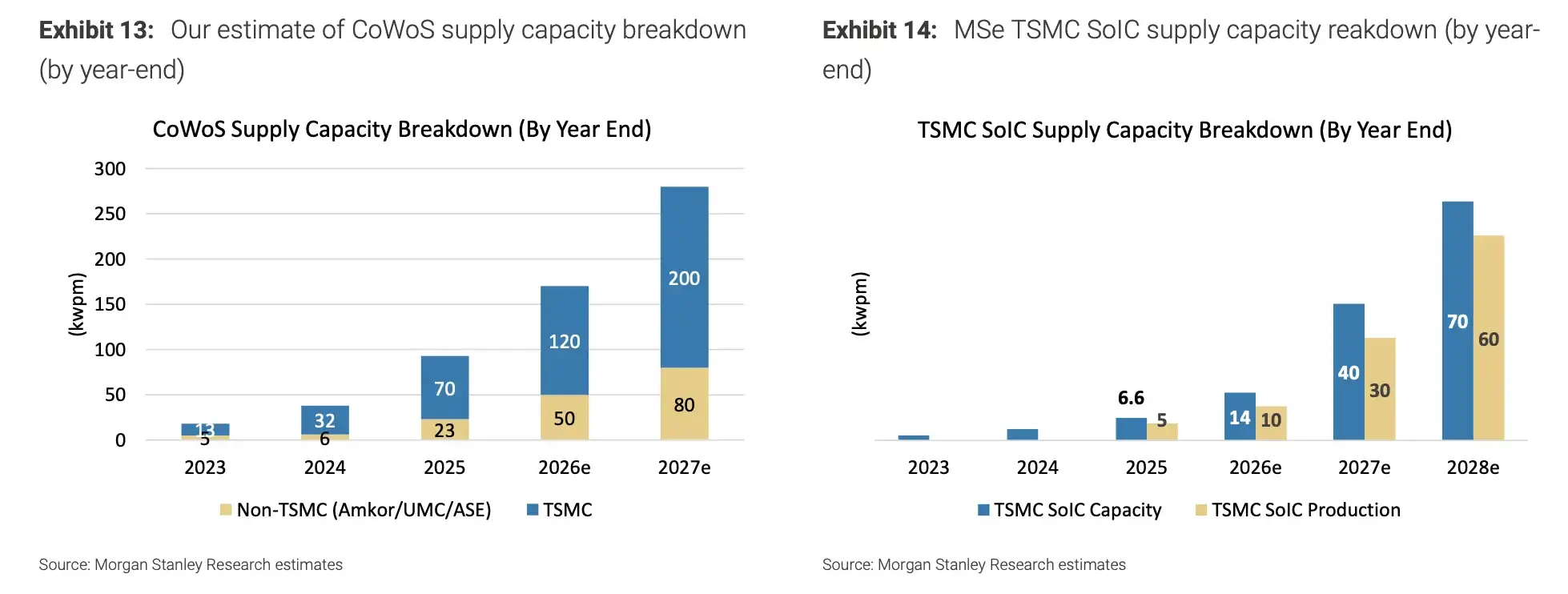
TSMC's strongest growth driver remains AI and high-performance computing. During the Q1 earnings call, management described AI-related demand as 'extremely robust' and raised full-year 2026 USD revenue growth expectation to over 30%. Revenue composition reinforces this view: HPC accounted for 61% of Q1 revenue, and advanced nodes (7nm and below) contributed 74% of wafer revenue. AI chip demand has pushed advanced packaging capacity higher, with CoWoS and SoIC remaining key expansion focuses. AI accelerators and custom cloud chips are physically larger and more complex, driving higher order value and keeping high-end capacity tight. However, revenue growth does not automatically equal profit growth: initial ramp-up of advanced nodes brings equipment investment, higher depreciation, and yield learning costs. TSMC has pointed full-year 2026 capital expenditure to the upper end of the $52-$56 billion range, signaling management's view of a structural capacity gap driven by AI/HPC demand. Higher capex is a double-edged sword — it expands leadership when demand is strong, but can accelerate margin pressure when demand slows. Morgan Stanley projects Q2 gross margin of 67.4%, but the market awaits management's outlook on second-half profitability.
2nm Ramp: The Most Critical Variable for the Next Several Years
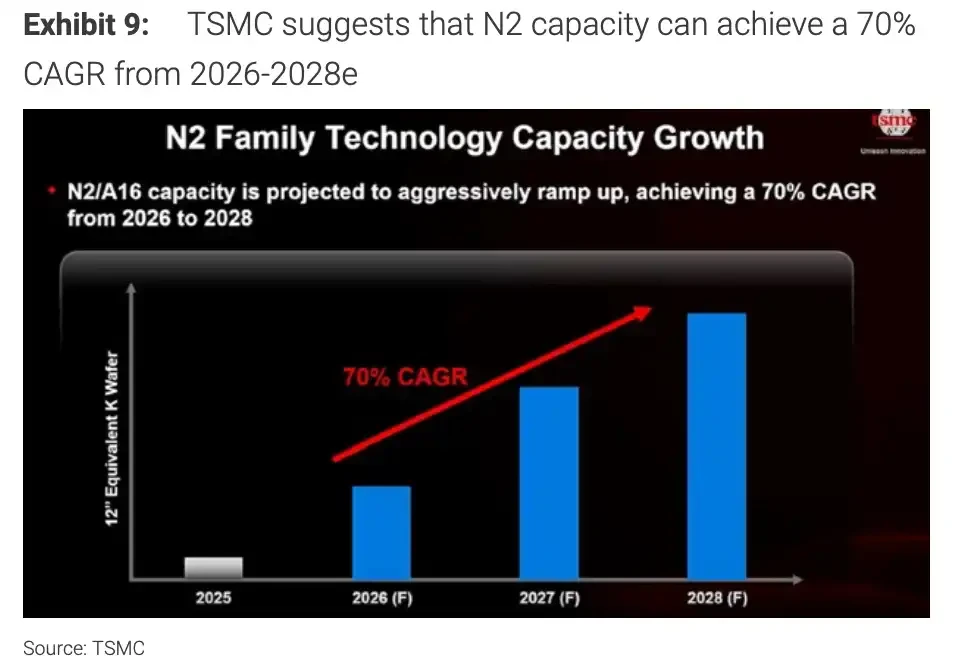
Management previously stated that N2 entered high-volume production in Q4 2025, with multi-phase ramp in Hsinchu and Kaohsiung, driven by demand from smartphones and HPC/AI. The 2nm node determines the performance boundary for next-generation flagship mobile chips, AI accelerators, and HPC processors, as well as TSMC's future pricing power, capacity allocation, and gross margin profile. The market is focused not on whether 2nm has entered production, but on how quickly supply can expand, whether yields improve as planned, and whether initial customer demand can cover the massive capital investment. If the 2nm ramp proceeds smoothly, TSMC can maintain its leadership in advanced-node supply during the AI demand peak and continue to command pricing power. If yields, equipment delivery, or cost pressures exceed expectations, margins could be dragged down even if revenue continues to grow. TSMC expects N2/A16 capacity to ramp rapidly from 2026 to 2028, with a CAGR of approximately 70%.

Implications for the Crypto Industry from the July 16 Earnings Call
Although TSMC does not directly serve cryptocurrency mining, its AI/HPC chip supply capacity directly impacts the production cost and capacity of GPU makers like NVIDIA, which in turn indirectly influences AI tokens (e.g., Render Network) and the GPU computing market. Statements from management regarding orders, inventory, and cost pressures will provide macro demand signals for crypto market investors. If TSMC maintains a strong demand outlook and gross margin holds within the 65.5%-67.5% guidance range, confidence in the AI hardware supply chain will be reinforced, indirectly benefiting AI-related crypto projects. Conversely, cautious remarks about orders, inventory, or cost pressure would prompt investors to reassess the sustainability of high growth in the AI supply chain. TSMC's current strength stems from AI/HPC demand, tight advanced-node supply, and high capex-driven expansion. The risks lie on the same chain: demand, pricing, yield, depreciation, and overseas execution — if any single link falls short, the gross margin near 66% will be the first to be tested.