
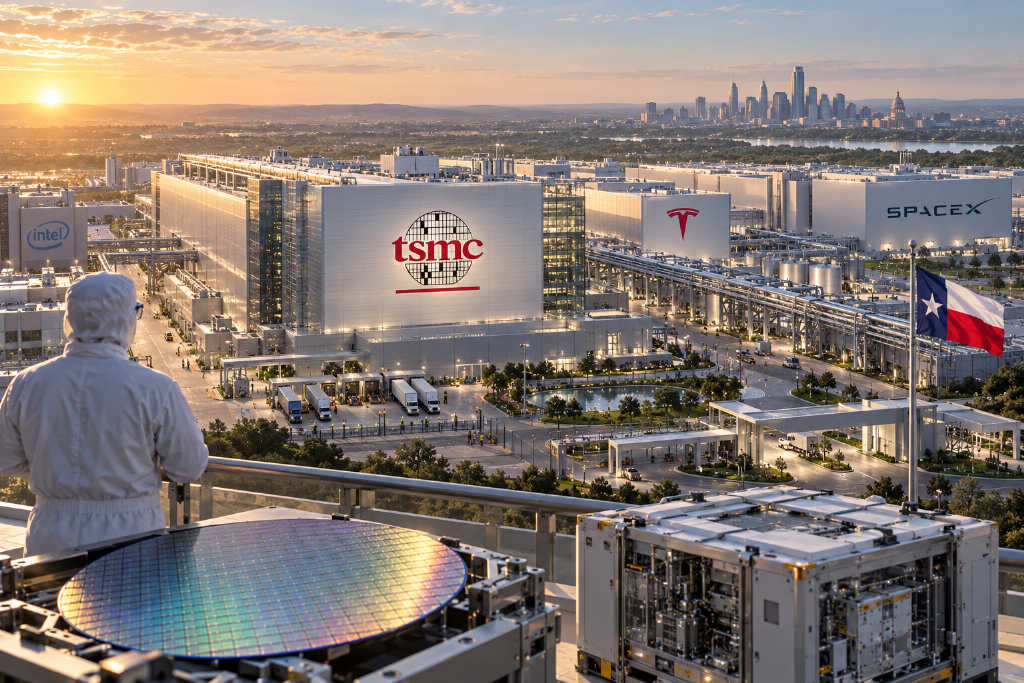
Taiwan Semiconductor Manufacturing Co. is evaluating a possible partnership with Elon Musk’s Terafab mega-fab project in Texas, according to independent tech journalist Tim Culpan, who disclosed the matter in his newsletter Culpium.
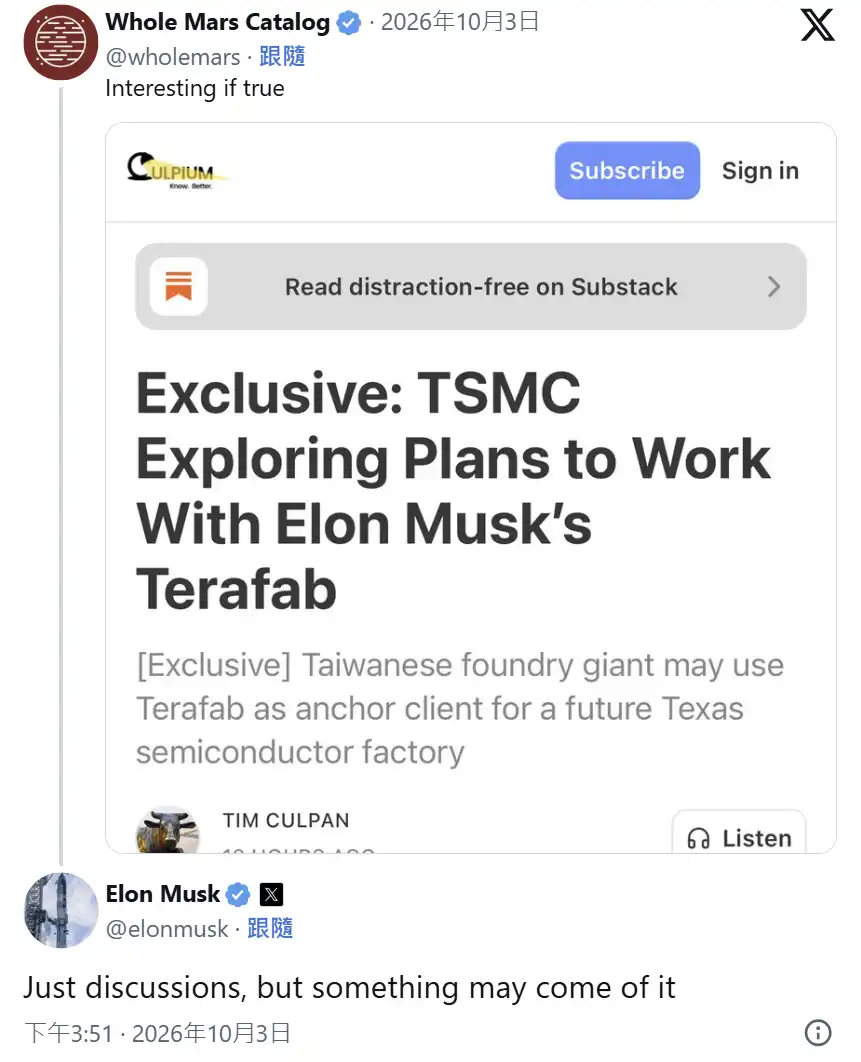
Musk later addressed the report on X and said the discussions are real but still preliminary. TSMC has not made any public comment. Industry sources cited in the report said the two sides have been in contact, though they described the process as still far from a signed deal and closer to an early-stage courtship.
Two structures are being discussed
Culpan, citing sources, said the final structure has not been decided, but two paths appear most likely.
Under the first, TSMC would invest in Terafab, take an ownership stake and run the operation, while Tesla and SpaceX would participate through equity and long-term capacity purchase commitments. The report compared that setup with TSMC’s joint-venture fabs in Kumamoto, Japan, and Dresden, Germany.
In Japan’s JASM project, TSMC holds about 86.5%, while local partners including Sony, Denso and Toyota hold minority stakes and provide demand commitments. In Germany’s ESMC project, TSMC holds about 70%, while Bosch, Infineon and NXP each own 10%. In that model, TSMC keeps control over advanced process technology and fab operations, while partners mainly contribute capital and committed orders.
The second option would give Tesla and SpaceX majority ownership of the joint venture, with TSMC taking only a minority stake while still supplying advanced process technology and fab operating know-how. The report said that would break with TSMC’s long-standing practice of retaining operational control. People familiar with TSMC were quoted as calling that scenario “impossible,” arguing that the company would not give up control because it needs to keep its technology in its own hands.
After X user Whole Mars Catalog (@wholemars) reposted the report, Musk replied on Oct. 3: “It is only in the discussion phase right now, but there may be progress.”
Another source said TSMC has been considering a Texas fab plan for months, which would add to its Arizona expansion rather than replace it. In late September, Taiwanese media, citing semiconductor equipment industry sources, also reported that TSMC was considering a second U.S. manufacturing campus in Texas, with total investment expected to exceed the $265 billion tied to its Arizona buildout.
If that reporting proves accurate, the implication is that TSMC could end up taking the lead in Terafab.
Intel’s place in the project could shrink
A TSMC entry would also complicate Intel’s role in Terafab.
In early April, Intel said it was honored to join the Terafab project, and Musk publicly confirmed at the time that Terafab planned to use Intel’s next-generation 14A process to make chips.
In June, former Intel factory manager Gary Jiang joined Tesla as director of the Terafab project. That move was widely seen as helpful for advancing cooperation between Terafab and Intel.
Culpan said, however, that progress between Terafab and Intel has been limited so far. If TSMC formally joins and brings in its own advanced process technology, Intel’s 14A could be marginalized or even removed from the plan.
Some industry sources offered a different possibility. Because TSMC leads in advanced packaging, Musk could keep front-end manufacturing on Intel 14A at Terafab in Texas, while using TSMC technology for advanced back-end packaging at the same site.
One online commenter said any TSMC role in Terafab would likely be supplementary because the project itself is expected to be enormous. Musk reposted that comment and replied: “Quantity has a quality all its own. A single-celled bacterium and a human with 35 trillion cells are vastly different, even though both are made of cells.”
Patent exposure may be part of the calculation
The report said patent risk may be another reason Musk wants TSMC inside the Terafab structure, beyond the company’s process leadership and fab operating experience.
Intel and TSMC have broad cross-licensing arrangements, but Terafab itself does not automatically sit under that umbrella. Under a patent licensing agreement signed by TSMC and Intel in 2022, each side granted the other licenses to certain patents.
Even so, if Terafab were to manufacture chips on its own using Intel technology, it could face legal risk tied to key TSMC patents, according to the report. Bringing TSMC into the project as a direct stakeholder could therefore be a way to reduce the chance of future patent disputes.
Terafab is aimed at supply control, not merchant foundry business
Tesla, SpaceX and xAI jointly announced Terafab in March. The plan calls for a vertically integrated chip manufacturing base at the north section of the Austin Gigafactory in Texas, combining design, lithography, fabrication, storage, packaging and testing.
Musk’s push for Terafab stems from dissatisfaction with the current supply chain. He has said existing suppliers such as TSMC and Samsung are expanding too slowly to meet the computing demand from Tesla vehicles, the Optimus humanoid robot, and SpaceX and xAI. In his words, current global chip capacity can satisfy only about 2% of his “future demand.”
Under Musk’s plan, 80% of the compute chips produced by Terafab would eventually be moved to low Earth orbit, while only 20% would remain for ground-based applications.
Public hearing documents from SpaceX in Grimes County, Texas, show an initial investment of $55 billion for Terafab. If all phases are completed, total investment could reach $119 billion. The project’s early target is 100,000 wafers per month, with a long-term goal of 1 million wafers per month.
That scale is far above Musk’s earlier estimate of $20 billion. Analysts cited in the report described the effort as a 15-year strategy.
The report said Musk’s end goal is not to build another commercial foundry to compete directly with TSMC, Intel or Samsung. The core objective is to secure stable, uninterrupted and ample supply of customized chips for Tesla’s electric vehicles and autonomous driving systems, SpaceX’s aerospace hardware and xAI’s large computing needs.
On that reading, even if Terafab is led by Tesla and SpaceX, it would not necessarily be in direct competition with either TSMC or Intel. The report said that is one reason the three sides can still discuss working together. With Terafab targeting 1 million wafers a month in the long run, becoming its main technology partner would carry clear strategic value.



