
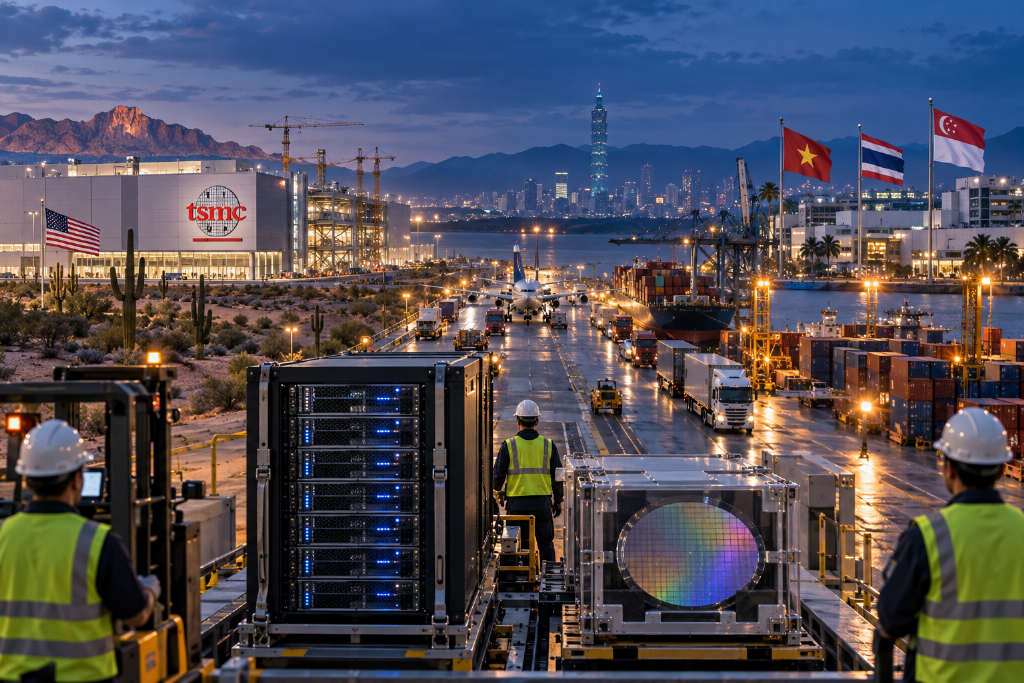
Rising demand for AI servers is pushing Taiwan’s technology supply chain further overseas. According to Nikkei, Taiwan Semiconductor Manufacturing Co. has raised its total investment in the United States to $265 billion, while server makers including Quanta and Wistron have also been injecting capital into their U.S. subsidiaries. Component manufacturers, meanwhile, are expanding output in Southeast Asian countries such as Vietnam and Thailand.
In an estimate released in April, the Market Intelligence & Consulting Institute (MIC) said the U.S. share of AI server production capacity held by Taiwanese companies is expected to rise from 23% this year to 40% by 2030. Taiwan’s share is projected to fall from 47% to 30%, leaving it behind the U.S. As demand for AI computing infrastructure keeps expanding, Taiwanese technology companies are accelerating efforts to build supply chains overseas, with the main focus on the U.S. and Southeast Asia.
TSMC adds another $100 billion in the U.S.
According to Voice of America, TSMC announced in July that it would add another $100 billion in U.S. investment, bringing its total there to $265 billion. The report said the company is also planning four more advanced wafer fabs, which would bring its total number of U.S. facilities to 12.
Other Taiwanese companies are moving in the same direction. Taiwan’s Ministry of Economic Affairs said in September that publicly announced U.S. investment plans by major Taiwanese companies had reached a combined $55 billion. As of May, excluding TSMC, around 20 semiconductor, server and related companies had announced cumulative investment of about $35 billion.
Quanta, Wistron and Inventec expand U.S. operations
Electronics manufacturing service providers that assemble servers are also increasing their U.S. exposure. On Sept. 29, Taiwan’s Department of Investment Review approved several outbound investment cases:
- Quanta Computer (2382): approved to invest $973 million in its U.S. subsidiary, with a Tennessee-based unit handling assembly of computers, servers and peripheral equipment.
- Wistron (3231): approved to inject $150 million to expand printed circuit board assembly at its U.S. subsidiary. Nikkei also reported that Wistron separately committed up to $146 million to another U.S. subsidiary for factory renovation and equipment installation in Texas.
- Inventec (2356): approved to inject $110 million to support server assembly operations in the U.S.
Component makers shift expansion to Southeast Asia
While the U.S. is taking on wafer manufacturing and server assembly, Southeast Asia has become the main expansion base for Taiwanese component makers, covering critical AI server parts such as circuit boards and thermal modules.
- Thermal solution maker Auras (3017) said in September that it would invest NT$7.78 billion to build a new plant in Vietnam.
- Copper-clad laminate maker TUC (6274) plans to invest THB7.79 billion, or about $231.8 million, to expand capacity at its Thailand subsidiary, including a new plant and additional equipment.
- PCB makers Compeq (2313) and Zhen Ding Technology Holding (4958) have also announced related investment plans.
ASE Technology Holding (3711) said in September that its Singapore subsidiary had purchased about NT$1.26 billion in production equipment and decided to acquire a factory for about NT$2.15 billion. ShunSin Technology Holdings (6451), a Foxconn subsidiary, said in August that it would invest up to $65 million to establish semiconductor production lines in Vietnam, covering processes including circuit formation.
Trade data points to a faster supply-chain split
The impact of Southeast Asia expansion is already showing up in trade figures. Nikkei reported that Taiwan’s imports from ASEAN countries reached $70.4 billion in the first eight months of the year, up 75.4% from a year earlier. Taiwan’s Ministry of Finance said the main reason was stronger demand for components as the AI supply chain gradually spread across different regions.
Based on the direction of investment, the U.S. is taking the lead in wafer manufacturing and server assembly, while Southeast Asia is concentrating on components such as circuit boards, thermal management parts and packaging and testing. The cross-border division of labor in the AI supply chain is becoming clearer.