
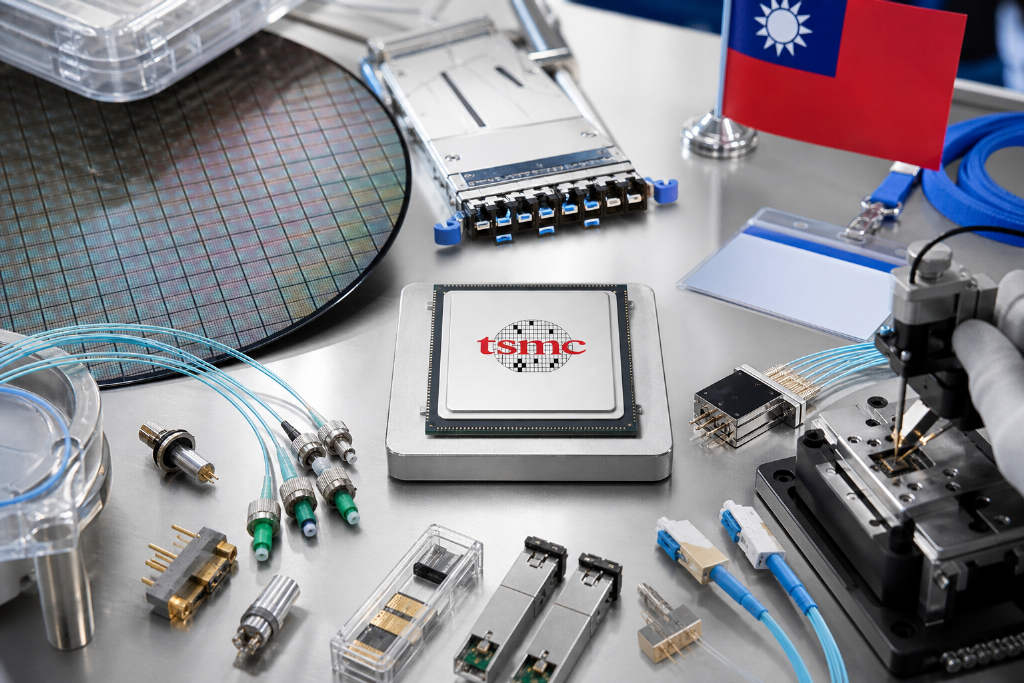
TSMC Vice President of Advanced Packaging Technology and Service Jun Tsai Hsu said on Aug. 31 at the SEMICON Taiwan Silicon Photonics Global Forum that long-standing reliability concerns around co-packaged optics, or CPO, have been removed by testing results and market validation data. Leading companies in the sector are expected to begin formal mass production in the second half of 2026.
AI demand is pushing optical transmission to the center of data center design
Speaking in his role as co-convener of the SEMI Silicon Photonics Industry Alliance, Hsu said the AI revolution is no longer only a software story. It has become a physical and power challenge as well. As the basic unit of AI computing expands from a single server to an entire data center, traditional copper-based electrical interconnects are nearing their physical limits, and optical transmission has become essential infrastructure for modern data centers.
Citing market data, Hsu said optical transceiver sales are set to grow 25% in 2025 and 50% in 2026. In the high-end transmission segment, defined as 800G and above, sales doubled in 2024 and are projected to rise another 60% in 2025. He also said a new stage of AI scaling in 2028 is expected to trigger another wave of large demand.
Silicon photonics is on track to become the mainstream architecture
Hsu said the underlying architecture of optical transceivers is going through what he described as a permanent structural shift. Silicon photonics, he said, has already secured its place as the mainstream direction and is expected to surpass 50% global market share before 2027. He also said the unit value of related chips will continue to rise.
He described CPO as the final form of a mature silicon photonics stack. By integrating the optical engine and compute chips within the same package, the technology can sharply reduce optoelectronic conversion loss and power consumption. Hsu said the industry’s earlier doubts about CPO reliability have now been “completely eliminated” by real testing data and market validation.
He added that major semiconductor companies have already announced plans to move CPO into formal mass production in the second half of 2026, taking the technology from research deployment to commercial rollout.
TSMC says optical engine manufacturing at scale is feasible
Hsu said Taiwan’s foundry ecosystem already has the capability to manufacture optical engines at scale and with high precision. He added that TSMC’s advanced packaging platform can support the integration needs of silicon photonics components. Still, he drew a distinction between what a wafer manufacturer can do and whether the broader supply chain is ready to match that capacity.
He identified four main constraints on large-scale commercial deployment: laser sources, fiber, fiber connectors, and product testing. The maturity and supply of those areas, he said, will determine whether the silicon photonics industry can move from sample validation to meaningful volume expansion.
Taiwan’s role extends beyond wafer manufacturing
Hsu closed with a broader view of Taiwan’s position in the silicon photonics supply chain. He said the SEMI Silicon Photonics Industry Alliance was created to build three bridges: one between IC design and foundry manufacturing, one between local Taiwanese companies and global technology giants, and one between electronic computing and optical transmission.
He said Taiwan’s semiconductor industry should treat the current bottlenecks as opportunities for coordination rather than as isolated technical barriers for individual companies. In his view, integrating the ecosystem can turn supply chain gaps into collective competitive strength and help drive the shift from an era of copper and electronics to one centered on silicon and light.