
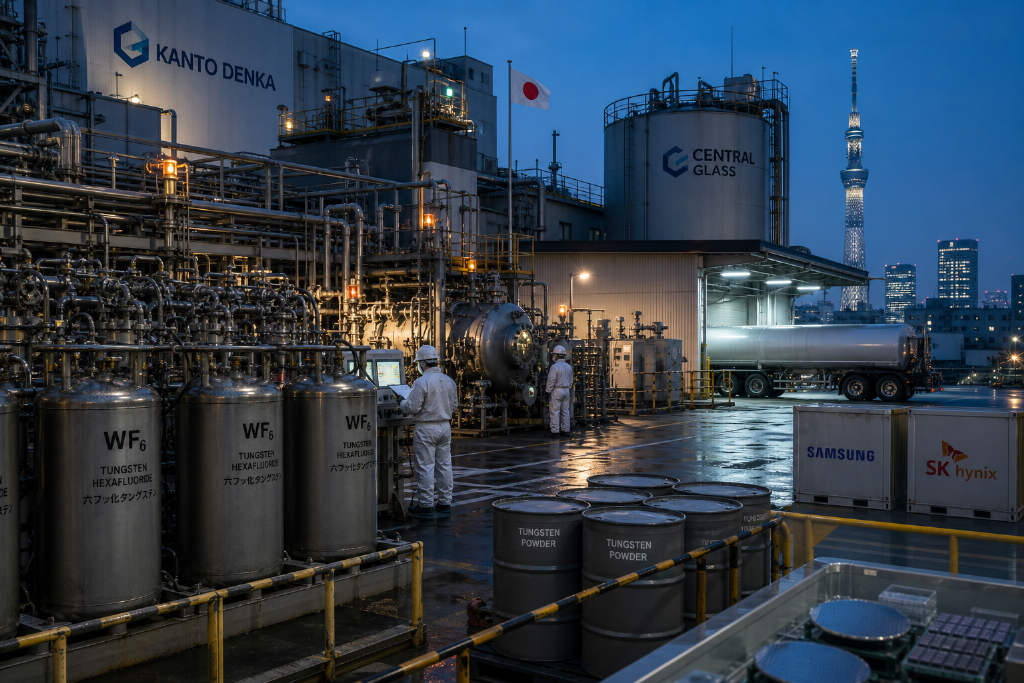
Global tungsten supply is slipping into a severe shortage, according to a ZeroHedge report that cited comments from Almonty Industries CEO Lewis Black. Demand from AI, semiconductors, and defense continues to rise, while China’s dominant position in tungsten raw materials is increasing supply chain risk worldwide.
The report said the U.S. strategic stockpile sought price quotes this year for tungsten purchases, but the effort did not move forward. Tight spot supply, rising prices, and concern that large-scale government buying could disrupt the market were cited as the reasons. Industry participants said Western buyers currently have limited access to non-Chinese tungsten resources, and a large share of that supply has already been locked up in advance.
WF₆ disruption hits chip manufacturing
Supply risk is also building in semiconductors. Tungsten hexafluoride, or WF₆, is a key material used to form microscopic tungsten interconnects in advanced memory chip production. Japan’s Kanto Denka and Central Glass previously supplied about one-quarter of global WF₆ output on a combined basis, but both companies stopped production on July 1 because they could not obtain the high-purity tungsten powder needed for manufacturing.
The report said the relevant feedstock mainly comes from China, which tightened tungsten-related exports starting in 2025. Samsung and SK Hynix are now accelerating efforts to identify and qualify new WF₆ suppliers. Market expectations point to a 70% to 90% increase in WF₆ prices in the second half of the year. At the same time, one Chinese company has announced an additional 1,000 tons per year of WF₆ capacity.
APT prices stay elevated
Tight tungsten supply is also spreading into the hard metals and cutting tools industries in Japan, Europe, and the United States. In Western markets, APT, or ammonium paratungstate, remains priced above $3,000 per mtu WO₃, and some companies have already run into raw material shortages.
Industry participants said tungsten demand has low price elasticity over the short to medium term. Even if prices climb, downstream manufacturers in sectors such as autos and aerospace may still struggle to reduce purchases.
Hard metals remain the main demand center
The report added that tungsten is used far beyond defense and semiconductors. About 60% of U.S. tungsten demand, and roughly two-thirds of global demand, goes into hard metals, including industrial products such as cutting tools and drill bits. As AI, defense, and advanced manufacturing continue to expand, the role of the global tungsten supply chain is becoming more important.