


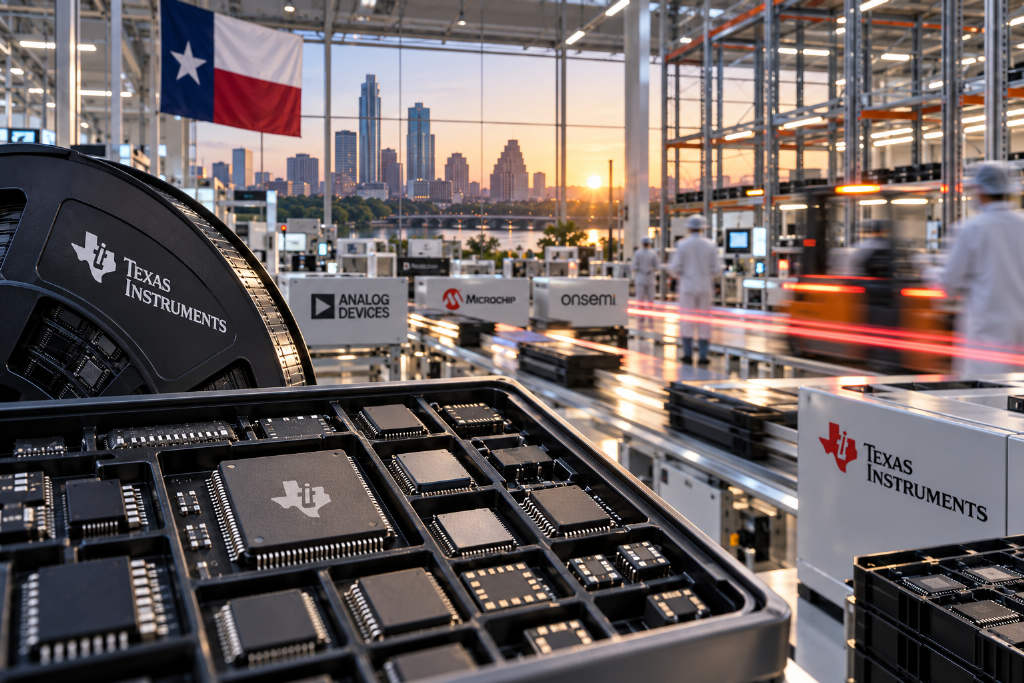
UBS said concerns that the analog chip cycle may be topping out have not changed its view. In its U.S. semiconductor report published on Oct. 16, 2026, the bank said three core channel checks all pointed to the same conclusion: the analog cycle is still moving higher, distributor inventories are still falling, pricing is rising in several categories, customer demand expectations remain strong, and both direct buyers and distributors are reporting tighter supply.

UBS said the key question for how long the upcycle can continue is when distributors begin restocking and how long supply tightness persists.
Distributor inventories fell again and restocking has not started
According to UBS channel inventory tracking, the True Analog unit inventory index stood at 85, with 1Q24 set at 100, down 7% quarter over quarter and 15% year over year. Power Analog inventory was 76, down 10% from the prior quarter and 18% from a year earlier. MCU inventory was 91, down 5% quarter over quarter and 3% year over year.
UBS said those readings show distributor inventories have not started to rebuild. The bank expects the inventory decline to reverse over the next several quarters as supply tightens, but said current inventory levels remain low enough to show that restocking demand has not yet begun and that the uptrend in the cycle remains intact.
Prices rose in most categories, with TXN standing out
On pricing, UBS said average selling prices for True Analog rose 12% quarter over quarter, while Power Analog increased 9%. MCU prices fell 7%, and discretes rose 34%.
UBS said Texas Instruments was a positive outlier in both True Analog and Power Analog pricing, while its MCU pricing was flat. Microchip Technology posted low-single-digit price declines across all three product categories. ON Semiconductor, after several quarters of declines in True Analog pricing, began to show strength.
Demand stayed strong while supply concerns increased
UBS said demand expectations eased slightly from an extremely strong second quarter but remained elevated. In its semiconductor buyer survey, net near-term demand expectations came in at +79%, down 10 percentage points from the previous quarter. Recent net demand was +75%, recent net price increases were 68%, expected price increases were 65%, and lead-time momentum was +65%.
On the supply side, 38% of distributors and 26% of direct buyers said supply on hand was above target levels. UBS said supply adequacy for direct buyers weakened relative to demand, which could leave parts of the market exposed to localized shortages. Concern about supply shortages over the next six months was reported by 70% of distributors and 76% of direct buyers, both up 3 percentage points from the prior quarter.
The report also said buyers are now placing more weight on supply certainty than on price negotiations. Among respondents, 73% said they were locking in supply by ordering early or signing long-term supply agreements, while 53% said they were increasing inventory or safety stock. The share of respondents seeing longer lead times rose from 62% to 65%.
Third-quarter revenue expectations came in above seasonal levels
UBS forecast third-quarter sequential revenue growth of 10.7% for Texas Instruments, above the seasonal pattern of 6.1%. It projected 8.5% for Analog Devices versus a seasonal 4.6%, 8.5% for Microchip Technology versus 4.3%, 5.4% for ON Semiconductor versus 4.0%, and 6.0% for Allegro, below its seasonal 7.1%.
UBS said earnings expectations look especially favorable for TXN and ADI. For Texas Instruments, the bank cited its inventory position, potential for share recovery, and an inflection point in free cash flow after capital spending rolls over as the main reasons it remains the top pick.
On inventory, TXN finished goods stood at 75 days, above the industry average of 39 days and also above NXP Semiconductors at 43 days. UBS said Texas Instruments has a distinct setup for share gains as industrial demand recovers and data center tailwinds remain in place.
Production and inventory data showed the industry still leaning offensive
A deeper review of earnings inventory data showed analog companies increased production by 7% quarter over quarter in the second quarter, while revenue rose 11% and total inventory was flat. UBS said the industry as a whole still appears to be leaning offensive while keeping a close watch on inventory levels.
Microchip Technology continued to execute its nine-point plan, with inventory days down 9 days quarter over quarter to 175 days. ON Semiconductor cut inventory days by 11 days to 189 days, while production remained at about 100% of sales.
UBS kept its upcycle call and flagged risks
UBS set its fourth-quarter sequential growth expectation at 200 to 300 basis points above normal seasonality. The bank said four signals support a continued rise in the cycle: low distributor inventories, continued price increases, strong demand, and tight supply. Even with investor sentiment turning weaker recently, UBS said the fundamental signals still support a higher analog cycle.
On risk, UBS said the technology sector carries elevated investment risk because of rapid technological change, intensifying competition, and exposure to macro cycles. For Texas Instruments, the report listed risks including fast technology shifts, intense competition, high capital intensity, pricing pressure, and cyclical demand in end markets.
The original article said this piece was a整理与解读 of a third-party broker research report from UBS Group dated Oct. 16, 2026, combined with public market information. It also said that ratings, target prices, earnings forecasts, and related judgments cited in the text were the views of the broker's analysts only, represented the institution's position, did not represent the view of Chaoxiang Research, and did not constitute investment advice. The article also said market risk exists, decisions should be made independently, and the text should not be used as a basis for buying or selling any security.
