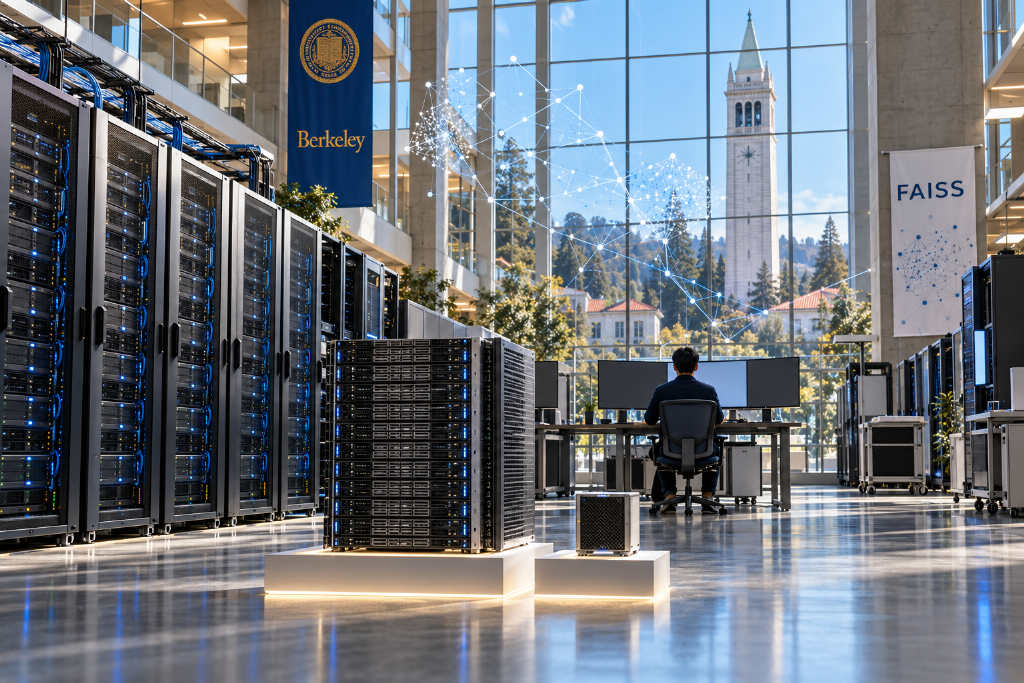
UC Berkeley’s Sky Computing Lab has released LEANN, an open-source vector index designed to reduce storage needs by avoiding the long-term storage of full vector embeddings and computing them at query time instead. According to the figures cited in the report, LEANN shrank the index size for a Wikipedia corpus containing 60 million paragraphs from 201 GB to 6 GB. The research paper behind the system won the Best Paper Award at MLSys 2026.
LEANN is built on FAISS and keeps a compact graph structure while discarding full vectors. In the NQ benchmark, using the Qwen3-4B model on an RTX 4090, LEANN and HNSW both reached 25.5% downstream accuracy. The storage footprint, however, was far smaller for LEANN at 4 GB, compared with 188 GB for HNSW. That reduction came with slower retrieval: 2.48 seconds for LEANN versus 0.05 seconds for HNSW on the NQ task.
The project is aimed at making semantic search and retrieval-augmented generation, or RAG, practical on personal laptops. A GitHub repository cited in the report also showed index reductions from 1.8 GB to 64 MB for 400,000 chat messages and from 130 MB to 6.4 MB for 38,000 browser records.
UC Berkeley’s Sky Computing Lab has open-sourced LEANN, a vector index that largely avoids storing vector embeddings and computes them at query time instead, according to Techub News.
The reported result is a sharp reduction in storage. For a Wikipedia corpus containing 60 million paragraphs, LEANN cut index size from 201 GB to 6 GB. The research paper received the Best Paper Award at MLSys 2026.
Built on FAISS with a compact graph structure
LEANN is built on FAISS. Its approach is to retain a compact graph structure while discarding full vectors, which lowers storage requirements.
NQ benchmark: same downstream accuracy, very different storage use
In the NQ benchmark, using the Qwen3-4B model on an RTX 4090, LEANN and HNSW both reached 25.5% downstream accuracy.
The storage gap was substantial. LEANN used 4 GB of storage, while HNSW required 188 GB. The trade-off was retrieval speed: on the NQ task, LEANN took 2.48 seconds for retrieval, compared with 0.05 seconds for HNSW.
Targeting semantic search and RAG on personal laptops
The index is intended to make semantic search and retrieval-augmented generation, or RAG, workable on personal laptops.
A GitHub repository cited in the report showed that the index for 400,000 chat messages was reduced from 1.8 GB to 64 MB, while the index for 38,000 browser records fell from 130 MB to 6.4 MB.
The report cited MarkTechPost as the source of the information.
This article was originally published by Bit.Fan. For more cryptocurrency news and market insights, visit www.bit.fan. Disclaimer:
The market information, project data, and third-party content displayed on this platform are for industry information sharing only and do not constitute any form of investment advice or return commitment.
Cryptocurrency trading carries high risks. Users should fully assess their risk tolerance and make independent decisions. All profits, losses, and legal responsibilities are borne by the users themselves.