
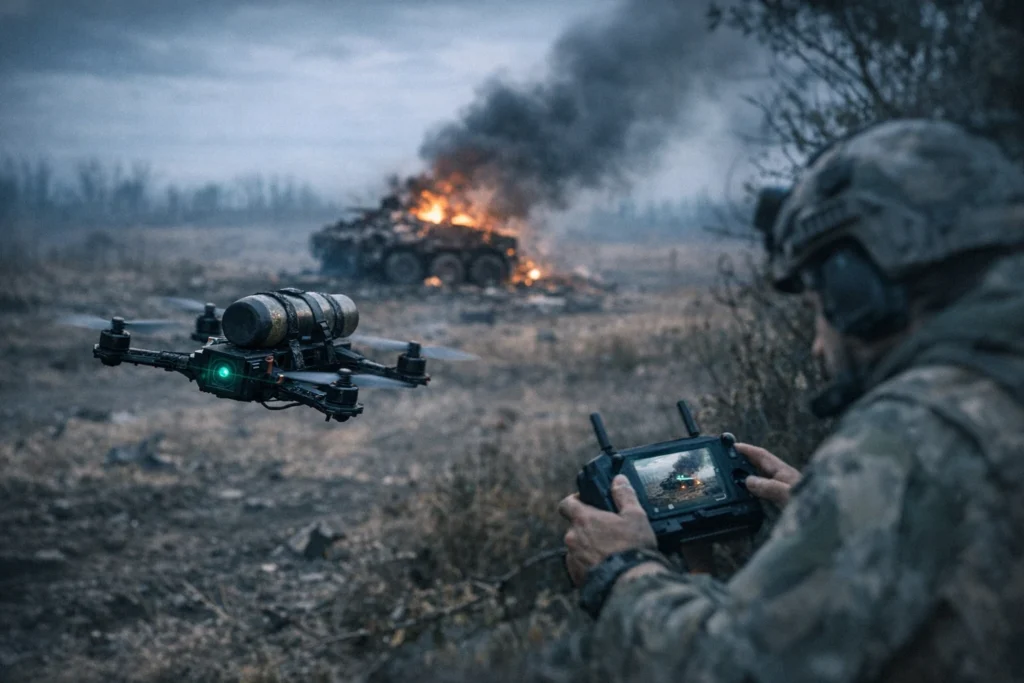
Ukraine’s cheapest front-line FPV drones are starting to gain autonomous guidance. SkyFall’s Shrike kamikaze drone, once flown entirely by a human operator, can now keep tracking a moving target even if GPS is fully jammed and the remote-control link is cut, after being fitted with an autonomous tracking system from U.S. company Auterion. In an official announcement, SkyFall and Auterion said 50,000 such drones began shipping to the Ukrainian front in mid-July, with the full batch set to arrive over the coming months.
Unit cost rises from $400 to $2,000
The report said the Shrike previously cost about $400 per unit and depended on manual piloting. After the autonomous tracking system is added, the price rises to $2,000, but the drone is able to lock on and continue toward a moving target even when signals are interrupted and GPS is unusable.
Before this upgrade, Ukraine’s military relied heavily on operators guiding drones by eye. One of the few exceptions was a small number of medium- and long-range strike drones, including models built by Perennial Autonomy, a company founded by former Google CEO Eric Schmidt. Those drones cost about $5,000 each and are used to cross the front line and strike oil refineries and energy facilities.
By contrast, the low-cost FPV drones closest to the front, and often among the deadliest, had long lacked autonomous capability and depended almost entirely on operator skill.
Autonomous mode starts after target designation within half a mile
That changed starting in mid-July. Operators can still manually fly the drone into the target area and designate a target within half a mile, or about 800 meters. After that, a switch sends the drone into autonomous terminal guidance mode.
Auterion CEO Lorenz Meier told Ars Technica that the system relies entirely on imagery from the drone’s main onboard camera to determine the target’s position and does not use GPS. Even if the signal is lost because of buildings or terrain, or if enemy electronic warfare disrupts the link, the drone can still independently track and hit a moving target. If the operator remains connected, the attack can still be canceled or redirected to another target.
$100 million contract behind the 50,000-drone order
The 50,000-unit order is tied to a $100 million contract. The official announcement identified the backer only as an unnamed European country, but Reuters reported that Germany is the actual source of funding. Meier also said the order is being fulfilled by Auterion’s team in Munich, Germany.
It is the largest delivery order Auterion has received to date. Earlier, in July 2025, the company had already committed to deliver 33,000 autonomous drone kits under a $50 million Pentagon contract.
The key part is an $18 Arm system-on-chip
At the center of the system is a Western-made Arm system-on-chip that costs just $18, according to Meier. He told Ars Technica that Auterion’s work involved replacing Shrike’s original flight-control board, which had no onboard computer and no AI, with an avionics system that includes a microprocessor and onboard AI.
In practical terms, the board that once only followed commands to spin propellers is replaced by a small computer that can interpret video and make its own targeting judgment.